Employee vs Owner-Operator: What the Numbers Actually Mean
The towing industry runs on two very different financial models, and which one a driver picks decides what actually lands in their bank account. An employee driver trades a fixed wage or salary for stability: the company owns the truck, buys the fuel, carries the insurance, and pays for repairs. An owner-operator runs the truck as a business. Gross revenue is higher, but so is the exposure – fuel, insurance, and maintenance all come out of the operator’s own pocket before anything counts as profit.
Every figure in this article is net income, not gross revenue – what remains after the truck has been fueled, insured, and maintained. For comparing the two roles, that is the number that counts.
Three costs sit between what a truck bills and what a driver keeps:
- Fuel – the largest variable cost, driven by mileage, idle time, and the weight of each tow.
- Insurance – commercial liability, cargo, and combined coverage that scales with gross vehicle weight.
- Maintenance – tires, brakes, hydraulics, winches, and routine service tied directly to duty cycles.
Any comparison that skips these costs is fiction. A driver may bill $120,000 in a year yet net far less once fuel receipts, premium notices, and repair invoices are tallied. Gross revenue is where the math starts, not where it ends, and every model here gets measured the same way: what lands in a driver’s pocket after the truck has been paid for.
Gross revenue vs net income: the numbers that actually matter
Two figures get confused constantly in this comparison: gross billable revenue and net profit. Keep them separate.
Gross billable revenue is the total amount you invoice for completed towing work before any expense is subtracted. If you finish ten calls at $150 each, your gross billable revenue is $1,500. That is the top-line number, nothing more.
Operating costs – frequently described as towing business costs – are every dollar required to produce that revenue. Fuel, insurance premiums, maintenance, tires, licensing, dispatch fees, and equipment loan payments all sit in this category. For a driver who owns the truck, these are owner-operator expenses paid directly out of pocket rather than quietly deducted from a company paycheck.
Net profit, also called net income or take-home pay, is what stays after operating costs are subtracted from gross billable revenue. It is the only figure that reflects what you actually keep.
A single workday shows how the pieces fit:
| Line item | Amount |
|---|---|
| Gross billable revenue | $1,500 |
| Fuel | -$180 |
| Insurance (allocated daily) | -$120 |
| Maintenance and tires | -$95 |
| Dispatch, licensing, misc. | -$55 |
| Total operating costs | -$450 |
| Net profit | $1,050 |
The math is simple, but the reading takes care. The $1,050 net figure – not the $1,500 headline – is the number to weigh against an employee’s wages. An employee earning a straight hourly rate never sees the operating costs, because the employer absorbs them. An owner-operator carries them personally, which is why a higher gross can still leave a thinner net.
Keeping maintenance spending predictable with reliable truck parts and maintenance services helps protect that net figure. Fuel, insurance, and maintenance each take a slice of the operating cost line you just met.
Employee vs owner-operator: side-by-side cost and income structure
The biggest misconception in towing is that gross revenue equals take-home pay. It does not. The table below isolates each cost and income line item so you can see where the money actually goes for both roles. All figures are illustrative industry estimates and vary by region, equipment class, call volume, and season. Treat them as a structural framework, not a guarantee. Staying compliant on maintenance and inspections protects your margins either way.
| Cost/Income Line Item | Employee Driver | Owner-Operator |
|---|---|---|
| Gross revenue potential (illustrative) | Not directly billed by the driver; earns $55,000-$75,000 in wages, hourly, or commission | $120,000-$180,000 in annual gross billings |
| Fuel responsibility | Covered by employer; no out-of-pocket fuel cost | Paid by operator; roughly $25,000-$40,000 per year |
| Insurance (liability, cargo, non-trucking/occupational) | Covered by employer; workers’ compensation on top | Paid by operator; roughly $12,000-$20,000 per year |
| Maintenance and repairs | Employer pays all; driver reports issues only | Operator pays all; roughly $8,000-$15,000 per year, plus tires and towing gear |
| Truck payment / equipment financing | None; employer-owned truck and equipment | $1,800-$2,800 per month, or about $21,600-$33,600 per year |
| Taxes and self-employment | Employer withholds; driver pays ~7.65% FICA only | Self-employment tax of 15.3% plus income tax on net profit |
| Dispatch or motor-club fees | Cost absorbed by the company; no driver charge | 15%-25% of gross, or a flat monthly dispatch/motor-club fee |
| Resulting net income range (illustrative) | $42,000-$58,000 per year | $35,000-$65,000 per year |
The trade is straightforward: the employee gives up upside for predictability, while the owner-operator absorbs every variable cost in exchange for uncapped gross. Two operators can post identical revenue and still land thousands of dollars apart in net income, because fuel, insurance, and maintenance discipline separate a profitable year from a merely busy one. Before committing to either path, run your own numbers against local rates and confirm your equipment safety inspection requirements so repair bills and compliance gaps do not quietly erase your margin.
Every cost an owner-operator absorbs
Here is what an owner-operator actually pays for, line by line. Each item reshapes what a tow truck driver nets.
- Fuel – Diesel runs roughly $1,800 to $2,500 per month for a working wrecker, and heavy winter idling or long highway recoveries can push that higher.
- Commercial insurance – Tow-specific commercial coverage typically costs $12,000 to $18,000 per year depending on your radius, cargo limits, and claims history.
- Truck payments – A financed wrecker usually carries a $1,500 to $2,500 monthly payment, which is money an employee driver never has to find.
- Maintenance and tires – Set aside $8,000 to $12,000 per year for hydraulic repairs, brakes, oil services, and the six to ten tires a busy truck burns through; sourcing dependable parts through reliable truck parts and service helps hold that number down.
- Registration and permits – Plates, IFTA, apportioned registration, and local operating permits add another $1,500 to $2,000 per year.
- Dispatch or motor-club fees – If you rely on club or dispatch work, expect to hand back 10% to 25% of each call, or roughly $300 to $800 per month.
- Self-employment taxes – Because you are both boss and employee, you owe the full 15.3% self-employment tax on top of income tax.
- Lost revenue from downtime – A truck in the shop earns nothing, and each dead day can erase $500 to $1,000 in potential gross revenue.
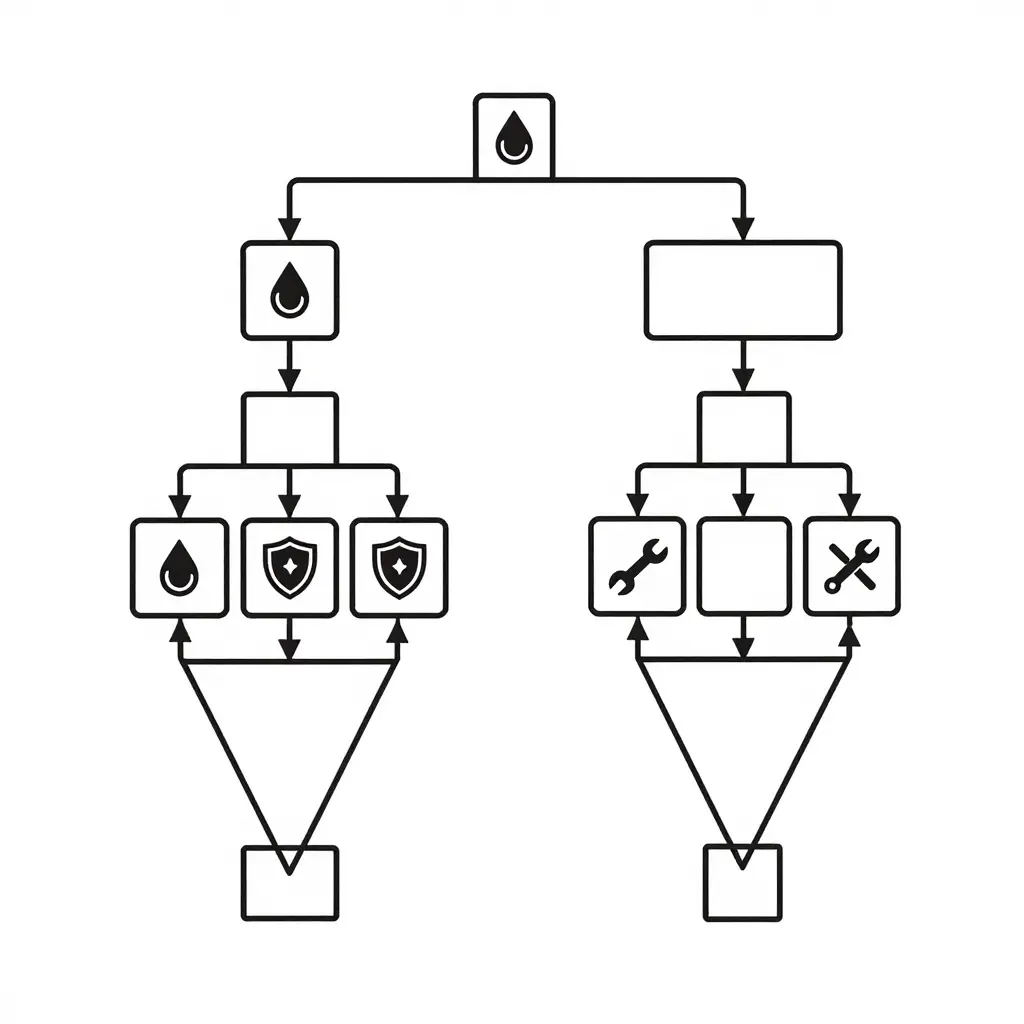
The diagram shows where the money goes before any single line item gets its own section. Gross towing revenue sits at the top, then splits into two tracks that behave differently.
- The left track represents the employee path. Gross revenue enters the carrier’s books, and the driver’s paycheck is carved out after the business absorbs fuel, insurance, and maintenance.
- The right track represents the owner-operator path. The driver collects gross revenue directly, then watches that figure shrink across the same three deduction categories – and occasionally more.
Each bar narrows as the flow moves downward. Fuel, insurance, and maintenance shave the total until only a small final node remains. That final node is take-home pay, and its size is where employee and owner-operator economics diverge most sharply. The gap between the two bottom nodes is the comparison in miniature.
Fuel: the largest variable cost
Fuel is the single largest variable cost a tow truck operator carries. A working wrecker or flatbed typically covers between 30,000 and 50,000 miles per year, burning diesel at roughly 6 to 10 miles per gallon depending on class and load. At a diesel price range of $3.60 to $5.10 per gallon, that produces the following annual figures:
| Truck type | Annual miles | MPG | Gallons used | Cost at $3.60/gal | Cost at $5.10/gal |
|---|---|---|---|---|---|
| Light-duty flatbed | 40,000 | 10 | 4,000 | $14,400 | $20,400 |
| Medium-duty wrecker | 35,000 | 8 | 4,375 | $15,750 | $22,313 |
| Heavy-duty wrecker | 45,000 | 6 | 7,500 | $27,000 | $38,250 |
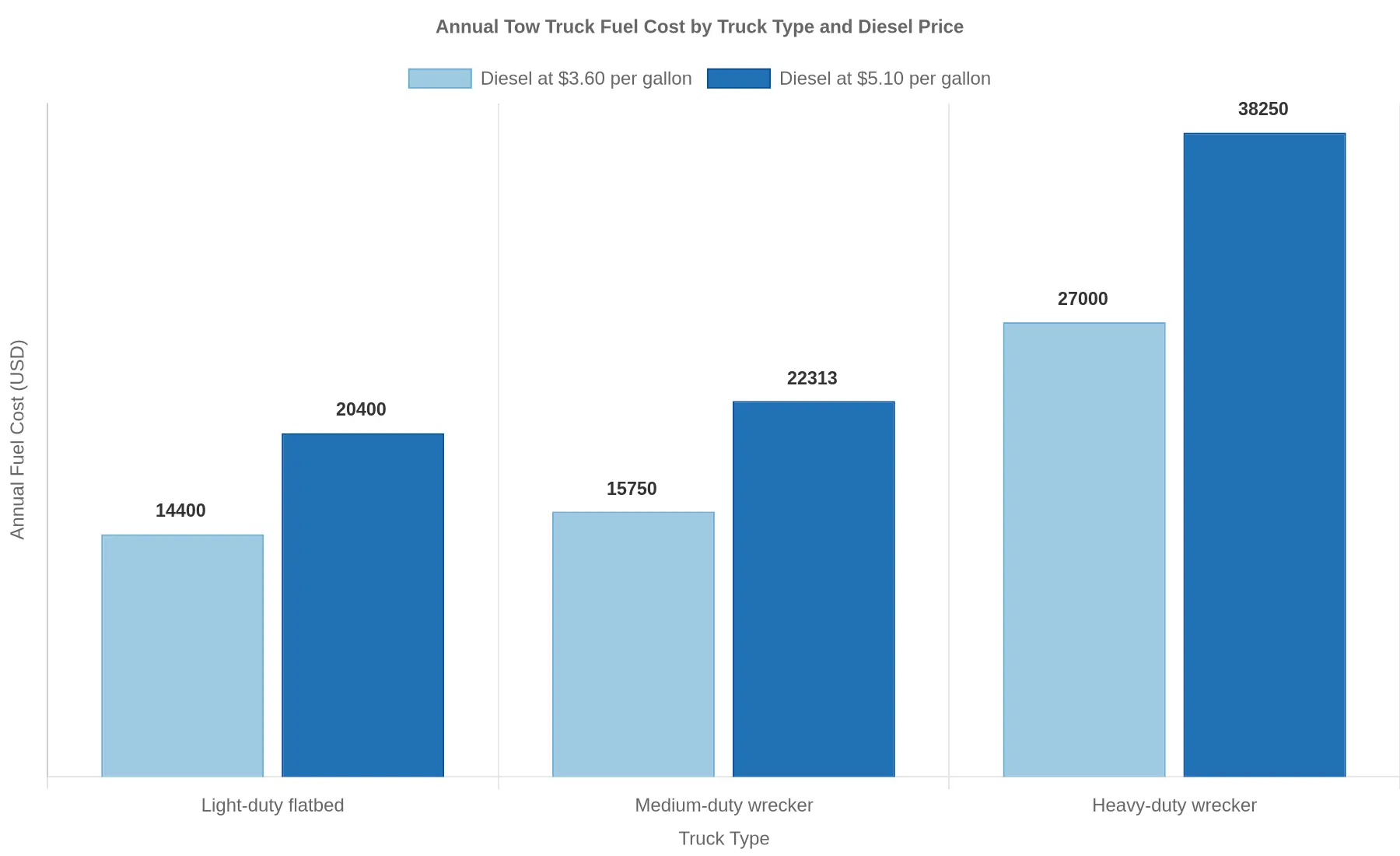
So tow truck fuel costs land anywhere from about $14,400 to $38,250 per unit per year, with a heavy-duty wrecker burning nearly twice the gallons of a light flatbed. Miles driven and fuel economy drive that spread almost entirely, not the rates charged to customers.
Who actually pays for the fuel
This is where employee vs owner-operator changes everything. An employee driver fuels a company truck with a company card. Every gallon in the table above is absorbed by the employer, so the driver’s net pay is untouched by diesel prices, route length, or idle time.
An owner-operator pays that bill directly. The revenue that covers the truck payment, the insurance, and the maintenance also covers the pump. On a truck grossing $85,000 a year, a $22,000 fuel bill consumes roughly 26% of gross revenue before any other expense is deducted. A $3,000 swing in annual fuel volume moves straight to the bottom line.
What fuel does to net pay
For an owner-operator, fuel is rarely a rounding error. It is the dominant variable cost and often the difference between a profitable year and a marginal one. For an employee, fuel is a line item someone else manages. That single structural difference – who holds the fuel card – can shift annual net pay by tens of thousands of dollars. Operators looking to compress this cost can start by tracking fuel economy per unit and reviewing fleet efficiency practices, such as those behind a sustainability strategy for eco-friendly fleets, before assuming the only lever available is charging customers more.
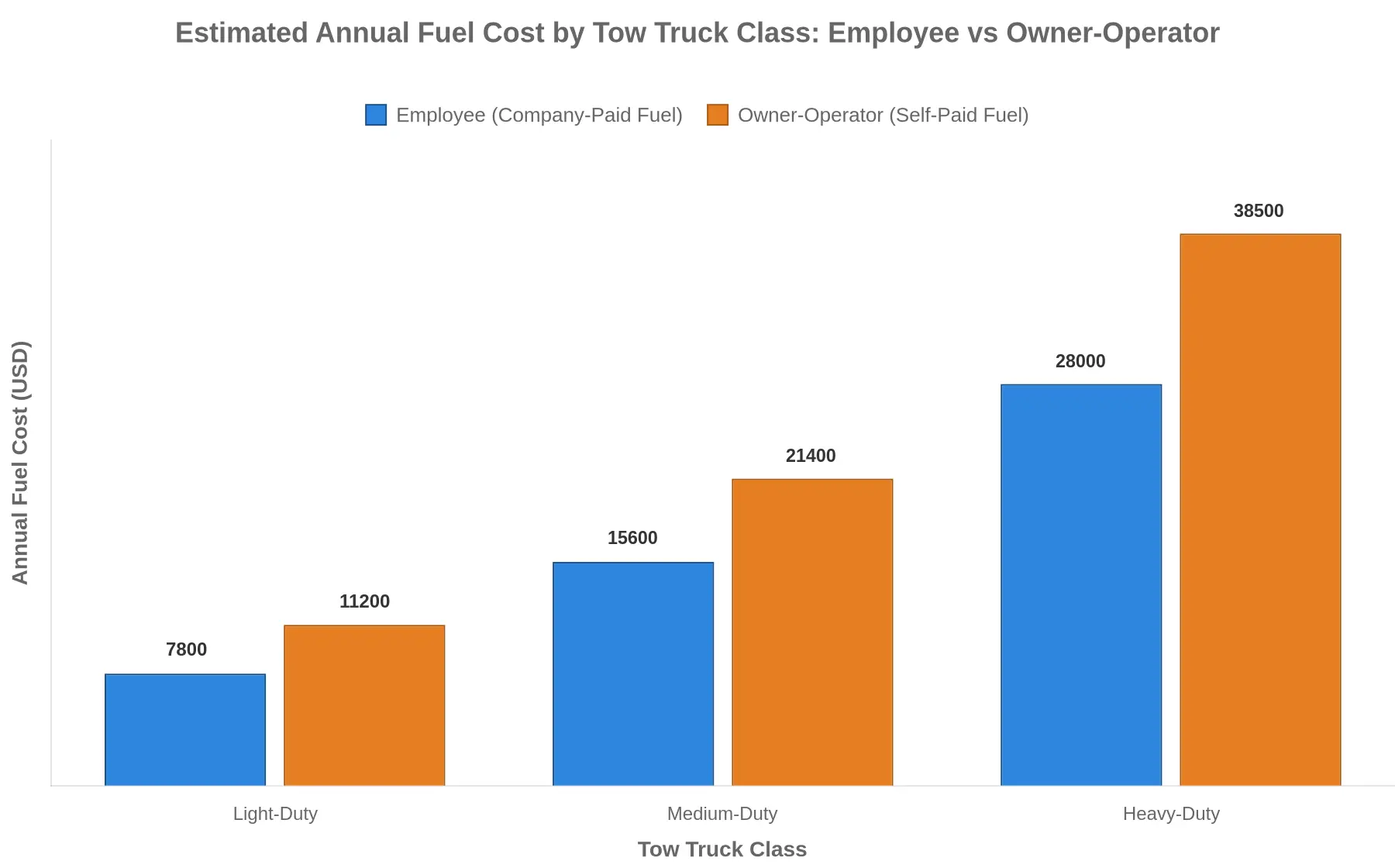
The fuel gap by truck class
The gap between the blue and orange bars is fuel exposure. In an employee arrangement, fuel sits on the company’s books – a business expense the driver never touches. As an owner-operator, that same diesel bill lands on your own ledger, and it scales with the size of the truck you run.
The chart compares realistic annual figures across three classes:
| Tow Truck Class | Employee (Company-Paid) | Owner-Operator (Self-Paid) | Annual Difference |
|---|---|---|---|
| Light-Duty | $7,800 | $11,200 | $3,400 |
| Medium-Duty | $15,600 | $21,400 | $5,800 |
| Heavy-Duty | $28,000 | $38,500 | $10,500 |
Two things push the owner-operator numbers higher. Owner-operators tend to run more loaded miles chasing revenue to cover their own overhead, so annual mileage climbs. Heavier wreckers and rotators also burn more fuel per mile, compounding both volume and per-unit cost.
For drivers weighing the jump from employee to owner-operator, the chart is a reality check: the higher gross revenue of self-employment has to absorb a fuel line that can exceed $38,000 a year on a heavy-duty rig. Seeing that number before you sign a lease-purchase or finance a truck is what separates a profitable move from a costly one.
Insurance: a fixed cost that scales with risk
Insurance is the fixed cost that refuses to stay fixed. It sits quietly in the background until a heavier wrecker, a longer haul, or one careless driver pushes your risk exposure up, and the premium follows. For anyone weighing employee versus owner-operator life, knowing how commercial towing insurance cost is structured is the difference between a realistic net-pay projection and an unpleasant surprise.
Four coverage lines matter most:
- Commercial auto liability – the legally mandated core, covering bodily injury and property damage your truck causes. Heavier, higher-mileage equipment pushes this line upward.
- Cargo insurance – protects the vehicles or equipment you are hauling against damage in transit or storage.
- On-hook coverage – covers damage to a vehicle while it is hooked and being towed, a scenario that is nearly unavoidable in this trade.
- General liability – responds to non-vehicle claims such as slips, spills, or property damage at a jobsite.
Typical annual premiums for a single, well-run truck:
| Coverage Type | What It Protects | Typical Annual Premium |
|---|---|---|
| Commercial auto liability | Bodily injury & property damage | $8,000 – $25,000 |
| Cargo insurance | Vehicles and equipment being hauled | $1,500 – $6,000 |
| On-hook coverage | Towed vehicle while hooked | $1,000 – $4,000 |
| General liability | Non-vehicle third-party claims | $1,200 – $5,000 |
| Annual total per truck | Full operating coverage | $12,000 – $40,000 |
Who actually pays? An employee driver is covered by the employer’s policy – the premium never touches the driver’s paycheck, and a claim lands on the company’s loss record. An owner-operator wears the whole cost directly: the premium, the deductible, and the underwriting consequences of every incident. Because insurance is priced on claims history, a single at-fault accident can raise an owner-operator’s renewal by double digits and eat into the higher gross revenue that drew them into the role. Reviewing unsafe towing practices that drive up premiums shows how quickly risk translates into cost.
When a claim does occur, the deductible comes straight out of net pay before a cent of revenue counts. A $2,500 deductible on a minor fender-bender is a week’s profit gone; a serious loss can spike premiums for three years.
Insurance is where the employee and owner-operator split is sharpest: the employee trades upside for insulation, while the owner-operator trades insulation for control and has to budget for risk on every mile.
Where the Money Goes: An Owner-Operator’s Cost Concentration
Strip away the romance of being your own boss, and an owner-operator’s year comes down to one equation: revenue minus expenses. With the fuel and insurance numbers in hand, the next question is how those costs sit alongside everything else competing for the same dollar. The doughnut chart below answers that.
It maps the percentage breakdown of a typical owner-operator’s annual operating expenses, with a legend and on-chart percentage labels so the concentration of cost is impossible to miss.
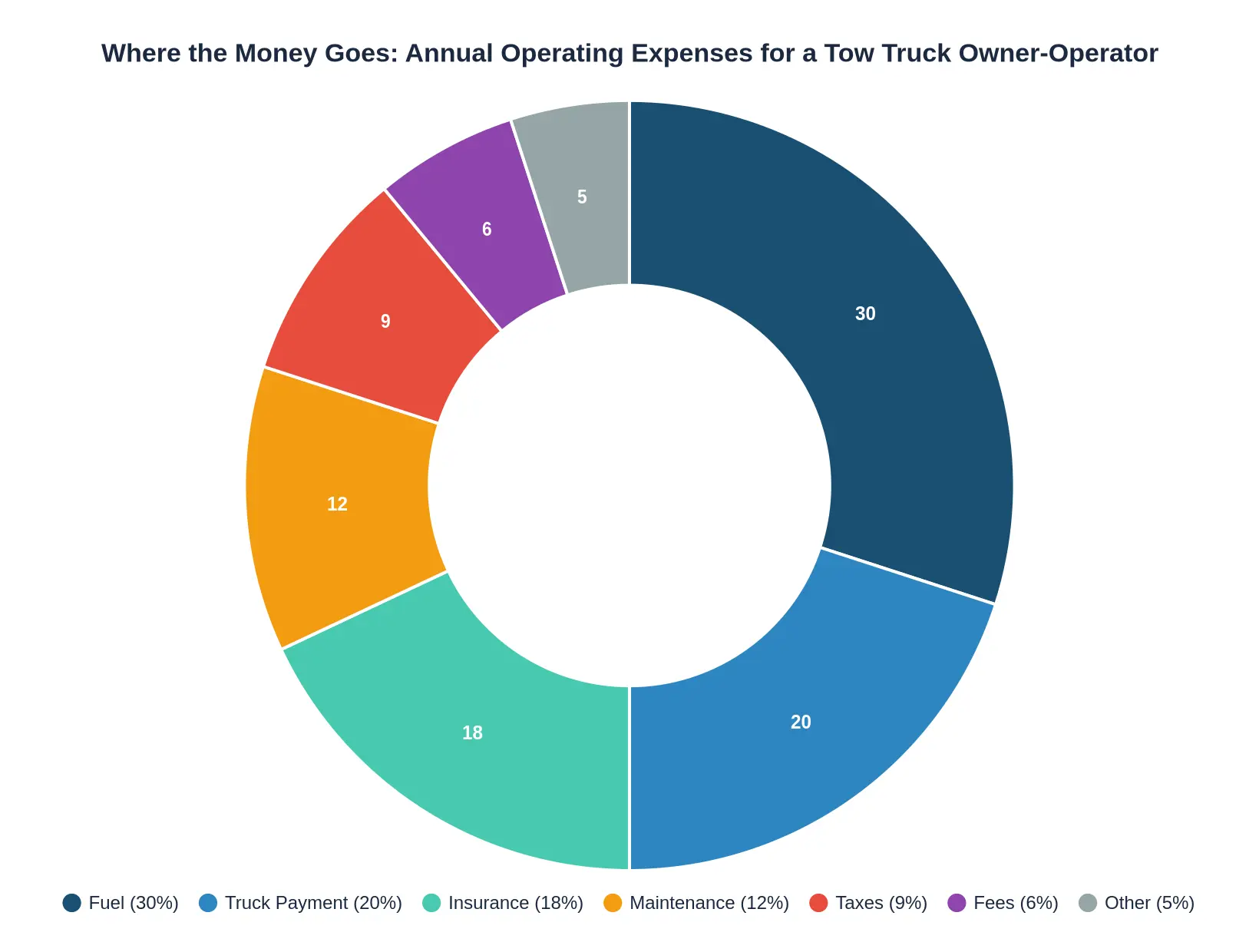
How the expenses break down
| Cost Category | Share of Annual Expenses |
|---|---|
| Fuel | 30% |
| Truck Payment | 20% |
| Insurance | 18% |
| Maintenance | 12% |
| Taxes | 9% |
| Fees | 6% |
| Other | 5% |
Where the leverage is
The chart is blunt: three line items – fuel, truck payment, and insurance – consume roughly 68% of every operating dollar. Fuel alone is the largest slice at 30%, which is why mpg discipline and route planning move the needle more than almost anything else. Because fuel and insurance are largely non-negotiable, the real leverage sits with maintenance (12%) and the smaller categories that quietly compound.
Two takeaways for anyone weighing the employee-versus-owner-operator decision:
- The big slices are mostly fixed or consumption-driven. You cannot talk your way out of fuel or insurance, you can only manage them.
- The small slices add up to real money. Taxes, fees, and “other” together reach 20% of expenses, a figure often underestimated when drivers pencil out their first year.
Keeping maintenance costs predictable is where disciplined owner-operators separate themselves. Sourcing dependable parts and service flattens that 12% slice instead of letting it spike unpredictably. You can explore reliable truck parts and service options for islanders to keep that line item under control.
Gross revenue is flattering, but net income lives in this ring. Understand your slices and you understand your actual take-home.

What a tow truck driver really nets
The number on the invoice is never the number in your pocket. To understand tow truck driver net income, start at gross billable revenue and strip away every cost that eats into it. The math is unforgiving, but it is clarifying.
Step 1: Start with gross billable revenue
Earnings begin with billable hours, and billable hours are never guaranteed. They depend on the driver’s responsibilities on scene, from safe traffic control to fast, accurate hookups that keep jobs moving. The way the driver’s role in roadside emergencies is handled decides how many hours each shift can actually bill: an efficient, safety-first driver clears more calls per day, while a careless one loses time to rework, damage claims, and downtime.
For this example, an owner-operator bills $180,000 in a strong year, while a W-2 employee earns $62,000 in wages plus steady hours.
Step 2: Subtract the real costs
- Fuel – a heavy wrecker burns roughly $28,000 a year; an employee’s commuting fuel is minor.
- Insurance – commercial liability and cargo coverage runs about $12,000 for an owner-operator.
- Maintenance – brakes, tires, hydraulics, and repairs total roughly $15,000.
- Truck payment – financing or lease on a rig often reaches $18,000.
- Fees – licensing, permits, dispatch software, and phone plans add up to $6,000.
- Taxes – self-employment and income tax hit an owner-operator for about $22,000.
Step 3: Compare employee vs owner-operator
| Line item | Employee driver | Owner-operator |
|---|---|---|
| Gross billable revenue | $62,000 | $180,000 |
| Fuel | -$3,000 | -$28,000 |
| Insurance | -$2,400 | -$12,000 |
| Maintenance | -$1,500 | -$15,000 |
| Truck payment | $0 | -$18,000 |
| Fees (licenses, permits, dispatch) | -$1,200 | -$6,000 |
| Taxes | -$12,000 | -$22,000 |
| Net income | $41,900 | $79,000 |
What the math says
The employee keeps about $41,900 out of $62,000, while the owner-operator keeps roughly $79,000 out of $180,000. The owner-operator nets more in raw dollars, but over $100,000 in costs and risk was absorbed to get there, while the employee handed fuel, insurance, and repairs to an employer in exchange for a smaller, steadier check. Net income is not about the biggest gross number, it is about how many costs you carry and how much risk you can survive. When a strong year turns slow, the owner-operator’s fixed payments do not shrink with the workload – and the employee’s paycheck largely does not move either. That difference, not the headline revenue, is the real decision.
Five-Year Net Income: Employee Driver vs. Owner-Operator
The chart tracks annual net income over five years for two roles: a W-2 employee tow truck driver and an owner-operator running their own truck. The employee line is steady, climbing gently as modest raises and tenure kick in. The owner-operator line is volatile, shaped by vehicle age, fuel price swings, and insurance costs that compound differently every year.
What makes the comparison useful is not the starting point but the trajectory. The worker who earns less up front is the one who ends up ahead.
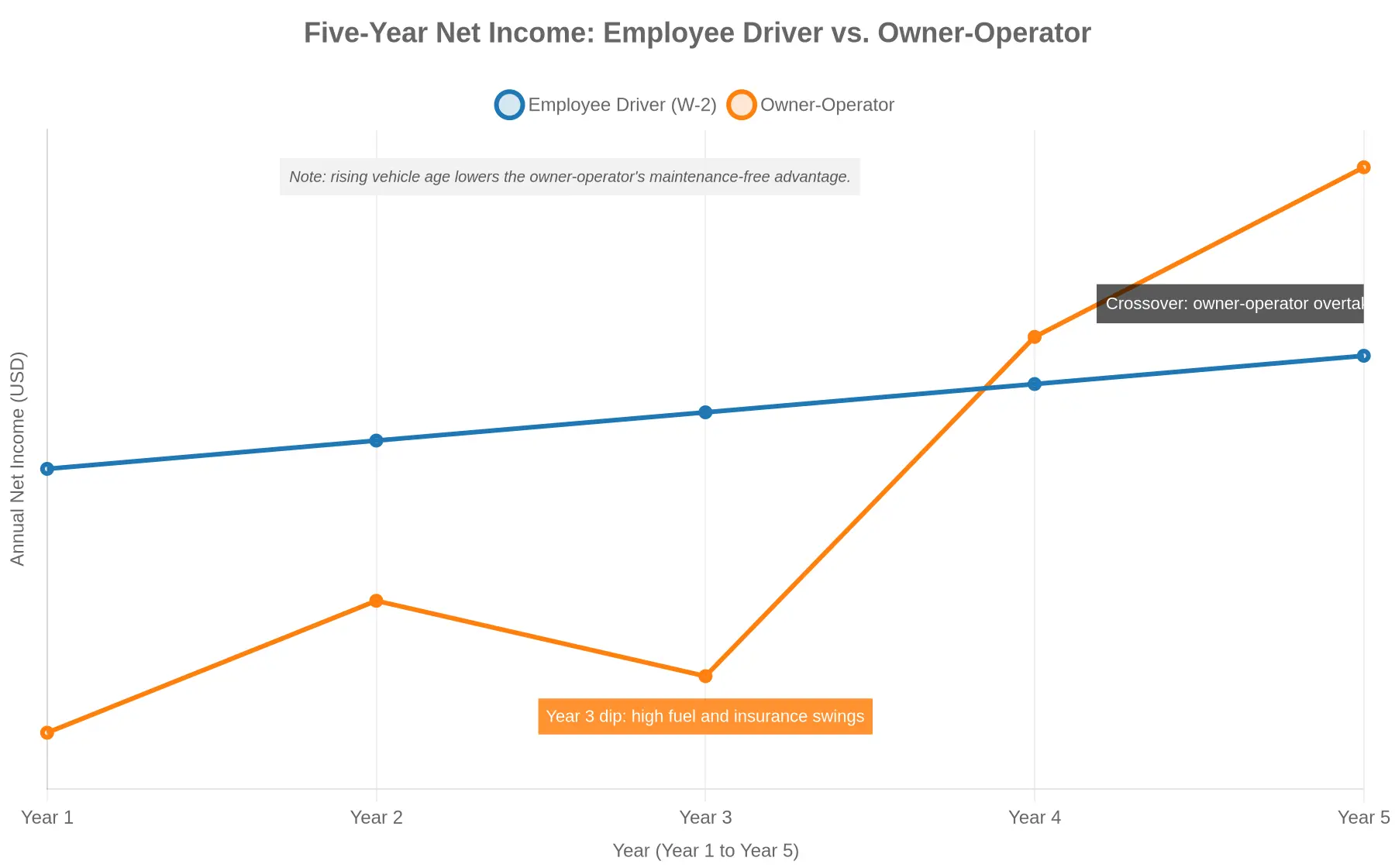
The two income paths
- Employee Driver (W-2): The blue line is a fixed paycheck. Employers absorb fuel, insurance, and repair costs, so take-home pay holds around $52,000 in Year 1 and grows steadily to roughly $58,000 by Year 5. The trade-off is a ceiling – there is an upper limit on what a salaried or hourly driver can net.
- Owner-Operator: The orange line starts lower, near $38,000, because the operator now pays for diesel, commercial insurance, and maintenance out of pocket. As the truck approaches payoff and dispatch rates settle, income diverges sharply upward.
Why the Owner-Operator Line Dips in Year 3
The Year 3 sag is not a mistake. It is a realistic snapshot of the pressures that hit independents hardest:
- Fuel prices spiked, and unlike an employee, the owner-operator eats every cent of that increase.
- Insurance costs climbed as the truck aged and the odometer rolled past warranty thresholds.
- Maintenance exposure grew. When a rig hits its third year, the “cheap to run” honeymoon fades and bigger components start demanding attention.
Sourcing dependable, reasonably priced replacement parts is one of the few levers an owner-operator controls directly. See how to keep a rig road-ready with reliable truck parts and services for islanders.
Why the Lines Cross Around Year 4
By Year 4 the owner-operator overtakes the employee, and by Year 5 the gap has widened to roughly $10,000 per year. Three forces drive the crossover:
| Cost Factor | Effect on Employee | Effect on Owner-Operator |
|---|---|---|
| Fuel price swings | Fully absorbed by employer | Passed through – high risk, high reward |
| Insurance | Covered by employer | Direct annual expense that rises with vehicle age |
| Maintenance & repairs | Covered by employer | Owner-paid, heavy early, lighter after payoff |
| Income ceiling | Fixed growth curve | Scales with volume and rate negotiation |
The owner-operator path asks you to survive a lean, front-loaded stretch in exchange for uncapped upside later. The employee path trades that upside for consistency. Neither is “better” in the abstract – it depends on your tolerance for volatility, your access to capital, and how disciplined you are about controlling fuel, insurance, and parts costs.
Frequently Asked Questions: Employee vs Owner-Operator Towing Income
Does an owner-operator net more than an employee?
Usually, but not by the margin gross revenue suggests. An employee driver might earn a predictable $55,000-$75,000 salary. An owner-operator can gross $120,000-$180,000 per truck, yet after towing business costs such as fuel, insurance, maintenance, and a truck payment, the disciplined operator often nets $65,000-$95,000. How tightly you control expenses decides the gap.
How much does fuel cut into tow truck income?
Fuel is the largest variable cost, typically 20-30% of gross revenue. A heavy-duty wrecker running 40,000 miles a year at 6 MPG burns roughly 6,700 gallons. At $4.00 per gallon, that is about $26,700 annually – a bill employees never see because the company absorbs it.
Is commercial towing insurance cheaper for employees?
By a wide margin. A company policy covers the driver at no direct cost to them. Owner-operators buy commercial auto liability, cargo, and on-hook coverage themselves, often $8,000-$15,000 per year depending on radius and equipment. That is a fixed cost employees avoid entirely.
How much should be set aside for maintenance?
Budget 8-12% of gross revenue, or about $0.15-$0.25 per mile. On a 40,000-mile wrecker, that is $6,000-$10,000 a year for tires, brakes, hydraulics, and winch service. Sourcing reliable truck parts and service keeps that number predictable instead of punitive.
Are self-employment taxes higher for owner-operators?
Yes. Employees split payroll taxes with their employer (7.65% each). Owner-operators pay the full 15.3% self-employment tax on net earnings, plus income tax. On $80,000 net, that is roughly $12,240 versus an employee’s $6,120 share – a real gap that reshapes the entire employee vs owner-operator decision.
The bottom line: the employee vs owner-operator trade-off is not about gross pay, it is about who carries the risk. Employees trade upside for stability; owner-operators trade stability for control. Run your own towing business costs line by line before you assume the bigger number is the better one.
How to choose between employee and owner-operator
Once the fuel receipts, insurance premiums, and maintenance invoices are lined up side by side, the choice between being an employee driver and an owner-operator stops being about gross pay and becomes about fit. Use the five factors below as a practical checklist, then match them to your own finances and temperament rather than to someone else’s success story.
-
Net income stability. Employees collect a dependable paycheck with withholding and overhead already taken care of. Owner-operators can out-earn them in strong months, but they also absorb every slow week, surprise breakdown, and unpaid repair day. If predictable cash flow keeps your household afloat, employment usually wins; if you can weather lean periods, ownership offers a higher ceiling.
-
Risk tolerance. Ownership concentrates risk. A blown engine, a liability claim, or a sudden insurance increase lands entirely on your books. Employees push most of that exposure onto the carrier. Be honest about how much volatility you can genuinely absorb.
-
Upfront capital. Buying or financing a truck, covering a down payment, and funding an emergency repair reserve demand real money before the first load. Employees need little beyond their license and a clean record.
-
Maintenance responsibility. As an owner-operator, preventive service, tires, and roadside repairs are your problem and your expense. As an employee, the fleet’s shop handles them – you just drive.
-
Tax obligations. Employees see taxes deducted automatically. Owner-operators estimate quarterly payments, pay self-employment tax, and track deductions for fuel, insurance, and depreciation with far more discipline.
Training and licensing pathways feed both roles, and the rules keep shifting. Our breakdown of CDL testing and training reforms explains how these changes affect drivers entering the field.
The bottom line: after subtracting fuel, insurance, and maintenance, a disciplined owner-operator can net more than an employee driver, but only by absorbing the capital, risk, and administrative burden that employment quietly removes. The role that matches your tolerance for those trade-offs is the one that will actually pay off.