The 26,000 lb GVWR Line, Stated Plainly
Whether you need a CDL to drive a tow truck comes down to one number on the manufacturer’s label: the truck’s rated gross vehicle weight rating (GVWR). Boom size, axle count and the kind of work you do all matter on the job, but none of them decides the license question. Where a truck sits relative to 26,000 lb GVWR tells you whether a standard license covers it or whether your state will ask for a commercial driver’s license.
At or below 26,000 lb GVWR, most operators can drive with a standard license plus an endorsement. That “standard” license is rarely unconditional. Many states attach a towing endorsement, a non-commercial class designation or a separate tow-operator permit to light and medium towing work. The base credential stays non-commercial; the add-on is what makes the operation compliant.
Above 26,000 lb GVWR, a commercial driver’s license is typically required. Class B covers a single vehicle rated at 26,001 lb or more, which is where most medium- and heavy-duty wreckers land when they run without a heavy trailer. Class A takes over once a trailer or a towed unit pushes the gross combination weight rating past the Class A threshold. Check the class before you book a test, because a retest costs money, and recent changes to CDL testing and training have shifted some of the pathways applicants used to rely on.
GVWR is a manufacturer-rated number, not the weight of the vehicle on any given day. It is the maximum the manufacturer rates the completed vehicle to carry, counting chassis, body, fluids, occupants and payload. A wrecker that tips the scale at 19,000 lb empty is still a 26,000 lb GVWR truck for licensing purposes if that is what the compliance label says. The label on the door jamb governs, however light the truck runs on a particular job.
GVWR vs GCWR: The Terms That Decide Your License
Weight ratings are the language regulators use to sort tow trucks into license classes. Misread one term on a door jamb or a spec sheet and you can end up running a truck that needs a CDL while the driver holds a non-CDL credential. Six terms carry most of the weight here.
GVWR (gross vehicle weight rating). The most the manufacturer allows the truck itself to weigh at the ground: chassis, body, fluids, occupants, fuel, tools and any load riding on the truck. The builder sets the limit; you do not choose or adjust it. GVWR is the first filter in tow truck weight classification because federal rules place vehicles at or above 26,001 lb in the heavier classes, which is why the 26,000 lb line gets repeated so often.
GCWR (gross combination weight rating). The most the towing vehicle plus the trailer or towed vehicle may weigh together, as specified by the manufacturer of the towing vehicle. GVWR describes one unit; GCWR describes the whole moving system. Licensing turns on this figure more often than drivers expect, because a combination can cross a class threshold while the truck by itself looks modest.
Curb weight. The weight of the truck as built and ready to work: full fuel and fluids, no cargo, no occupants and usually no towed load. It is a baseline, never a ceiling, and it anchors the payload and axle math behind classification and compliance checks.
Payload capacity. GVWR minus curb weight, which leaves the pounds available for the operator, tools, chains, dollies and anything else carried on the truck rather than towed behind it. Payload is what decides whether the equipment you add keeps the truck inside its rated class or quietly pushes it over.
GAWR (gross axle weight rating). The most a single axle, with its tires, springs and brakes, may carry. GAWR governs how weight has to sit on the truck, and it is checked at scale houses, so an overweight axle can fail compliance even when gross weight is legal.
Registered weight. The weight you declare and pay fees on, which ought to reflect real operating weight. Regulators compare it against GVWR and GCWR, and under-declaring turns up in roadside inspections often enough to be worth checking before a trip rather than after.
Why the combination, not the curb weight, sets your class
A tow truck towing a vehicle is assessed as a combination, so the regulator reads the combined figure, not the truck’s solo weight. That is the practical core of GVWR vs GCWR: a nominally light truck with a modest curb weight can land in Class A territory once the towed vehicle, a trailer or a heavy under-lift assembly is factored in. Fitting a trailer, a boom attachment or a wheel-lift rated above the base configuration changes the manufacturer’s rating that regulators read, and your license class can change with it. The federal definitions sit in 49 CFR 383.91, which sets out the weight thresholds behind Class A, B and C.
| Term | What it measures | Why it drives licensing |
|---|---|---|
| GVWR | Maximum weight of the truck alone | Sets the base class and the 26,000 lb line |
| GCWR | Maximum weight of truck plus towed load | Can lift a light truck into Class A |
| Curb weight | Truck as built, fueled, unloaded | Baseline for payload and axle math |
| Payload capacity | GVWR minus curb weight | Added equipment can change the class |
| GAWR | Maximum weight per axle | Overweight axle fails inspection |
| Registered weight | Declared weight on the registration | Must match real operating weight |
Ratings change the moment equipment changes, so read the door jamb label and the manufacturer’s towing guide every time you add a boom, a wheel-lift or a trailer, then check the new numbers against your state’s licensing rules. For a look at how testing and training standards are shifting, see the latest reporting on CDL testing and training reforms.
Tow Truck GVWR Bands and Typical License Requirements
| GVWR Band | Typical Tow Truck Configuration | License Typically Required | Common Additional Requirements |
|---|---|---|---|
| Under 10,000 lb | Light-duty wrecker, pickup-based | Non-CDL | DOT medical card, state tow endorsement |
| 10,001-26,000 lb | Medium-duty rollback or flatbed | Non-CDL; Class C with endorsement in some states | Medical certificate, tow-specific endorsement, hours-of-service logs |
| 26,001-33,000 lb | Heavy medium-duty wrecker | Class B CDL | Air brake endorsement, medical card, vehicle inspections |
| Over 33,000 lb | Three-axle heavy-duty wrecker | Class B CDL | Air brakes, HAZMAT or tanker if applicable, weight permits |
| Combination units where GCWR exceeds 26,000 lb | Wrecker towing a trailer or heavy unit | Class A CDL | Towing endorsement, air brakes, oversize/overweight permits |
| Heavy-duty recovery units well above 33,000 lb | Rotator, 50-ton or larger recovery rig | Class B CDL; Class A if towing a heavy trailer or unit | Multiple endorsements, oversize permits, specialized recovery training |
This table is illustrative of the general national pattern only: individual state towing regulations and a truck’s specific configuration can shift a vehicle into a different license class, so always confirm requirements with your state licensing agency.
Above 26,000 lb, the question shifts from “do I need a CDL?” to “which CDL and which endorsements?” Combination units and recovery rigs rated far above that line usually need the broadest class and the most documentation. Operators tracking upcoming changes may want to follow the reforms as they roll out.
How to Determine Your Tow Truck’s Weight Class
Classifying a tow truck is an exercise in reading documents, not judging how big the truck looks in the yard. Seven checks, worked in order, narrow the answer until only one license class is left standing.
-
Read the GVWR on the door-jamb compliance label, then the incomplete-vehicle label. Start with the vehicle itself. The door-jamb label carries the gross vehicle weight rating the final-stage manufacturer assigned after the body went on. If the chassis arrived as an incomplete vehicle, the chassis builder’s incomplete-vehicle label records the original rating and any conditions attached to it, and the two labels together are your certified baseline.
-
Read the GCWR from the manufacturer’s towing or conversion documentation. The gross combination weight rating caps the combined weight of truck plus trailer or towed unit. It usually appears in the owner’s manual, the body-builder’s book or the conversion paperwork rather than on the door jamb, so pull the documentation before assuming a combination is within limits.
-
Add the rated capacity of the towing or recovery attachment actually installed. A boom, wheel-lift, integrated crane or underlift carries its own rating, and only the attachment mounted on that truck counts. Match the rating plate to the serial-numbered component in place, not to a spec sheet for a different build.
-
Confirm scaled weight on a certified weigh ticket and compare it to the rating. Weigh the truck as it works: fuel, tools, fluids and operator aboard. Compare the ticket against the GVWR and against each axle rating, and treat the lower figure as the one that controls. A truck running above its GVWR is outside its documented class no matter what the label says.
-
Check whether a trailer or towed unit creates a combination that changes the class. Hitching a trailer, or towing a unit that meets the statutory definition of a towed vehicle, can push the combination across a threshold the power unit alone never reaches. When that happens, the class follows the combination.
-
Confirm whether the operation is intrastate or interstate. Federal thresholds govern interstate commerce. Purely intrastate work falls under state thresholds, which often differ, so the same truck can sit on opposite sides of the line depending on where the load or vehicle crosses.
-
Check the state licensing authority’s current requirements before assigning a driver. Statutes and interpretations get amended and older summaries go stale. Verify the current text, review background on how testing and training requirements are changing, and write down your determination before dispatch.
When the labels, the ratings and the scale ticket all agree with the governing statute, you have a defensible answer to how heavy a tow truck can be without a CDL where you operate.
The Federal Baseline and Where States Diverge
Whether you need a CDL to drive a tow truck is really two questions stacked together: what class is the vehicle, and where is it driven? The federal government sets the ladder. States decide how high an intrastate operator has to climb, and many add towing-specific requirements that have nothing to do with license class. Get the order wrong and the result is a citation, an out-of-service order, or an insurance carrier that declines the claim.
The Federal Vehicle Group Definitions
49 CFR 383.91 sets the vehicle group definitions that every state CDL program is written around. They turn on weight and configuration, not on industry, which is why two trucks that look alike on the lot can sit in different classes.
- Class A covers combination vehicles with a gross combination weight rating (GCWR) of 26,001 lb or more, provided the towed unit has a GVWR of more than 10,000 lb.
- Class B covers a single vehicle with a GVWR of 26,001 lb or more, or any such vehicle towing a unit whose GVWR does not exceed 10,000 lb.
- Class C covers vehicles designed to carry 16 or more passengers (driver included) or to haul placarded quantities of hazardous materials, and that fall below the Class A or Class B thresholds.
| Class | Configuration | Threshold that triggers it |
|---|---|---|
| A | Combination vehicle | GCWR 26,001 lb or more, with towed unit over 10,000 lb GVWR |
| B | Single vehicle, or single vehicle plus light tow | Vehicle GVWR 26,001 lb or more |
| C | Small passenger or hazmat vehicle | 16 or more passengers, or placarded hazmat |
| Not required | Light-duty tow vehicle | GVWR 26,000 lb or less, no towed unit over 10,000 lb |
For towing work the reading is short. A medium-duty rollback or an integrated wrecker on a chassis above 26,000 lb GVWR is Class B, and a Class B CDL is what those operators carry. It does not authorize a combination that crosses the Class A line. Put a trailer or a towed unit over 10,000 lb GVWR behind the same truck and the combination becomes Class A. Note also that GVWR and GCWR come off the manufacturer’s plate rather than a scale ticket, and enforcement reads the plate.
Interstate Operations
Interstate work is where the federal floor applies and states have no discretion. A tow truck that meets a Class A, B or C definition and crosses state lines in commerce needs a driver holding the matching CDL, a current medical examiner’s certificate, and entry-level driver training completed before the test. No state can issue a lesser credential for interstate operation, and a restriction printed on the license follows the driver across the line. Applicants who plan to work on both sides of a state line should look at how CDL testing and training reforms reshaped the sequence from permit to skills test, since entry-level driver training now sits in front of nearly every first-time Class A or Class B applicant.
Intrastate and State-Specific Rules
Intrastate is where the map breaks up. Some states apply a lower threshold than the federal rule and require a CDL well below 26,001 lb GVWR. Others track the federal number closely and let lighter wreckers run on a standard driver’s license. A few carve out tow trucks altogether, exempting certain wrecker operations from the CDL requirement and imposing a separate tow operator certification in its place. That is a different layer of regulation: a state-issued wrecker or tow operator permit with its own application, background check, insurance filing or knowledge test, existing independently of the license class the driver holds. State towing regulations also cover rotation call lists, maximum allowable rates, equipment and lighting specs, and permit classes, so two states can both require Class B and still want completely different paperwork.
The license class travels across state lines. The towing-specific add-ons generally do not, so confirm both.
Illustrative Non-CDL GVWR Ceilings: Why 26,000 lb Is a Line, Not a Uniform Rule
Most tow truck operators meet the 26,000 lb figure early, usually the moment a dealer or an insurer asks whether the new unit is “CDL territory.” The answer depends on where the truck runs. The federal standard governs interstate commerce and is fairly rigid: once a vehicle or combination crosses the 26,000 lb GVWR threshold, or hauls a towed unit above 10,000 lb, it generally falls into the CDL group definitions. A tow truck that never leaves its home state answers to that state’s intrastate rules instead, and those ceilings are not identical from one jurisdiction to the next.
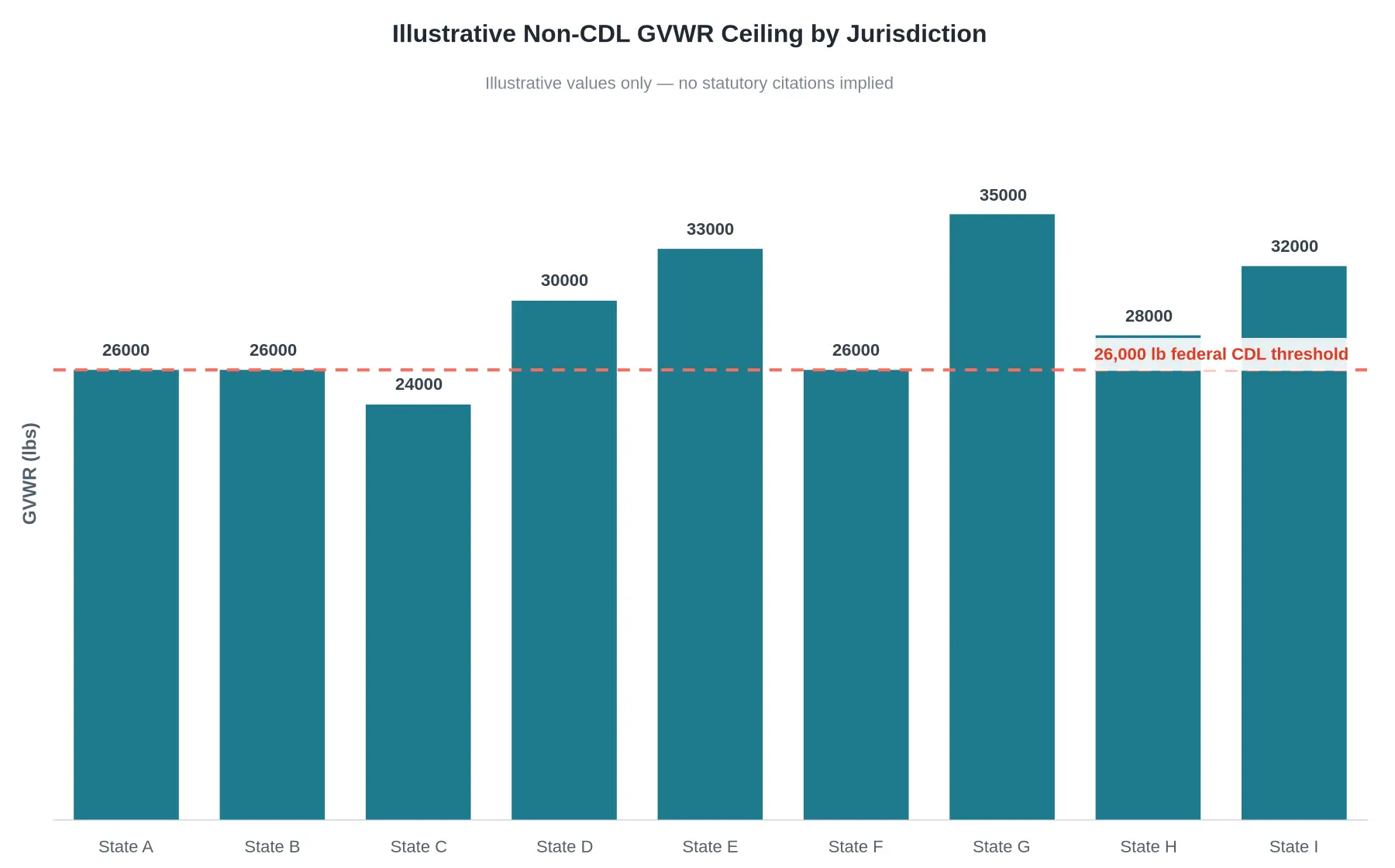
Illustrative bar chart: each bar represents a hypothetical jurisdiction’s intrastate non-CDL GVWR ceiling, with the dashed 26,000 lb line marking the federal threshold used in interstate operations. Jurisdictions are shown as generic labels (State A through State I) and values are illustrative, not statutory citations.
The chart shows the shape of that variation. Some jurisdictions track the federal number almost exactly, a few sit below it, and several allow heavier non-CDL operation inside their own borders before requiring a class upgrade. Read it as a shape, not a spreadsheet.
What the shape of the chart actually tells you
- A ceiling at or near 26,000 lb is the common posture, because regulators tend to copy federal group definitions for simplicity.
- A ceiling below 26,000 lb means a mid-weight wrecker can trigger CDL-level requirements earlier than the federal line suggests.
- A ceiling above 26,000 lb buys no interstate freedom. Cross a state line at 33,000 lb GVWR and the federal definitions still apply to the operation.
- The gap matters for fleet planning. A truck specced to sit just under a state ceiling can still be a compliance problem the day it takes an out-of-state recovery job.
Weight class and licensing is where most tow startups get surprised, so it pays to follow how testing and training requirements are moving alongside these weight rules.
Before you buy or re-rate a unit, read the actual GVWR on the door jamb and the manufacturer’s rating documentation, then check your own jurisdiction’s intrastate ceiling with the licensing agency. Generic thresholds are a starting point. The certified rating on your truck is what an inspector reads.
What Changes Above 26,000 lb GVWR
Above 26,000 lb GVWR, the truck becomes a commercial motor vehicle under federal rules, and with that come licensing, documentation and cost obligations that cannot be sorted out after the fact. Five areas account for most of the trouble operators run into.
License Class and Endorsements
Class B is the minimum credential above 26,000 lb GVWR. It covers a single vehicle at that weight and any towed unit rated 10,000 lb or less. Add a trailer, a dolly or a towed unit above 10,000 lb and the combination rules apply, which moves the requirement to Class A. Trucks with air brakes also need the air brake restriction cleared from the license, because a driver who tested in a hydraulic-brake vehicle cannot legally operate a full-air system. That is why whether you need a CDL to drive a tow truck is never a plain yes or no. It depends on the heaviest configuration the driver will actually be dispatched in.
Dispatch assignments therefore have to follow license class rather than seniority. A Class B holder cannot legally move a tractor-trailer combination, however many years they have behind the wheel.
Medical Certification and Driver Qualification
Once the vehicle is a CMV, DOT medical certification becomes a credential you maintain continuously rather than a document collected at hire. The driver needs a valid medical examiner’s certificate from an examiner listed on the FMCSA National Registry, has to self-certify the type of driving being performed with the state licensing agency, and has to keep that self-certification aligned with actual operations. The carrier, for its part, must query the Drug and Alcohol Clearinghouse at the pre-employment stage and at least annually afterward, and keep the responses.
An expired card or an unresolved clearinghouse query puts the driver out of service and idles the truck. A renewal calendar is cheaper than a parked truck.
Operational Compliance
A heavy-duty tow truck above the line falls under hours of service limits, electronic logging device requirements, and documented pre-trip and post-trip inspections every shift. Periodic inspection programs add an annual obligation, and the records proving all of it have to be retrievable on demand rather than reconstructed later. Roadside inspections test the paper trail as much as the equipment, so gaps convert directly into violations even when the truck is mechanically sound. Operators who treat logging and inspection records as administrative overhead tend to find out how quickly those gaps turn into carrier safety violations during a compliance review.
Enforcement is record-based, which means a compliant truck with poor documentation scores the same as a non-compliant one on a carrier profile.
Vehicle and Equipment Standards
Weight changes the equipment standard as well as the license. Brake system performance, lighting configuration and load securement are all specified against the vehicle’s weight rating and the load being moved. A towed vehicle is cargo for securement purposes: working load limits have to be rated against the weight actually being towed, with the required number of tie-downs and secondary restraint. A chain setup that passed on a light wrecker does not pass on a loaded heavy unit. Regular equipment safety inspections catch rated-capacity mismatches before a scale or a roadside check does.
Fail a securement or brake standard and the truck goes out of service on the spot. The recovery job stops, and the customer’s vehicle sits on the shoulder with it.
Insurance, Permits, and Cost Structure
The money side moves just as fast. Liability minimums rise to commercial levels, commonly USD 750,000 for general freight operations and higher for certain cargoes and passenger configurations. Oversize and overweight permits become a recurring line item whenever axle or gross limits are exceeded, and interstate operation brings apportioned registration and fuel reporting into the picture. Each of those costs scales with GVWR, not with what you bill per job.
Rates therefore have to be built on the compliance cost of the heaviest unit in the fleet. A truck priced like a light-duty wrecker loses money on every heavy call it answers.
| Requirement | Above 26,000 lb GVWR | Practical impact |
|---|---|---|
| License | Class B minimum, Class A for combinations | Dispatch by license class |
| Medical | Registry certificate plus Clearinghouse query | Renewal tracking is mandatory |
| Records | Hours of service, ELD, DVIR, annual inspection | Auditable trail every shift |
| Equipment | Weight-rated brakes, lighting, securement | Out-of-service risk on failure |
| Cost | Higher liability, permits, apportioned registration | Rate on the heaviest unit |
Above-the-Line Compliance Checklist
Once a truck crosses 26,001 lb GVWR, the paperwork burden shifts along with the driving. The items below turn the Class A and Class B discussion into a pre-dispatch routine, and they cover the state-level towing license requirements that sit on top of federal CDL rules.
Driver File
- Match each driver’s license class to the truck’s rated GVWR and GCWR before assigning a unit.
- Confirm DOT medical certification is current and on file, with the expiration date tracked.
- Keep proof of entry-level driver training completion in the file.
- Check Clearinghouse registration and query status for every CDL holder.
- Maintain a complete driver qualification file, including employment history and annual reviews.
- Run a recurring MVR and license-status check so nothing lapses between renewals.
Vehicle and Operations
- Maintain inspection, repair and maintenance records for each truck at the required intervals.
- Confirm the ELD is configured for the right vehicle, axle and weight profile.
- Match securement equipment ratings to the loads you actually haul.
- Review insurance limits and cargo coverage against the value and weight of the vehicles you tow.
- Confirm overweight and oversize permit procedures, including route approvals and escort rules.
- Validate registration and apportioned plates for every jurisdiction you enter.
- Schedule recurring weight verification on a certified scale, especially after body or equipment changes.

Exemptions, Nuances, and Where Operators Get It Wrong
Most of the confusion about whether you need a CDL to drive a tow truck comes from exemptions people assume travel with the vehicle, not from the 26,000 lb line itself. Farm implements, recreational vehicles and emergency response apparatus all carry partial or conditional licensing relief in many jurisdictions. What those provisions almost never do is cover a for-hire tow truck. A farm tractor may run on a restricted farm plate, a motorhome may qualify for a recreational exemption, and an ambulance or fire apparatus may operate under an emergency-services carve-out. A commercial wrecker dispatched for pay generally falls outside all three, and treating a personal or agricultural exemption as portable is one of the more expensive mistakes in the trade.
The next trap is measuring weight in the wrong place. A truck rated at 19,500 lb GVWR can still need a Class A combination license once the combination it forms with a trailer or towed unit passes 26,000 lb GCWR and the towed unit exceeds the Class A towed-weight threshold, typically 10,000 lb in states that follow the federal model. Licensing agencies evaluate the combination, not the power unit, so a heavy trailer or a heavy casualty behind a light truck can push the driver into Class A territory even though the truck itself never crosses 26,000 lb.
Air brakes add a layer that has nothing to do with weight. A truck with an air-brake system can trigger an endorsement requirement, or a restriction if the driver has not earned one, independent of GVWR. A 24,000 lb wrecker with air brakes can demand more licensing paperwork than a 27,000 lb truck with hydraulic brakes, so reading GVWR alone will not answer the question.
Who the truck works for matters as well. Private or in-house operations, such as a dealership moving its own inventory, a municipality, or a repair shop repositioning customer vehicles, can face different state treatment than a for-hire carrier. Some jurisdictions apply narrower commercial-vehicle definitions to intrastate private operations, with different plates, inspection cycles and hours-of-service rules. None of that transfers automatically, and assuming a neighboring operation’s approach applies to yours is a reliable way to run into trouble over what counts as illegal towing practices.
Last comes administrative wishful thinking. Owners sometimes try to solve a licensing problem by lowering the registered weight on the title or registration. That changes the fees and what the paperwork shows. It does not change the manufacturer-rated GVWR that licensing authorities use to classify the vehicle. A non-CDL tow truck is a legitimate category, but only when the truck, the trailer and the load each stay below their respective thresholds under your state towing regulations.
The reliable rule is that class follows the manufacturer-rated weight, the towed load and the equipment, so a truck above 26,000 lb GVWR or a combination above the towed-weight threshold requires the corresponding CDL. The exceptions for farm equipment, recreational vehicles, emergency apparatus and some private operations are narrow, jurisdiction-specific, and rarely available to a for-hire tow truck. Confirm them with your state licensing agency rather than assuming.
Where the Extra Cost Actually Lands
Crossing 26,000 lb GVWR changes more than which license you hold. A truck above that line pulls into a heavier regulatory lane: a CDL or an upgraded class, medical certification and a driver qualification file, electronic logging and hours-of-service discipline, more frequent inspection and maintenance cycles, and a steeper insurance and permitting profile. The chart below shows those burdens as planning proportions, which is enough to sanity-check a startup or expansion budget before you sign for the truck.
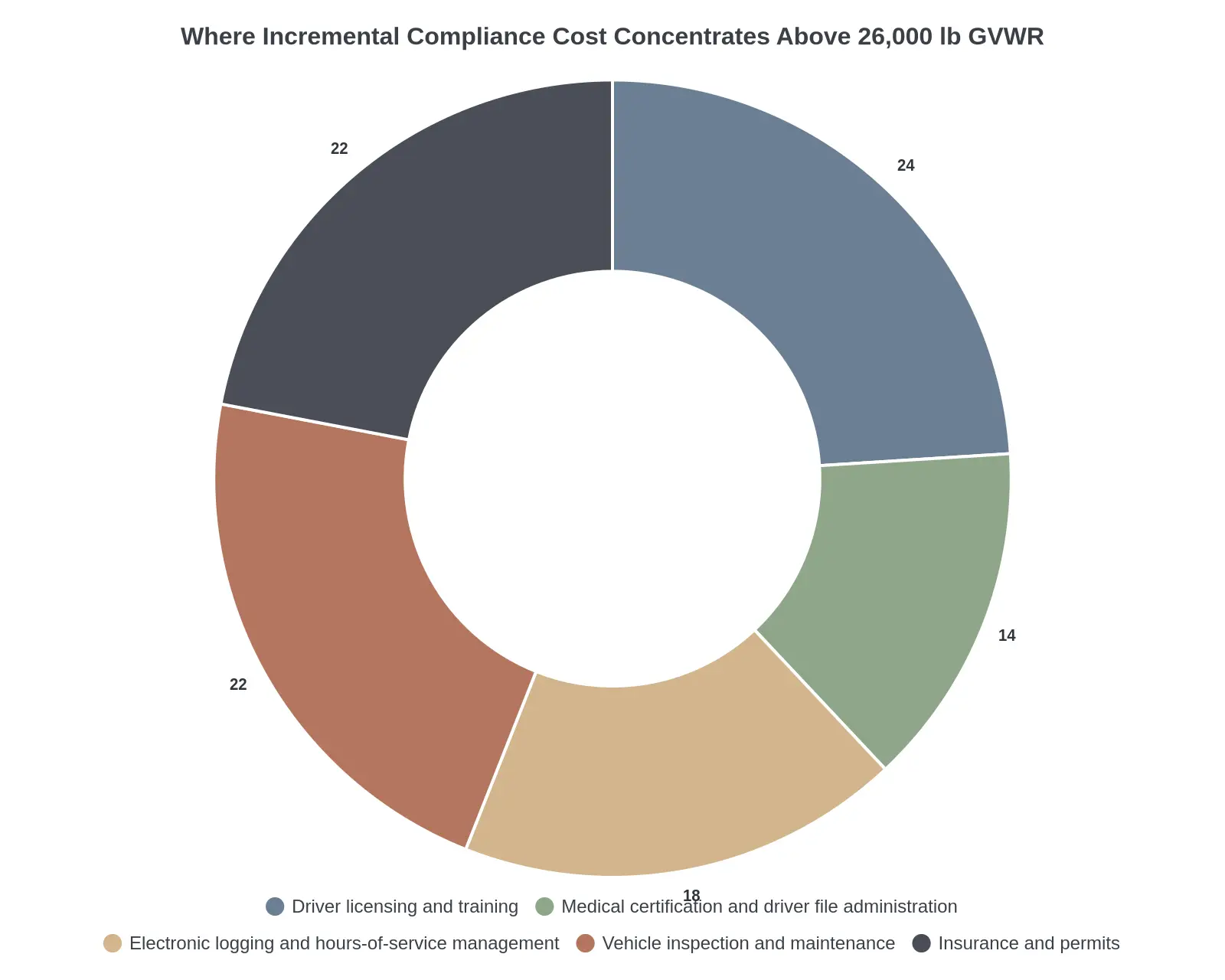
Caption: Values shown are illustrative planning proportions, not audited figures. Use them to frame a budget conversation, then confirm actual pricing with your own licensing authority, insurer, and accountant.
- Licensing and training is the largest single slice. It is also the one you can plan furthest ahead, which is why following testing and training changes pays off well before renewal season arrives.
- Insurance and permits, plus inspection and maintenance, come to nearly half the total, and both reward disciplined recordkeeping over time.
- Medical certification and driver file administration looks small by comparison, but a lapse there is the likeliest reason a driver comes out of service.
Treat the 26,000 lb line as a budgeting threshold as much as a licensing one.
Frequently Asked Questions
The same questions come up in almost every conversation with new drivers and new towing company owners. Here are the eight we hear most often.
Do you need a CDL to drive a tow truck under 26,000 lb GVWR?
In most states, no. A wrecker at 26,000 lb GVWR or below sits outside the federal CDL rules in 49 CFR Part 383, which apply to vehicles rated at 26,001 pounds or more. You still need a valid driver’s license and, usually, a state-issued tow operator credential. “No CDL” does not mean “no paperwork”: most states add a tow truck operator permit, a background check or a medical self-certification on top of the base license, and a handful layer their own certification exam onto that. Confirm the exact requirement with your state licensing authority before a driver ever gets behind the wheel.
What license is required between 26,001 and 33,000 lb GVWR?
A Class B CDL. Once GVWR crosses the 26,000-pound line by even a single pound, federal rules treat the truck as a commercial motor vehicle, and Class B covers any single vehicle at 26,001 pounds or more. There is no separate upper class inside that band, so a 27,000-pound wrecker and a 33,000-pound wrecker fall into exactly the same category. Those class boundaries are federal and change far less often than the training and testing pipeline around them. Reform tends to land on the credentialing side, and the current push around CDL testing and training reforms is a good example.
Does towing a trailer or a heavy towed unit change the required license?
Yes. Federal rules define Class A around the combination rather than the truck alone: a combination with a GCWR of 26,001 pounds or more, towing a unit whose GVWR exceeds 10,000 pounds. A Class B driver can pull a light trailer or a compact car, but hooking a loaded box truck, a bus or a tractor-trailer changes the license class required. Rate your drivers against the heaviest thing you expect them to hook, not the average load.
Is a DOT medical card required for non-CDL tow truck drivers?
It depends on the state and the operation, but the federal medical requirement is not limited to CDL holders. Under 49 CFR Part 391, drivers operating commercial motor vehicles in interstate commerce must meet physical qualification standards and hold a medical examiner’s certificate. For CDL holders, the certificate is a condition of keeping the license. Several states still require a valid DOT medical card or state medical waiver for non-CDL tow trucks operating commercially, and most insurers require one regardless of statute. Check your state licensing authority for the intrastate rule and your carrier for the contractual one.
Do CDL requirements differ for intrastate versus interstate towing?
Yes, and the difference catches a lot of new operators. Interstate towing follows federal FMCSA standards, so the 26,000 lb GVWR threshold and the Class A and Class B definitions apply consistently across state lines. Intrastate towing follows each state’s own commercial vehicle code, and a number of states set different weight triggers, carve out recovery or agricultural exemptions, or offer a non-CDL commercial class for in-state work. Two companies running identical wreckers in neighboring states can face different obligations. Read your own state’s code through the licensing authority rather than borrowing a rule from somewhere else.
Can a Class B driver operate a combination tow unit?
Yes, but only while the towed unit stays at 10,000 pounds or less. A Class B CDL authorizes a single vehicle rated 26,001 pounds or more, plus a towed vehicle that does not exceed 10,000 pounds. Above that towed weight the operation becomes a Class A combination. Endorsements matter here too, since air-brake equipped wreckers and hazardous materials response work carry their own additional requirements. If your fleet regularly recovers heavy equipment or Class 8 tractors, plan on Class A staffing from day one.
Does a state tow truck operator certification replace a CDL?
No. A state or industry tow truck operator certification is an operating and safety credential, not a substitute for a CDL, and it never changes which license class the truck itself falls into. Certifications such as state patrol tow operator permits, recovery training programs and hazardous materials response courses are normally required in addition to the correct license. A driver holding every certificate available still cannot legally move a 30,000-pound wrecker without a Class B CDL, or a heavy combination without a Class A.
How does an operator verify a truck’s GVWR before hiring drivers?
Start with the manufacturer’s certification label, usually on the driver’s door jamb, which states the GVWR and gross axle weight ratings for that specific chassis. GVWR is a rating assigned by the builder, not a scale reading, so a truck with a 24,000-pound curb weight can still be a 33,000-pound GVWR vehicle. Cross-check the label against the title, the registration and any upfitter documentation, because body builders and wheel-lift installers occasionally re-rate a chassis. Keep a written tow truck weight classification log that maps every unit to its GVWR band and required license class, and re-verify it whenever a truck is added, re-bodied or sold.
Deciding Whether to Cross the Line
By the time you reach the 26,000 lb GVWR line, the question has stopped being about licensing and become one about capital. A heavier unit triggers CDL requirements, so the decision is no longer “what does the regulation say” but “does the work I can actually win justify the truck, the driver, and the insurance policy that come with it.”
Revenue ceiling and job mix. A non-CDL tow truck under the 26,000 lb threshold handles passenger cars, light pickups and most SUVs. That produces dependable volume and a hard ceiling on what each call can pay. Above the line, a heavy-duty truck opens municipal contracts, commercial fleet recovery and tractor-trailer casualty work that bill at multiples per incident. The honest test is whether your service area generates enough of that premium work to keep the truck loaded, not whether a bigger truck would look good in the yard.
The driver labor market and the CDL premium. Needing a CDL to drive a tow truck shrinks the hiring pool to commercial drivers other employers are bidding for, and that scarcity shows up as a wage premium you cannot negotiate away. Price it into the model before you buy. A truck sitting idle for lack of a qualified driver is the most expensive asset a towing company can own.
Insurance and permit overhead. Heavier equipment carries materially higher liability and physical damage premiums, and it usually drags in permitting, registration and inspection costs that a light-duty unit avoids. Get binding quotes on the specific VIN before signing a purchase agreement. An insurance number that arrives after the sale can erase the margin the upgrade was supposed to create.
Equipment and maintenance intensity. Bigger trucks consume tires, brakes, hydraulics and driveline components faster per mile, and the parts cost more and are less likely to be sitting on a local shelf. A dependable supplier of reliable truck parts and services is what keeps a heavy unit earning instead of waiting, and that maintenance belongs in the budget as a line item, not as a surprise.
Scaling from one truck to a fleet. Going from one unit to two multiplies obligations rather than doubling them: overlapping shifts, backup capacity when a truck goes down, written procedures a new hire can follow at 2 a.m. Operators planning that step should build around emergency preparedness for fleets so dispatch, driver readiness and equipment redundancy are defined before the second truck arrives.
The compliance administration burden. With CDL-class vehicles in the fleet, hours-of-service records, driver qualification files, drug and alcohol testing, periodic inspections and electronic logging become recurring administrative work measured in hours per week. Budget a person or a system to own that workload, or accept that compliance gaps will eventually cost more than the upgrade returned.
Match truck ratings to the work you actually intend to chase, not to the most impressive capacity on the dealer lot. Buy the class you can staff, insure and maintain. Capacity you cannot put a qualified driver in is a liability dressed as growth.
Related Reading for Tow Truck Operators
The CDL weight threshold is rarely the only question a tow operator has to answer. Licensing sits alongside operational, safety and inspection obligations that decide whether a truck can be run legally and profitably.
- Fleet Emergency Response Strategies That Hold Up Under Scrutiny walks through how carriers structure callouts and dispatch, which matters because compliance reviews often examine how a licensed operation performs on its worst day rather than its typical one.
- Advancements in Heavy-Duty Rescue Apparatus examines equipment design trends, useful context when you are matching an apparatus to a vehicle class and confirming the right license category before purchase.
- Training and Technology for Roadside Assistance in Island Regions covers instruction and tooling for remote service areas, where the license class is only one part of the competency an operator has to document.
- The Driver’s Role in Roadside Emergencies outlines responsibilities at the scene, a practical complement to the statutory duties that come with a commercial license.
- Fraudulent Safety Inspections in Ontario explains how falsified inspection records are detected, which matters for keeping a fleet’s annual and periodic inspections defensible.
- Unsafe Towing Practices: CHP Alerts Drivers reports on enforcement attention to unsafe hookups and loads, a reminder that equipment violations can affect a carrier’s operating record independently of the driver’s license status.
- TCA Fleet Safety Awards 2026 describes the criteria used to recognize strong safety programs, a useful benchmark for building the records regulators and insurers expect.
- Giant Tiger’s Eco-Friendly Fleet Strategy looks at fleet sustainability planning, relevant to operators weighing vehicle replacement and procurement decisions that affect weight classes and, in turn, licensing requirements.
The Bottom Line on the 26,000 lb GVWR Line
A tow truck rated at or below 26,000 lb GVWR generally does not require a CDL. Above that line it generally requires a Class B CDL, or a Class A when the combination crosses the Class A thresholds.
Classification follows weight ratings, not actual loads. The number on the certification label and the gross combination weight rating of the truck-and-trailer pairing decide which license class applies. A 33,000 lb chassis keeps that rating whether it is rolling back empty or carrying a full load; what can change the class is what you hook behind it. Operators who reason backward from “we only tow light cars” are the ones who end up cited after a routine scale check.
Two layers of rules apply at once. Federal group definitions set the baseline for Class A, B and C vehicles, then states add their own towing-specific requirements on top, from equipment endorsements and air brake testing to inspection credentials and permits. A driver who is compliant in one jurisdiction is not automatically covered in the next, so confirm both layers before dispatching across a border. Watch recent CDL testing and training reforms as well, since entry requirements for new drivers keep moving.
Crossing the line also changes how the business operates, not just which card the driver holds. Above it, expect CDL-holder requirements, medical certification, a DOT drug and alcohol testing program, hours-of-service and electronic logging rules where they apply, documented pre-trip inspections, weight-station compliance, and heavier insurance and maintenance recordkeeping.
Which leads to a straightforward planning rule: build fleet purchases around the license class the business can realistically staff, train and insure over the life of the truck, not around the truck that looks best on the lot today.