Do You Tip a Tow Truck Driver After a 3 Hour Winch Out on a Saturday Night?
It’s late Saturday, the roads are dark and slick, and your vehicle is stuck somewhere it has no business being. You’ve spent three cold, stressful hours watching a tow operator inch you out of the mud, snow, or ditch on a long winch out. Now the truck is packed up and the paperwork is signed. You’re standing there wondering whether to hand over extra cash or just say thanks and drive carefully home.
The short answer: tips are appreciated and optional. A tow truck driver tip is a discretionary thank-you, not a bill, and a fair operator won’t think less of you for paying and leaving.
A tough winch out, especially late at night and in bad weather, is the kind of job where a tip feels earned. You’re not paying for the service; your invoice covers that. You’re acknowledging the extra effort, patience, and physical risk. Many drivers see the role they play in roadside emergencies as more than a job, and a small gesture matters to them.
What a Multi-Hour Winch Out Really Involves
When a vehicle is buried in mud, wedged in snow, or stuck off a remote trail, getting it back to solid ground is slow work. A multi-hour winch out is what it sounds like: a methodical recovery that can run well past three hours. It isn’t one dramatic pull.
What happens during a long recovery:
- Assess and stabilize – the operator walks the scene, reads the terrain, and anchors the vehicle so it cannot slide further.
- Rig the equipment – winch lines, snatch blocks, recovery straps, and shackles are set up to redirect force safely.
- Winch in short stages – small controlled pulls with constant re-checking, because yanking too hard can damage the vehicle or snap a line.
- Reset and repeat – after each pull, the whole setup is often rebuilt from scratch as the vehicle inches forward.
- Watch for hazards every step – a recoiling cable or a shifting load can seriously injure someone standing in the wrong spot.
The physical effort is real. A tow truck driver may haul heavy cable through knee-deep muck, re-anchor by hand, and stand in harsh weather for hours. The hazards are too: unstable ground, traffic on dark rural roads, and the stored energy in a taut winch line that can kill.
A Saturday night call stings a little extra because it’s someone’s weekend. A late-night winch out means lost sleep, canceled plans, and hours alone on a cold roadside while most people are home. That inconvenience comes on top of dangerous work.
That effort is the basis for deciding what a fair tip looks like. Good roadside assistance is skilled, exhausting labor, and the person on the other end of the cable works harder than the clock suggests.
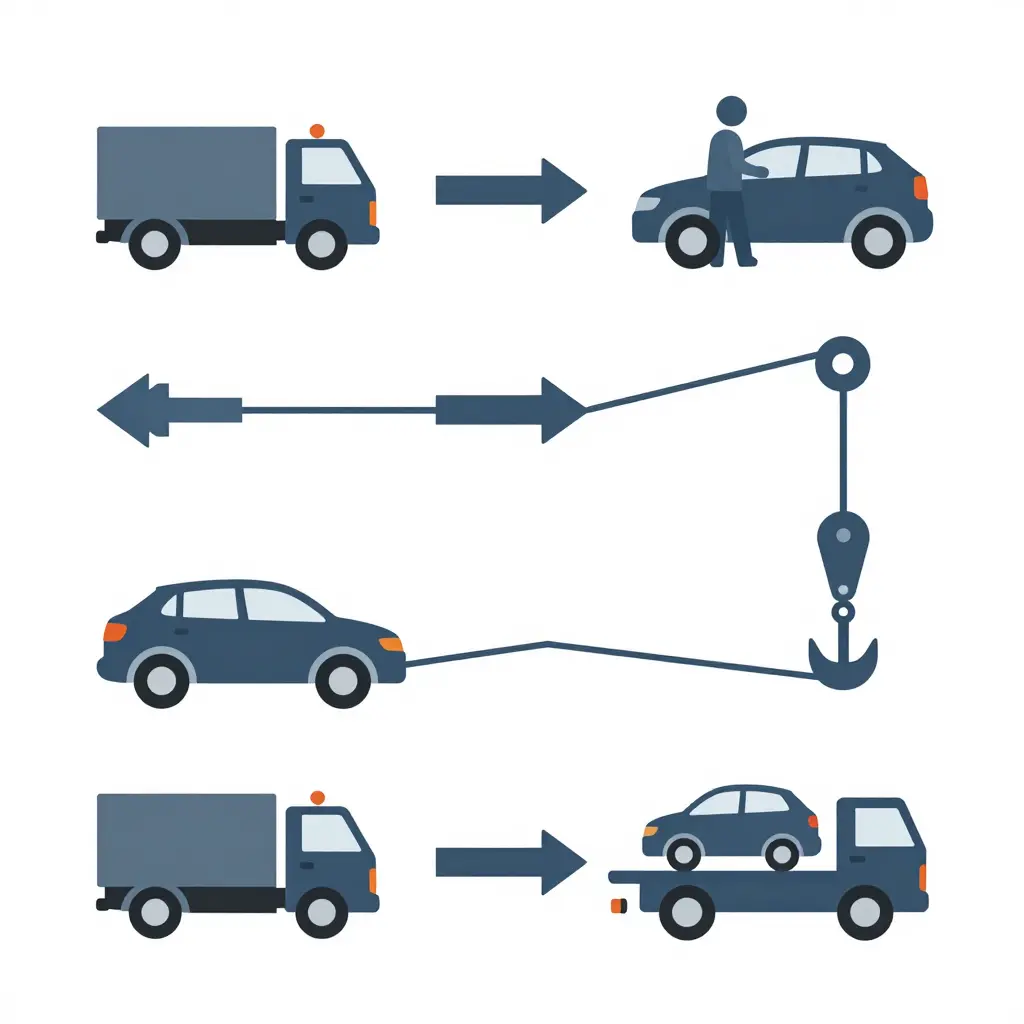
A minimalist 2D diagram of the winch-out recovery workflow. Flat geometric shapes, icons, and directional arrows illustrate five sequential stages, left to right: the tow truck arriving on scene, a technician assessing the stuck vehicle, setting up the winch line and anchor point, pulling the vehicle free along a pull-direction arrow, and finally securing the recovered vehicle. No text labels or photographic scenery.
General Tipping Norms for Tow Truck Drivers
So you just got winched out after three hours on a Saturday night. Your nerves are fried, your boots are muddy, and you’re standing in the dark wondering whether you’re supposed to hand over extra cash. This part is simpler than you think.
Start With This: Tipping Is Optional
Tipping a tow truck driver is never required. There is no law, no industry mandate, and no etiquette police writing tickets. Many drivers are already paid by their employer, their dispatch company, or the insurance provider or motor club that sent them. If your service came through a covered plan, the driver’s time and equipment are typically paid for. A tip in that case is a gesture of thanks, not a bill you forgot to settle.
When a Tow Truck Driver Tip Makes Sense
A tip feels right when someone went beyond the job: crawling through freezing mud, working in the rain at midnight, calming a panicked passenger, or carefully protecting your bumper while pulling you out. When the job was quick and routine, a tip is still welcome but not expected.
Common Ranges People Actually Use
There is no formula, but these are common:
| Situation | Typical Tip |
|---|---|
| Quick jump-start or tire change, paid out-of-pocket | $5 – $20 flat |
| Standard tow or winch-out, paid out-of-pocket | 10 – 15% of the service fee |
| Long, difficult, or late-night recovery | 15 – 20% or a generous flat amount |
| Service covered by insurance or a motor club | $5 – $20 for great service |
Why Expectations Vary
Good roadside assistance etiquette isn’t the same everywhere. In some regions, tipping is common; in others, drivers rarely see an extra dollar and don’t mind. Cities, tourist areas, and remote rural routes each have their own unwritten habits. Snowstorms, off-road recoveries, and holiday weekends push the range up because the work is harder and the hours are worse. For a closer look at how operators handle tough calls, explore the role drivers play in roadside emergencies.
The Bottom Line
If you can tip, do it. If you can’t, don’t sweat it. A sincere “thank you” and a five-star review also help. The point isn’t to follow a rulebook; it’s to show appreciation to someone who got you moving again.
| Situation or Service Type | Suggested Tip Range | Reasoning |
|---|---|---|
| Short hookup (quick pull, a few minutes) | $5-$10 or 5-10% | Minimal time and low effort; a small thank-you for fast help |
| Standard tow (short distance, routine) | $10-$20 or 10-15% | Typical job done well; the common courtesy range |
| Lengthy multi-hour winch out (e.g., 3 hours) | $20-$50+ or 15-20% | Hours of skilled, physical labor in tough conditions |
| Hazardous or off-road recovery | $40-$100+ or 20%+ | High risk, specialized gear, and real potential for injury |
| After-hours or weekend call (nights, holidays) | Add $10-$20+ to your base tip | Sacrificed personal time; an inconvenience premium |
The longer, harder, and later the job, the closer to the top of the range you should lean. A three-hour mud winch out on a Saturday night falls in the generous zone.
What Actually Shapes the Tip Decision
After a three-hour winch out on a Saturday night, there is rarely one tidy answer. A tow truck driver tip usually comes down to a few factors, none carved in stone. Treat them as nudges, not rules.
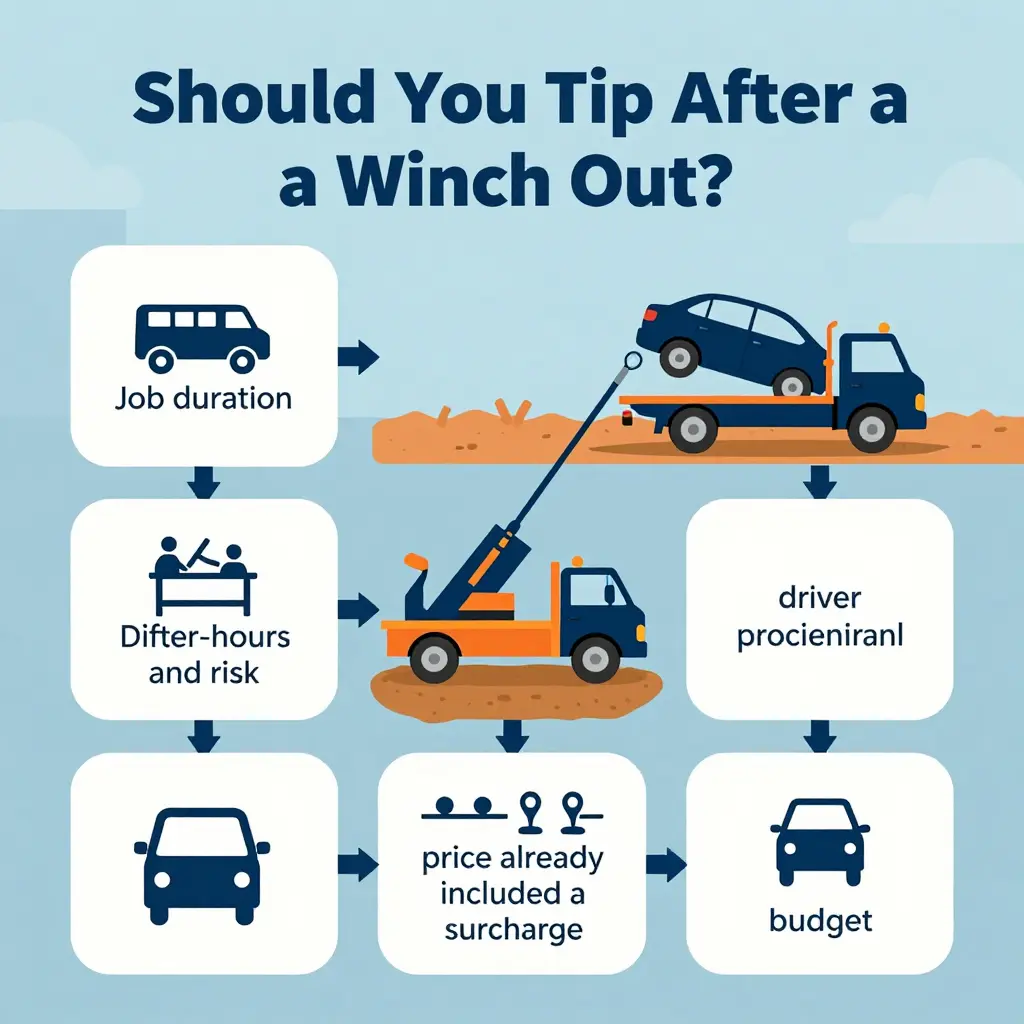
Time and duration
A recovery that eats three hours of someone’s evening is a real commitment. The longer a winch out drags on, the more reasonable a generous tip feels. A twenty-minute pull and a multi-hour recovery are not the same job.
Difficulty and risk
Deep mud, steep terrain, snow, or a truck balanced on a ditch edge raise the stakes. When the operator risks their own safety, or works carefully to avoid damaging your vehicle, that skill and nerve is worth acknowledging. The driver’s role in roadside emergencies explains what the job involves.
After-hours or weekend timing
A Saturday night call interrupts dinner, rest, and family time. Late-night or weekend work is inconvenient, and that is a fair reason to tip more. Timing alone isn’t the whole story, though.
The driver’s professionalism
Were they calm, honest, and respectful? Did they explain what they were doing and take care of your vehicle? Good service deserves a tip whatever the hour. Rude or careless behavior, understandably, cools that impulse.
Was a surcharge already built in?
If your bill already included a hefty after-hours or holiday surcharge, that money is partly the reward for the timing. You don’t have to stack a big tip on top, though a smaller gesture still lands well.
Your own budget
Be honest about your own wallet. A tip is optional, and no one should go into debt to say thank you. A modest amount given sincerely beats an amount you can’t afford.
Tipping etiquette is about judgment and context, not a fixed percentage. This table sums up how each factor usually pulls you.
| Factor | How it nudges the tip |
|---|---|
| Long duration | Up |
| High difficulty or risk | Up |
| After-hours or weekend timing | Often up |
| Attentive, professional driver | Up |
| Surcharge already applied | Neutral or smaller |
| Tight personal budget | Whatever you can afford |
Use these as clues, not commands. There is no single correct number after a long winch out, only a choice that feels fair to both of you.
Chart Brief: Typical Tip Amounts by Tow & Recovery Service Type
Chart type: Bar chart (vertical)
Purpose: Visually reinforce the tipping guidance in the accompanying table and surrounding text, letting readers quickly compare how gratuity expectations rise with the effort, risk, and time involved in each type of call.
Title: Typical Tip Amounts by Tow & Recovery Service Type
Subtitle: Suggested gratuity ranges for common call types
Axis labels:
- X-axis: Service Type
- Y-axis: Typical Tip (USD)
Data plotted (illustrative ranges):
| Service Type | Typical Tip (USD) |
|---|---|
| Short Hookup | 10 |
| Standard Tow | 20 |
| Multi-Hour Winch-Out | 50 |
| Hazardous Off-Road Recovery | 80 |
Design notes:
- Each bar uses a distinct color (blue, green, orange, red) so the escalation in tip size is instantly readable at a glance.
- Dollar values are printed on top of each bar for easy comparison without needing to trace back to the axis.
- The y-axis runs from $0 to $100 in $20 increments (begin-at-zero), which keeps the relative differences honest and proportional.
- A source note in small text sits at the bottom: “Source: industry etiquette guidance, theislandtowtruck.com (illustrative ranges; individual situations vary).”
Source note: The figures are illustrative gratuity ranges drawn from general tow-and-recovery etiquette guidance, not a rigid fee schedule. Actual tips depend on the driver’s effort, the conditions, and regional norms.
Placement: Insert directly beside or below the tipping-by-service-type table and above the closing guidance paragraph, so the visual and text tell the same story: the tougher and longer the job, the more generous the tip.
Before you reach for your wallet, a few quick-reference points:
- Job length and timing – A three-hour winch out late on a Saturday night is far more labor and lost personal time than a ten-minute jump-start, so longer, later jobs justify a bigger gesture.
- Difficulty of the recovery – Deep mud, steep banks, icy ditches, or awkward off-road angles raise the risk and the skill required, pushing the gratuity higher.
- The driver’s attitude and care – Patience, calm communication, and gentle handling of your vehicle are worth rewarding, especially when you’re already stressed and stranded.
- Whether a surcharge was already applied – If you were charged a weekend or after-hours surcharge, a modest tip is still thoughtful but not required. Knowing your rights around unfair towing charges helps you tip with confidence.
- How to pay the tip – Cash is simplest and most appreciated, though many drivers can take a card or app payment if you ask first.
There’s no rigid rule here. Let your budget, the driver’s effort, and your own gratitude guide the decision.
How to Tip a Tow Truck Driver: Cash vs. Digital
When a driver spends three hours winching your truck out of a muddy ravine on a Saturday night, you’ll want to say thank you in a way that counts. Here is the practical side of tipping a tow truck driver: cash, apps, and everything in between.
Cash Is Still King
Cash is the simplest and most appreciated option. It reaches the driver’s pocket immediately, with no fees or waiting. Fold a bill into your hand, shake theirs, and say, “I really appreciate you coming out tonight.” No production required.
Mobile Payment Apps Work Great
Plenty of drivers now use Venmo, Zelle, Cash App, or PayPal. Once the job is done, ask, “Do you have a payment app I could send a tip to?” It’s fast and useful when you have no cash.
Ask if the Company or Driver Accepts Tips
Not every tow company lets drivers keep their tips, and some pool them among the crew. A quick question, “Is it okay if I tip you directly?”, clears up the awkwardness and respects whatever policy applies.
When Insurance or a Fleet Account Paid
If your roadside assistance was covered by insurance or billed to a fleet account, the driver may already have been paid for the tow. That doesn’t rule out a tip. A small cash gesture is still a personal thank-you, and it never has to go through the books.
If the Driver Declines
Some drivers will politely wave off your tip. Don’t push. Respect the answer, thank them, and consider leaving a review that names them. The role drivers play in roadside emergencies explains why that “no” often comes with a smile: they’re glad you’re safe.
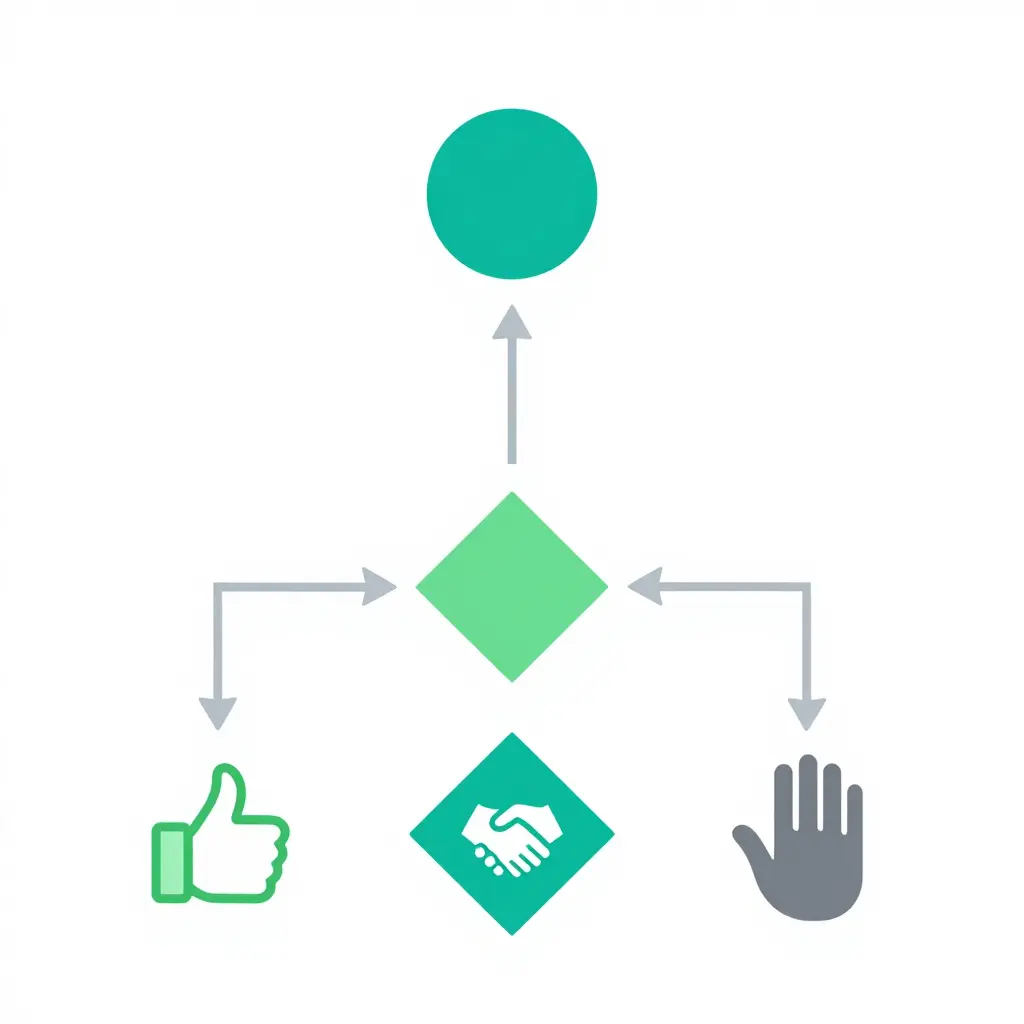
Image creation brief (text-free decision flow): A simple, minimalist two-dimensional flow diagram showing the reader’s tipping decision after a long winch-out. Starting node (rounded rectangle) at top feeds into three stacked diamond decision nodes connected in sequence – representing: long or hazardous job, after-hours call, and whether the driver exceeded expectations. Each diamond splits into two branches: a left branch terminating in a green thumbs-up/dollar-coin icon (tip) and a right branch continuing downward; the final right branch ends in a gray open-palm icon (no tip). Built from clean flat shapes and thin arrows only, using a teal, soft green, and light gray palette on white, with generous white space and no text labels or realistic scenery.
FAQ: Tipping a Tow Truck Driver After a Long Winch Out
Long winch outs are stressful, and the etiquette around tipping a tow truck driver shouldn’t add to it. These are the questions readers ask most.
Do you have to tip a tow truck driver?
No. Tipping a tow truck driver is never mandatory; it’s a gesture of appreciation, not an obligation, and you shouldn’t feel pressured into it. After a long, draining winch out, a tip is a simple way to thank someone for the extra effort. The role drivers play in roadside emergencies makes the gesture meaningful.
How much should you tip after a 3 hour winch out?
For a three-hour winch out, many people suggest roughly 10-20% of the service fee, or a flat $20-$50 if the bill is already substantial. On a Saturday night, the higher end recognizes the late hours and the physical work. There’s no wrong answer; even $10 shows you noticed the effort.
Should you tip if insurance or roadside assistance is covering the cost?
Yes. The tip is for the driver, who did the work regardless of who pays the invoice. If your roadside assistance plan covers the cost, a cash tip thanks the person who got you out of the mud or snow. It isn’t required, but it’s appreciated.
Is it rude not to tip?
Not at all. Many drivers don’t expect a tow truck driver tip and are glad you got home safely. Skipping it isn’t rude, especially if money is tight or the service was covered by a plan you already pay for. A sincere thank-you can mean just as much.
Should you tip on a weekend or holiday call?
A weekend or holiday call, like that Saturday night winch out, is a good moment to tip extra if you can. Those shifts pull drivers away from family and often mean overtime or lost rest. Adding $10-$20 acknowledges the sacrifice.
How should you hand over a tip, cash or card?
Cash is easiest for drivers, but many now accept tips by card or payment app. If you have no cash, ask; most will take a digital tip or wave it off with a smile. The gesture matters more than the method.
The bottom line
Tipping after a long winch out is optional and personal, appreciated but never expected. Tip what fits your budget and the effort you saw.
The Bottom Line: A Winch Out Is a Thank-You Moment
A three-hour winch out on a Saturday night is nobody’s idea of a fun evening, but it’s the kind of job that deserves extra gratitude. Tipping a tow truck driver after a long recovery is entirely discretionary. No law, union rule, or industry standard requires cash. A common range is 10 to 20% of the bill, or a flat $20, $40, or $50 for a job that ran long and hard.
Your call should reflect three things: how long the operator worked, how difficult the extraction was, and when it happened. A muddy midnight recovery in freezing weather is the generous end. A quick daytime pull from a flat lot is the low end, or zero.
Trust your own situation and budget. A thoughtful tip you can afford beats a stressful gesture you can’t. If you’d rather prepare ahead for the next emergency, our guide to emergency preparedness for island fleets is a good place to start.
After a rough night, a sincere thank-you, a cold drink, or a kind word goes a long way.