An island tow truck business runs on different constraints than a mainland one. There are fewer roads, parts arrive by ferry, and call volume rises and falls with the tourist season. Those three facts decide how you buy equipment, price jobs, and staff the phones.
This guide is for first-time owners sizing up the opportunity, small operators adding recovery work, and established island companies trying to protect their margins. It walks from a rough idea to a licensed business that earns revenue, and it flags the costs that catch most newcomers off guard.
Two of those costs deserve attention on day one: tow truck business permits and licensing, and winter cash flow. Permits are rarely one form or one fee; municipal, marine, and environmental approvals can each take months to secure. Winter is when tourist traffic falls away and insurance, storage, and equipment loan payments keep running anyway.
What this guide covers
Later sections cover market research and demand assessment, equipment suited to island conditions, and a step-by-step look at the permitting and licensing process. Then pricing strategy, seasonal staffing, and the financial habits that keep winter cash flow above water. There are practical checklists for fleet maintenance, emergency preparedness for island fleets, and customer acquisition inside a tight-knit community. By the end you should have a plan you can act on and a realistic budget that includes the permits and winter gaps the pitch decks leave out.
Island-Specific Startup Challenges to Plan For
The trade skills are the same as on the mainland. The operating conditions are not. Each item below changes what you have to spend, when you can work, and what you keep. Weigh them as you build the business plan.
- Limited bridge and causeway access. Weight limits, single-lane crossings, and storm closures can strand your wrecker on the wrong side of the water while a customer waits. Plan coverage zones around the bridges you can legally and reliably cross.
- Ferry-dependent parts delivery. A critical component may be a two-sailing wait away, so a single missed crossing can idle a truck for days. Build relationships with reliable truck parts services designed for islanders and keep high-failure spares on the shelf.
- Salt-air corrosion on equipment. Coastal humidity and airborne salt attack cables, winches, hydraulic lines, and undercarriage steel year-round. Budget for frequent washing, protective coatings, and shorter replacement cycles.
- Seasonal population swings. Summer visitors can triple call volume, then winter leaves you servicing a fraction of that base. Cash reserves and flexible staffing get you through the slow months.
- Narrow coastal roads. Tight shoulders, blind curves, and overhanging vegetation leave little room to set up a safe recovery. Cones, flaggers, and patience become routine operating costs.
- Scarce heavy-duty repair shops. When your own truck breaks, the nearest qualified garage may be on the mainland. Downtime is measured in weeks, so preventive maintenance matters more than it does inland.
- A small pool of licensed drivers. Qualified operators are few, and you cannot recruit from the next town over. Expect to train locally and pay to keep good people.
- Higher fuel, freight, and storage costs. Diesel and replacement parts both arrive by boat, and the premium lands on your ledger. Price services with shipping surcharges already built in.
- Slow or unpredictable permitting. Island jurisdictions often process licenses, zoning approvals, and inspections on their own timetables. Start the paperwork early and assume it takes longer than promised.
Paperwork takes a bite out of the budget before the first hook ever leaves the lot. The table below lists the permits, licenses, and agreements island tow operators routinely need, with a rough sense of the cost and how often each one comes back around. Treat every figure as an estimate, not a quote: fees shift by state, province, county, and even by island, and smaller licensing offices sometimes add charges of their own. If you are still mapping out driver requirements, review the updated CDL testing and training requirements before you budget for endorsements.
| Permit or License Type | Issuing Authority | Typical Cost Range | Renewal Frequency | Notes for Island Operators |
|---|---|---|---|---|
| Business Registration (LLC or Corporation) | State or provincial business registry | $50 – $500 | Annual or biennial | File where your island is legally based; most registries accept remote or online filing these days. |
| Towing Operator License | State or provincial motor vehicle / towing authority | $100 – $1,000+ | Annual | Requirements and fees swing widely; some islands layer on a separate local endorsement of their own. |
| Commercial Vehicle Registration | Department of Motor Vehicles / licensing agency | $200 – $1,500 per truck | Annual | Island registrations can carry extra weight-based fees or ferry-related surcharges. |
| Hazardous Materials (HazMat) Endorsement | Federal / state driver licensing agency | $50 – $150 plus background check | Tied to the CDL cycle, roughly every 4-5 years | Required for placarded loads such as fuel, propane, and chemicals, not for routine vehicle tows. |
| Overweight / Oversize Permits | State DOT or highway authority | $10 – $100 per trip; $100 – $1,000+ annual | Per trip or annual | Tight bridge and ferry weight limits on islands frequently trigger these permits. |
| Police Rotation or Dispatch Agreement | Local police, sheriff, or municipal contract office | $0 – several thousand (bond and insurance often required) | Annual renewal or as contracted | Competitive to win; may require set response times and guaranteed impound lot access. |
| Environmental Spill-Response Certification | State or provincial environmental agency | $200 – $1,000 (training plus certification) | Every 1-3 years | Islands near water often mandate this for any tow involving fluids, fuel, or vessels. |
| Local Municipal Towing Zones | City, town, or parish licensing office | $100 – $5,000, varies by zone or franchise | Annual | Some islands allocate zones by competitive bid; exclusivity can be valuable and pricey. |
Caption: All figures are illustrative estimates only. Actual costs vary by jurisdiction and island, so confirm current fees with your local licensing office before you commit.
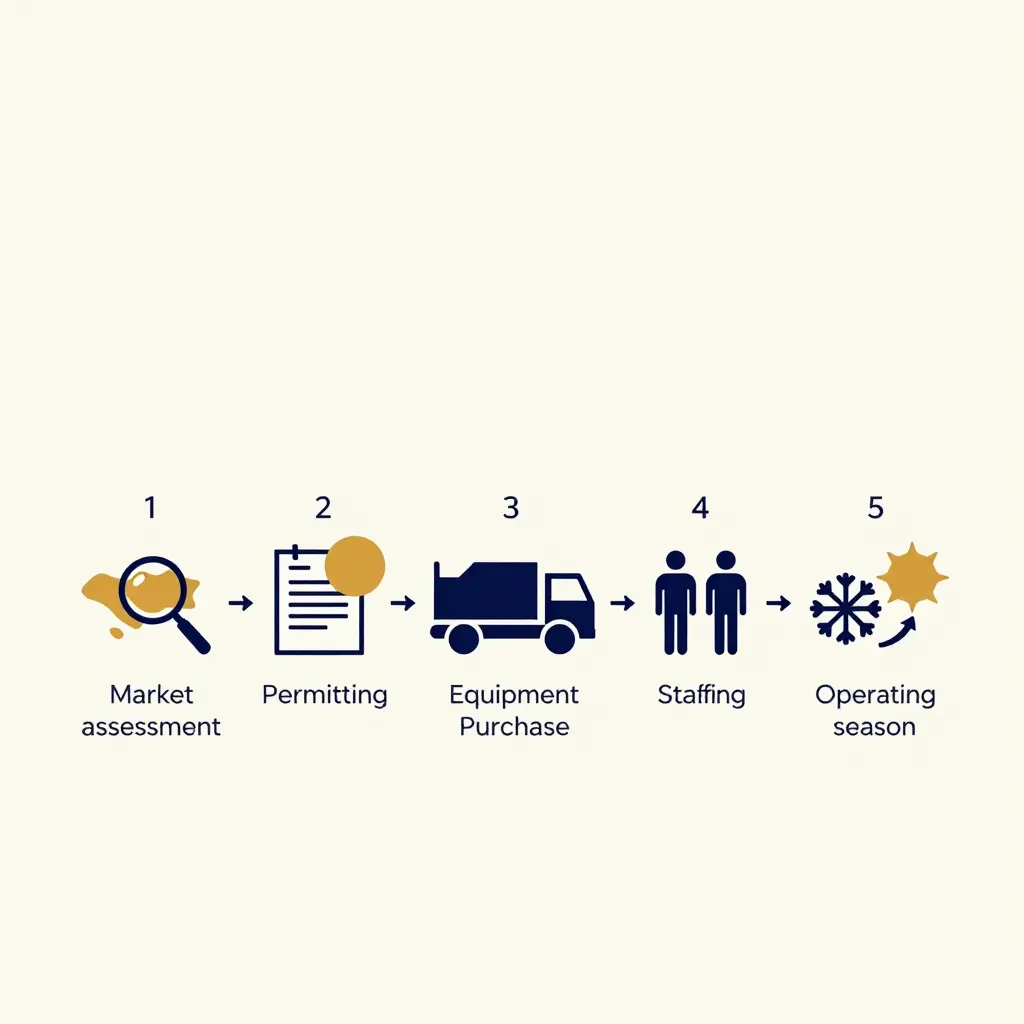
The roadmap above runs the launch sequence left to right: market assessment – permitting – equipment purchase – staffing – first operating season. Two stages carry a bold circular marker because owners underestimate them most: permitting and the winter cash flow that shows up during the first operating season. Each shape is a gate you clear before the next one opens.
The Permits Nobody Budgets For
On the mainland, one county clerk’s office often signs off on everything. On an island, the same ten-mile stretch of road can cross a village, a township, a regional district, and a national authority, and every one of them wants its own paperwork before you hook a vehicle. That layering is why tow truck business permits take island operators far longer, and cost far more, than the mainland estimate they started with.
Why Island Operators Face More Approvals Than They Expect
A small island can hold a surprising amount of government. A single towing route may cross two municipalities, a conservation authority, a ferry-controlled corridor, and federally managed land. Each layer attaches its own business licence, vehicle inspection, signage rule, and seasonal weight restriction.
A mainland operator usually answers to one jurisdiction. An island operator often answers to four or five, and they do not talk to each other. Confirm every requirement yourself, because no clerk will do it for you.
The Overlapping Layers, Decoded
- Municipal: business licence, zoning approval for an impound yard, and noise or idling bylaws.
- Regional: environmental rules for fuel and fluid storage, waste-tire handling, and road-use permits for oversize loads.
- National: commercial vehicle registration, operator licensing, and equipment standards. Your trucks still have to pass a formal equipment safety inspection even if they never leave the island.
Towing-Zone Auctions
Many islands hand out exclusive tow zones by public auction rather than open application. Your licence to operate in the busiest corridor is a competitive bid, not a form. Budget for the bid, the deposit, and the legal review, and be ready to lose to a bigger fleet the first time you try. Knowing how to spot predatory and illegal towing practices helps you compete fairly and flag competitors who do not.
Police Rotation Contracts
A police rotation contract is the steadiest revenue many island operators have, but it is a separate approval stacked on top of your licences. It usually demands a clean driver abstract, a specific insurance minimum, response-time guarantees, and a signed agreement before your first call. Miss one condition and you sit on the rotation list without ever receiving a dispatch.
Hidden Costs That Wreck the Budget
The permit column in the table earlier in this article is where island budgets tend to break. Watch for:
- Application fees that are non-refundable, even when you are denied.
- Insurance certificates that must be filed before approval, so you pay premiums before you earn a dollar.
- Bonding required by some municipalities and by most police rotation contracts.
- Downtime while you wait. Approvals can take weeks, and your truck sits idle the whole time.
These four costs belong inside your tow truck business permits budget from day one, not as surprises in month three.
Secure Your Permits in This Order
- National operator and vehicle registration, plus passing equipment inspection.
- Regional environmental and road-use permits for your yard and oversize moves.
- Municipal business licence and zoning approval for your impound lot.
- Towing-zone auction entry and bid deposits.
- Police rotation contract application and bonding.
Your Action Step
Skip the phone call and the hallway conversation. Send every authority—municipal, regional, and national—a written request describing what you plan to do, and ask them to confirm all requirements, fees, and deadlines in writing. Keep those replies on file. If an inspector or auditor ever questions your operation, that paper trail is your best defence.
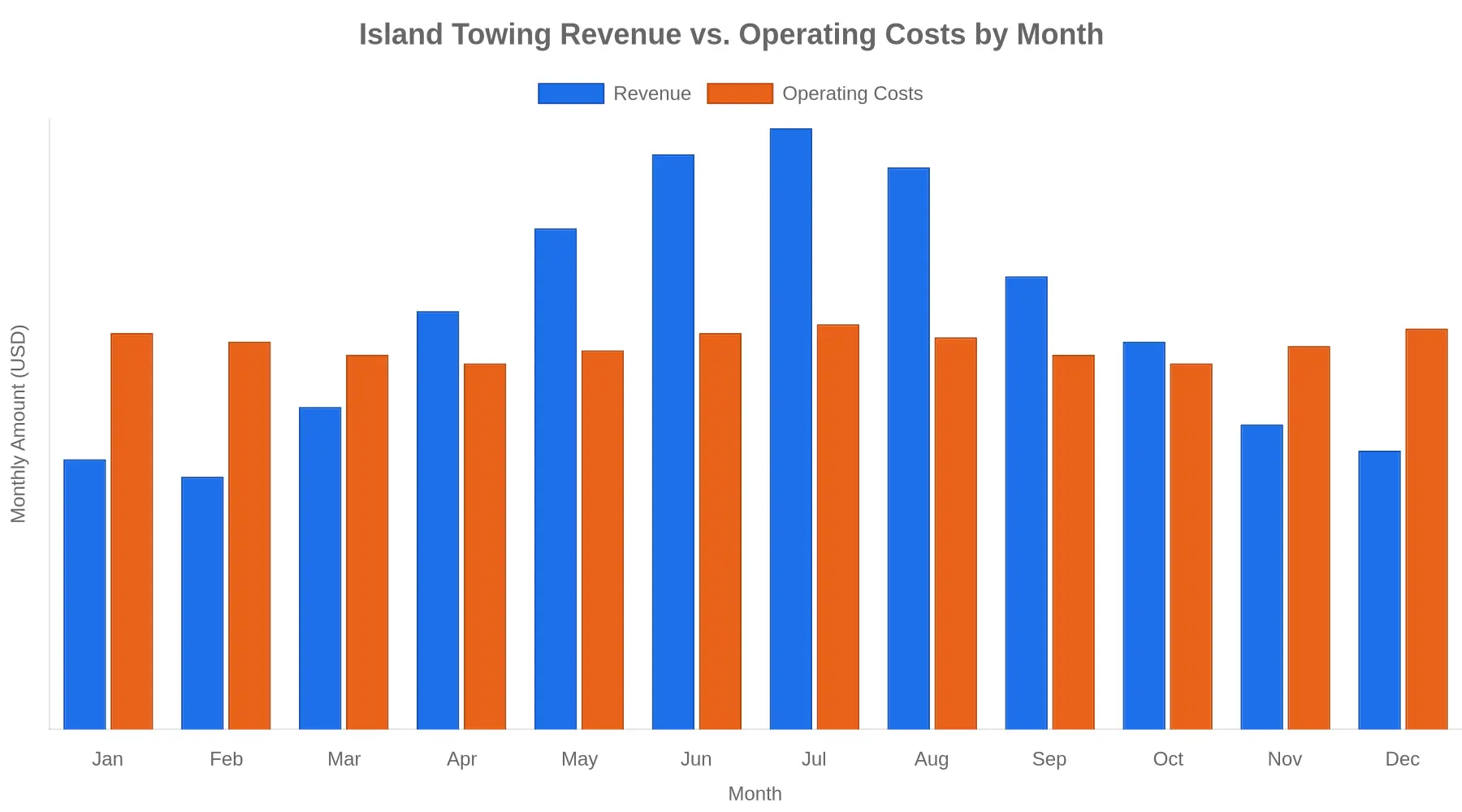
Island Towing Revenue vs. Operating Costs by Month – blue bars represent monthly towing revenue and orange bars represent monthly operating costs for a single-truck island operation.
Revenue drops below operating costs from November through March, as tourism-driven demand falls and fixed expenses keep climbing. That winter shortfall—not the permits—is the cash flow problem this guide teaches you to budget for before you buy your first truck.
Winter Cash Flow: The Gap Nobody Budgets For
Most island operators learn this in their first year: tourist traffic is a seasonal faucet, and when the visitors leave, the tows dry up almost overnight. Fixed costs do not take a holiday. Insurance premiums, loan payments on the truck and wheel-lift, storage and lot rent, and annual licensing renewals keep arriving on schedule, whether you hauled one vehicle this month or forty. That mismatch is winter cash flow, and because it repeats every year, it is entirely predictable—which means you can plan around it instead of dreading it.
The bar chart above shows the shape of it. Revenue falls in January and February to roughly the level of your fixed costs, while July brings in about three times that amount. The shaded band is the winter gap. Here is how to close it before it opens.
Build a Twelve-Month Rolling Forecast
Budget by season, not by month. Put every dollar of income and expense on a single twelve-month spreadsheet, then update it monthly so the next three months stay visible. Track revenue by service line (light-duty tows, jump-starts, roadside calls) and list fixed costs separately. Seeing June’s surplus next to February’s deficit on the same page makes setting money aside feel less like punishment and more like routing.
Fund a Winter Reserve During Peak Months
In your strong months, move a fixed percentage of every invoice into a dedicated winter reserve account before you touch it. Treat that transfer like a payroll obligation, not like what is left over. Even a modest skim of peak revenue builds the cushion that covers insurance and loan payments once the island empties out.
Negotiate Off-Season Terms Early
Call your lender or insurer in late summer, when your books look strong, and ask for seasonal payment structures, quarterly premiums, or a short deferment window on loan principal. Do not wait until January. Partners are far more flexible with a healthy client than a desperate one.
Add Winter Revenue Instead of Only Cutting Costs
- Standby contracts with the municipality, ferry terminal, or utilities for guaranteed on-call availability
- Snow and storm response agreements that put your truck to work when the weather turns
- Fleet maintenance agreements with local businesses that need vehicles serviced while fleets idle in the off-season
Keeping up with reliable truck parts and services for islanders helps you serve those maintenance contracts without long parts delays, and reviewing islands in crisis: training and technology for effective roadside assistance sharpens the storm-response skills that make standby work profitable. Pair these with the renewal schedule below so no licensing surprise lands in your worst month.
| Permit / Renewal | Typical Timing | Budget Note |
|---|---|---|
| Business license | Annual, Q1 | Set aside in fall |
| Tow authority / operating permit | Annual | Ties to insurance |
| Vehicle registration | Annual or biennial | Per-truck cost |
| Insurance policy | Annual or quarterly | Negotiate off-season terms |
| Signage / storage zoning | Renewal cycle | Local fee varies |
The Rule of Thumb
Size your reserve to cover three to six months of fixed costs, and lean toward the higher end if you operate a single truck. Three months keeps the lights on; six months gets you through a slow winter and still leaves room to say yes to a good opportunity. Fund it in peak season, protect it in the off-season, and winter cash flow becomes a routine instead of a crisis.
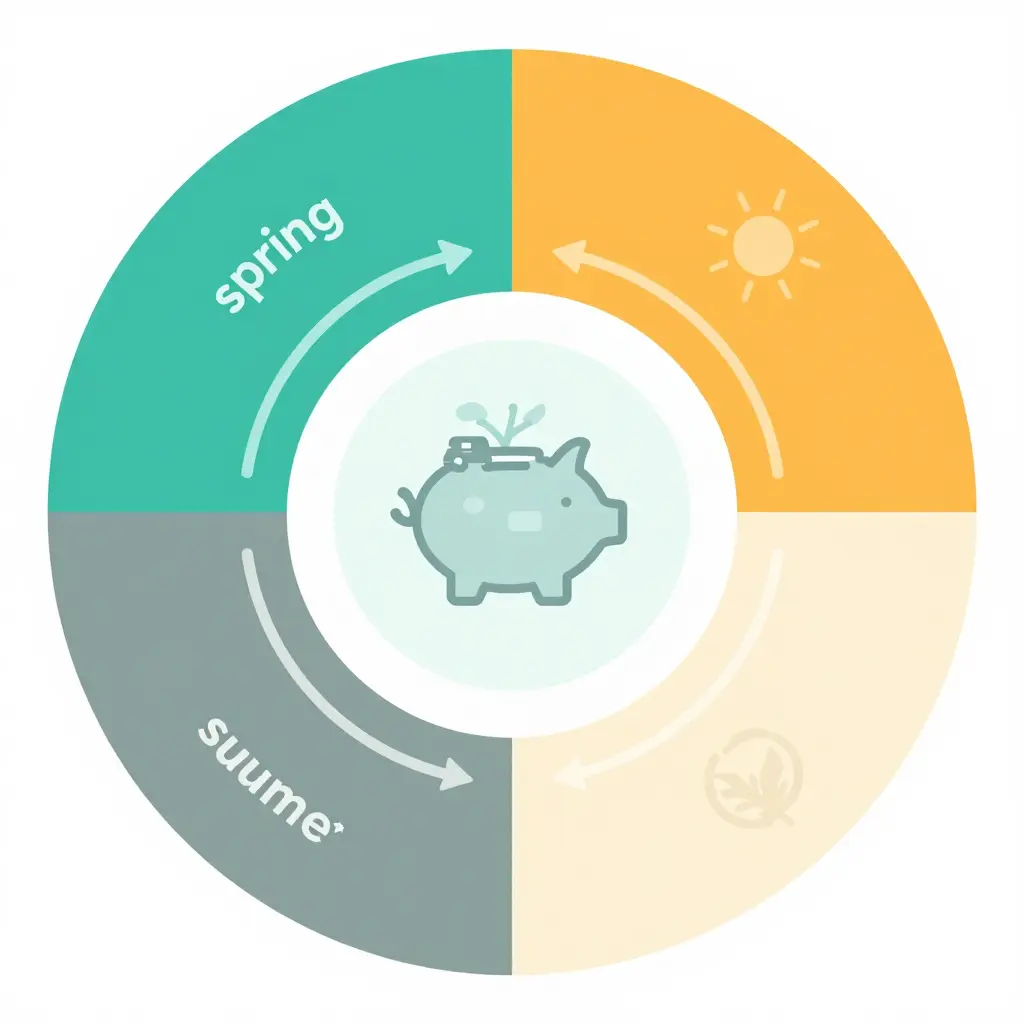
Here is the diagram at a glance: a single circle split into four seasonal segments, with the money always moving in one direction. During the bright peak months, revenue arrows bend inward toward the reserve pool at the center. During the quiet months, those same arrows reverse and push stored funds back out to cover the season. The middle never empties, and that is the point of a winter buffer.
How to read the cycle
- Peak season segments (the two vivid quadrants) represent the months when tourist traffic, ferry backups, and rental-vehicle breakdowns keep the trucks rolling and the invoices stacking up.
- The central reserve pool is the buffer you build during those good months instead of spending it all. Treat it as untouchable operating capital, not profit.
- Low season segments (the pale quadrants) are the months when revenue drops but fixed costs – insurance, loan payments, permits, storage – do not. The outward arrows show the reserve doing its job.
- The continuous loop is the point: the reserve refills, then drains, then refills. An island tow business survives on that rhythm, not on a single good summer.
Startup Cost Breakdown for an Island Tow Truck Business
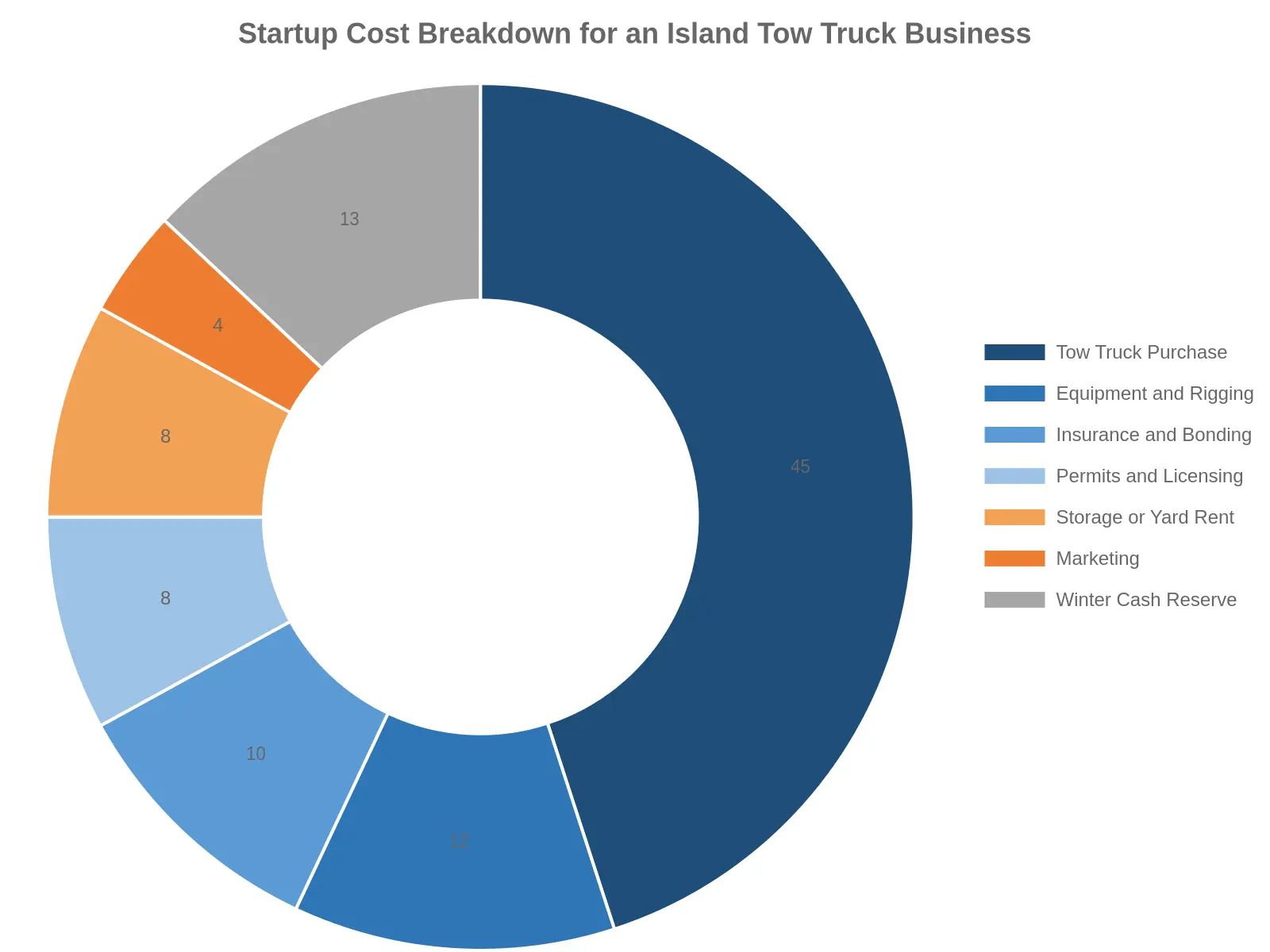
Before you hang a shingle on an island tow service, it helps to see where every dollar of startup capital actually lands. The doughnut chart above maps one illustrative split between your one-time purchases and your first-year operating costs:
| Cost Category | Share of Total |
|---|---|
| Tow Truck Purchase | 45% |
| Equipment and Rigging | 12% |
| Insurance and Bonding | 10% |
| Permits and Licensing | 8% |
| Storage or Yard Rent | 8% |
| Marketing | 4% |
| Winter Cash Reserve | 13% |
The largest line item is the truck itself, which swallows nearly half of a typical budget. The smaller slices deserve just as much attention, especially the emergency preparedness planning for island fleets that keeps your equipment ready when the ferry is not running and the weather turns.
Caption: Note that the permits and licensing slice and the winter cash reserve slice are the two segments most commonly underestimated by first-time island operators, even though together they account for more than a fifth of the total budget.
Winning Customers on a Small Island
A small island will not support a big advertising budget. There are simply not enough residents, visitors, or miles of road to justify one. What works instead is being the operator whose number people already have saved before they need it. That single fact shapes how an island towing business finds its first customers and keeps them for years.
Word of mouth travels fast in both directions. One slow response or a careless recovery becomes common knowledge around the island within a week. Earn trust in person and the community keeps your phone ringing. The same ground-level credibility shapes the drivers’ role in roadside emergencies, and it shows up in the community growth story behind Derrick Wolfe’s trucking work: relationships, not reach, drive the call volume.
Channels That Actually Bring Calls
- Police and roadside-assistance rotation lists. Get on the official rotation so dispatchers think of you first for collisions and breakdowns. Visit the station in person, and keep your insurance and licensing current so you stay eligible.
- Ferry terminals. Partner with terminal staff, who watch stranded tourists and commuters every day. Leave cards and offer a standing arrangement for vehicles that fail on the dock or in the queue.
- Auto repair shops and marinas. Mechanics refer vehicles they cannot move, and marinas bring boat trailers, launch-ramp rescues, and off-season storage moves.
- Local directories. Claim your spot in the island phone book, business-association lists, tourism sites, and map apps where visitors search “tow near me” in a panic.
- A responsive phone line. Answer live, day or night. A missed call on an island is a lost customer, because the next operator is already on the way.
Your Recommended Weekly Outreach Routine
Block a few hours every week for relationship-building, not for buying ads:
- Monday: call two partner shops to check how referrals are flowing.
- Wednesday: stop by the ferry terminal and police station with fresh cards.
- Friday: post one local update and reply to every review you have received.
- Weekend: audit your directory listings and test your own after-hours phone line.
Consistency beats spend. Do this week after week and the calendar fills on its own, no billboard required.
Scaling Beyond the First Truck
The busiest week of summer will convince you to buy a second truck. After a July packed with tourist breakdowns and after-hours calls, the math seems obvious. Resist it. On an island, summer demand hides a lean, punishing winter, and a truck bought on peak-season optimism sits idle and corroding in salt air while the payments keep coming.
Wait until your load data shows consistent demand across seasons, not across one sunny quarter. A single strong summer proves nothing; four seasons of rising utilization is a business.
The Evidence That Justifies a Second Truck
Pull twelve months of dispatch records and read them by season, not by month. One operator’s numbers swung from 78% utilization in summer to 32% in winter in Year 1, the kind of pattern no bank would respect; by Year 2, even winter had climbed to 47%. That trend—not a lone July—is what unlocked expansion.
Before you commit capital, three criteria should be true:
- Utilization rate: your single truck should sustain roughly 60-70% billable hours through all four seasons, not just peak.
- Contract wins: signed recurring work – a ferry authority, marina, municipal fleet, or insurance rotation – that guarantees baseline revenue even when tourism vanishes.
- Fully funded winter reserve: cash on hand to cover three to six months of fixed costs before you sign a second note.
A Phased Growth Plan
- Audit the data. Export two years of jobs, categorize by season, and calculate true utilization and revenue per hour.
- Ring-fence a winter reserve. Separate account, untouched, equal to at least three months of fixed costs.
- Land one anchor contract. Convert a handshake dispatch relationship into signed recurring volume.
- Add a second light-duty truck only after the above hold for two consecutive years.
- Certify a second operator. Rising capacity means rising responsibility – stay current on recent CDL testing and training reforms so new hires meet the bar.
- Invest in a heavy-duty unit once recovery calls and fleet contracts exceed what light-duty assets can safely handle.
Financial Guardrails for the Low Season
Growth failures usually show up in February. Never finance a truck whose monthly payment your worst winter month cannot cover on its own. Keep total debt service below roughly 15% of steady-state revenue, and treat the winter reserve as sacred. Budget for compliance too: Operation Safe Driver Week violations and out-of-service orders are hidden costs that grow when you add drivers, and one bad audit can wipe out a seasonal windfall.
Scale when the data says so, not when the phone rings. That is how an island operator grows from one truck to a real fleet without sinking under the first quiet winter.
Frequently Asked Questions About Starting an Island Tow Truck Business
How many permits do I typically need?
Most island jurisdictions require a business license, a commercial registration and plate for every tow truck, and a towing or motor-carrier operating authority. Many also issue a separate permit for police rotation lists and for any storage yard or impound operation. In practice, expect three to five distinct permits or approvals. Budget extra time for a local zoning or land-use sign-off if you plan to store or impound vehicles.
How much cash reserve do I need for winter?
Because tourism and traffic fall sharply in the off-season, hold three to six months of fixed operating costs in reserve, including insurance, loan payments, yard rent, and payroll. Winter cash flow is the most common reason new island operators fail, so plan for revenue to drop 40 to 60 percent. Keep that reserve in a separate account from your equipment-replacement fund so you never accidentally spend it.
Is a single truck enough to start?
Yes. One well-equipped truck is a legitimate starting point, especially if you drive it yourself and answer calls full-time. The catch is that a single vehicle has no backup, so a breakdown can shut you down completely. Before signing any contract that promises 24/7 coverage, set up a reciprocal service agreement with a nearby provider.
How do I handle salt-air equipment damage?
Salt air accelerates corrosion on cables, chains, hydraulic fittings, and electrical connections, so rinse the undercarriage and recovery gear with fresh water regularly. Apply corrosion-inhibiting coatings to exposed metal and inspect winch cables for rust more often than inland operators do. A documented maintenance routine and proven response planning make the difference, as outlined in these essential fleet emergency response strategies.
Do I need a heavy-duty truck as an island operator?
Not necessarily at first. Start with a medium-duty wrecker that handles passenger cars, light trucks, and the occasional van, which covers most island calls. Add a heavy-duty unit only after you land commercial, ferry, or construction accounts that justify the higher purchase price and operating cost.
How do I win police rotation work?
Get on the rotation list by meeting the requirements of the local police or highway authority, which usually include insurance minimums, response-time standards, and a clean safety record. Build your reputation by responding promptly, keeping accurate paperwork, and behaving professionally at every scene. A documented safety record strengthens your application, and programs like the fleet safety awards 2026 application are a good way to earn that credibility.
How long does licensing approval usually take?
Timelines vary, but most island operators can expect 30 to 90 days for a towing authority, insurance verification, and any local permits. If a storage-yard or impound license is involved, add several more weeks for inspection. Apply for every permit at the same time rather than one at a time, or you may lose a season.
What insurance does an island towing company need?
At minimum you need commercial auto liability, on-hook or cargo coverage that protects the vehicles you tow, and general liability for your yard and employees. Many authorities also require garage keepers’ coverage. Confirm the exact minimums with your licensing body before you shop for a policy.
Conclusion: Plan for Permits and Winter Cash Flow Before You Ever Tow a Single Vehicle
Starting a tow truck business on an island is viable, but only for operators who treat permits and winter cash flow as day-one line items rather than afterthoughts. The businesses that thrive on the water are not the ones with the biggest trucks; they are the ones that mapped every hidden cost before signing a lease.
Here is the sequence we have covered, condensed into something you can act on:
- Assess demand honestly. Study how many breakdowns, ferry queues, and stranded vehicles your island actually generates each month, then size your fleet to that reality.
- Secure permits early. Local licensing, environmental rules, and port or municipal access permissions can take longer than your equipment financing. Start the paperwork first.
- Manage seasonal cash flow. Summer tourism can carry you; winter will not. Build a reserve, line up off-season work, and price so that twelve months of overhead is covered by the busy ones.
- Choose island-ready equipment. Salt air, narrow roads, and limited parts suppliers demand rust-resistant, right-sized rigs with dependable maintenance access.
- Market locally. On an island, reputation travels fast. Partner with mechanics, marinas, and ferry operators rather than pouring money into generic ads.
- Scale carefully. Add trucks only when repeat demand and cash reserves, not optimism, justify the leap.
Before you finalize your budget, factor in supply-chain volatility that can quietly inflate equipment and parts costs. For a sharper look at how trade policy affects island transport economics, it is worth reviewing this related consideration on how tariffs could impact your cost planning.
The recommendation is straightforward: build your permit timeline and winter cash-flow cushion first, and let everything else follow. Operators who plan for the slow months become the dependable name islanders call, and that reliability is what turns a seasonal gamble into a durable, year-round tow truck business on an island.