
Understanding how much your truck can tow is essential, whether you’re a commercial fleet operator, a property manager, or simply someone looking to haul trailers safely. This guide provides insightful steps and methods to accurately assess towing capacity using your Vehicle Identification Number (VIN). We will explore the significance of the VIN in towing assessments, the factors that can influence capacities, and how to employ various tools and formulas to get precise data for your needs. Each chapter unfolds a part of this crucial knowledge, ensuring that you’re equipped with the right information tailored for island-centric operations.
Unlocking Tow Power: How a Vehicle Identification Number Defines Your Truck’s Real Towing Limits
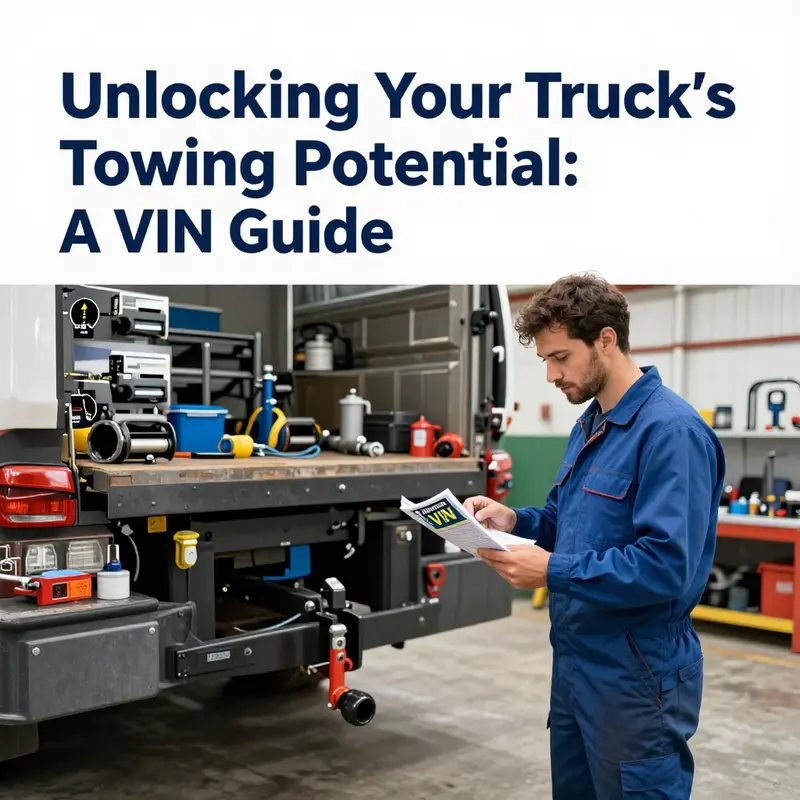
Understanding how much you can tow starts with a VIN. The VIN does not give a single towing number; it unlocks a manufacturer specification sheet that includes GVWR, GCWR, curb weight, payload, and sometimes towing-related notes. The GVWR is the maximum weight the vehicle can safely carry, including passengers, cargo, and fuel. The GCWR is the maximum combined weight of the vehicle and any trailer being towed. The curb weight is the vehicle’s weight in a typical unloaded state. The difference between GVWR and curb weight equals payload capacity, while GCWR minus GVWR gives a rough upper bound for trailer weight under ideal conditions. In practice, real-world towing must also account for tongue weight, weight distribution, braking capability, tires, suspension, and the trailer’s own weight.
Locating the VIN is the natural first step. In most trucks it appears on the driver’s side dashboard and is readable through the windshield, and it may also be found on the driver’s door jamb. The VIN is a fingerprint for the vehicle’s original build, and it unlocks access to the manufacturer’s specification sheet and archived data tied to that exact configuration. If the truck has been modified—engine swaps, different axles, suspension changes, or brake upgrades—the practical towing limit may shift. The VIN remains an important reference, but it must be interpreted in light of the current state of the vehicle.
A reliable path to accurate numbers runs through trusted VIN decoding channels. Manufacturer-provided decoders, official government portals, and reputable auto-data services typically return the key data points side by side: GVWR (maximum safe vehicle weight), curb weight (unladen weight), payload, and GCWR (maximum combined weight with a trailer). The GVWR and GCWR are the anchors for towing planning, but they must be considered alongside payload and tongue weight to avoid exceeding safe limits. The official towing figure published by the manufacturer—often in the owner’s manual, on a vehicle placard, or in the dealership literature—takes precedence over any back-of-the-envelope calculation.
To cross-check VIN data, you can consult official portals such as the DMV information systems or national transportation safety agencies that host VIN-based specifications. These sources help verify GVWR and GCWR and confirm that the numbers you rely on come from the vehicle’s sanctioned configuration. The VIN provides access to the data, and the data must be applied in the context of the vehicle’s actual hardware and state of wear.
In practical terms, the typical workflow is: use the VIN to pull GVWR, GCWR, and curb weight; subtract curb weight from GVWR to estimate payload; subtract GVWR from GCWR to estimate maximum trailer weight under ideal conditions; then compare those figures to your planned load and trailer. Remember that the manufacturer’s numbers represent design limits and are set with safety margins for braking, steering, and durability. The final, legal authority for towing limits is the manufacturer’s published figures and applicable regulations, not a calculation tucked away in a note pad.
If the VIN information is incomplete or the vehicle has undergone post-factory changes, involve a professional who can verify current configurations using onboard data and diagnostic tools. A dealer or qualified technician can reconcile VIN-derived data with the actual hardware, ensuring you are planning within safe and legal margins. The chaining logic remains: VIN to GVWR/GCWR to payload and trailer weight, verified against the owner’s manual and placard, then checked against professional sources when in doubt.
Example scenario: a pickup with a GVWR of 10,000 pounds, GCWR of 26,000 pounds, and a curb weight of 6,500 pounds. Payload would be 3,500 pounds (GVWR minus curb weight). Maximum trailer weight, per GCWR minus GVWR, would be 16,000 pounds. This illustrates the envelope, but real-world towing must consider tongue weight, brake requirements, axle limitations, and trailer distribution, which can tighten the limits beyond the simple arithmetic.
For readers seeking practical guidance, start with the VIN-derived data, then confirm with the owner’s manual and the vehicle placard for the exact towing capacity and any special hitch or braking requirements. If discrepancies arise, consult a dealership or a qualified technician to reconcile the data with the vehicle’s actual configuration. Finally, recognize that safe towing is about staying within the vehicle’s design envelope, planning for worst-case loading scenarios, and re-verifying after maintenance or modifications.
For further reading and authoritative VIN-derived specifications, consult trusted online resources that present weight-related data tied to VINs and cross-check with the vehicle’s official documentation. Official VIN decoding tools from manufacturers or government agencies provide a consistent, authoritative reference to GVWR, GCWR, curb weight, and related ratings.
VIN as the Key to Tow: A Deep Dive into How Your Truck’s Identity defines Its Towing Limits
The Vehicle Identification Number, or VIN, stands as a fingerprint for a truck. It isn’t just a string of characters to memorize or an inconvenient field on a form. The VIN links you to a precise set of manufacturer specifications that define how the vehicle was built and how it can perform under load. When you start planning a tow, especially a heavy or long-distance pull, that VIN becomes your most trusted guide. It anchors your expectations to the actual configuration of your truck rather than to generic assumptions. In practice, this means that two trucks that look identical at a glance can have different towing capabilities if their VINs reflect different engine choices, axle ratios, transmissions, or trim levels. The nuance matters because towing capacity depends on a bundle of interlocking specifications, not a single number scribbled on a chalkboard at the dealer. The VIN is the gateway to that bundle, precisely decoding what the vehicle was engineered to handle while maintaining safety, reliability, and compliance with the law.
To begin, it helps to understand the two core concept numbers that your VIN data will reveal: the Gross Vehicle Weight Rating (GVWR) and the Gross Combined Weight Rating (GCWR). GVWR is the maximum weight the truck itself can safely carry, including the weight of the vehicle, passengers, cargo, and any built-in equipment. GCWR, on the other hand, is the maximum combined weight of the vehicle and its trailer when both are fully loaded. These two numbers work in concert to set the ceiling for what you can tow and how much payload can be carried. In other words, the VIN is not merely a certificate of authenticity—it is the key that unlocks the exact load-bearing limits that apply to your specific truck. The distinction between GVWR and GCWR is subtle but essential. If you think of GVWR as the weight the truck can handle on its own, GCWR is the grand total that includes the trailer you pull and everything you load into it. When you have both numbers, you can begin to map out a towing plan that respects the vehicle’s physical limits and the road’s legal constraints.
Where you read these numbers matters. The owner’s manual remains the primary source, and most manufacturers publish model-by-model specifications on their official sites. The VIN is the tool you use to pull the exact sheet for your truck’s year and model, ensuring you don’t rely on a generic estimate. In practical terms, you can obtain GVWR and GCWR by either consulting the owner’s manual or by entering your VIN into the manufacturer’s website. The process is straightforward: locate your VIN, either on the dashboard near the windshield or on the driver’s door jamb, and use the site’s VIN lookup feature to reveal the precise specifications tied to your truck. In some jurisdictions, you can also pull related data from official records tied to your registration or title, which often lists GVWR and curb weight, both of which feed into your towing calculations. This is why, in many places, vehicle information portals emphasize that towing capacity is not a guess—it is derived from official, vehicle-specific data rather than a generic rating you might see in a brochure.
A useful, concrete anchor for this approach is the emphasis many government portals place on VIN-based data. For example, California’s DMV Vehicle Information Portal demonstrates how entering a VIN yields key details like GVWR and other safety-related data used to calculate towing limits. That direct link between VIN and official specifications is the backbone of responsible towing planning. The logic travels beyond one state; other agencies and manufacturers rely on the same principle: the VIN unlocks the precise, model-specific numbers that govern what your truck can safely tow and how it should be loaded. This is more than a best practice—it is a safety imperative. When you rely on the VIN to retrieve your truck’s exact GVWR and GCWR, you reduce the risk of underestimating or overloading the vehicle, both of which can produce dangerous dynamics on the road.
With the VIN-derived numbers in hand, the next step is translating those numbers into an actionable towing plan. The most widely taught rule of thumb is to use GCWR and GVWR to determine the maximum permissible weight that can be combined in the form of a tow. In practical terms, the towing capacity for the trailer alone—the maximum weight of the trailer and its cargo that your truck can pull without exceeding GCWR—is commonly calculated as GCWR minus GVWR. This figure is the theoretical ceiling for the gross weight of the trailer you may tow. It captures the balance between the truck’s structural integrity, its drivetrain, braking system, suspension, and the limits of the chassis. However, the real world introduces another constraint: the hitch and the trailer’s own weight. The hitch rating, the braking performance of the vehicle, tire load capacity, and the trailer’s own gross weight all encroach on that ceiling. In other words, while GCWR minus GVWR yields a maximum trailer weight permissible by the vehicle’s architecture, you must also ensure your hitch and trailer combination fits within those limits and adheres to local laws.
Within this framework, you can begin to perform a simple, practical calculation that helps you plan a safe tow. Start with the nominal maximum trailer weight your truck can handle, as indicated by GCWR minus GVWR. Then compare that figure with the actual weight of the trailer you intend to tow when loaded. If your trailer’s gross weight—meaning the trailer itself plus its cargo—does not exceed the GCWR-minus-GVWR figure, you are operating within the vehicle’s fundamental capability. If it does exceed that figure, you will need to reduce the trailer’s payload or choose a lighter trailer. In many scenarios, the trailer’s actual weight is not a fixed number for all trips; it changes as you unload or load cargo and as fuel is consumed. That means part of your pre-trip checklist should include a quick recalculation whenever the trailer’s payload changes.
To illustrate, consider a truck where GVWR is 11,000 pounds and GCWR is 23,000 pounds. The nominal maximum trailer weight would be 12,000 pounds (23,000 minus 11,000). If the trailer you plan to tow weighs 5,000 pounds before cargo (tare), and you load up 6,000 pounds of goods into the trailer, your trailer’s gross weight becomes 11,000 pounds. That sits exactly at the GVWR, leaving little residual capacity for the truck’s payload. In practice, the trailer would be pulling you toward GCWR, and you would likely exceed the GCWR by 1,000 pounds. What this reveals is that your plan of action must be to adjust either the trailer’s cargo or the trailer’s overall mass to stay within the calculated ceiling. This simple arithmetic demonstrates why VIN-based data matters: it anchors the calculation to your specific truck’s design and capacity. Without the VIN-derived GVWR and GCWR, you might be tempted to stretch the payload beyond safe limits, especially when towing close to the vehicle’s theoretical maximums.
Yet even with these clear formulas, there is a further, crucial nuance: the actual practical towing capacity also depends on the trailer’s own weight and how the cargo is distributed within it. The general rule that many professionals apply is that the portion of capacity allocated to the trailer’s weight is GCWR minus GVWR. If you know the trailer’s gross weight (the trailer weight plus cargo), you can gauge how much additional cargo you may add before reaching the GCWR limit. If the trailer weighs 5,000 pounds and the maximum trailer weight permitted is 12,000 pounds, you have room for 7,000 pounds of cargo on the trailer before hitting the limit—assuming you are not also exceeding the vehicle’s hitch rating or the trailer’s own weight distribution. This approach aligns with how professional operators think through heavy towing: confirm the VIN-based limits, verify the hitch rating, and then confirm actual payloads with a careful weigh-in where feasible. When you cannot weigh on site, plan with conservative margins to accommodate weight distribution, road slope, and dynamic forces such as wind and braking stress. The goal is not to push the upper edge of the limits but to maintain a safety cushion that protects the vehicle, the trailer, and everyone on the road.
The safety and regulatory implications of towing by VIN-derived data deserve emphasis. Compliance with legal weight limits, including state-specific gross vehicle and gross combined weight restrictions, is not optional. Load calculations feed into logs, insurance considerations, and the vehicle’s warranty context. Inaccurate assumptions or oversized loads can trigger roadside enforcement actions, endanger other road users, and increase the likelihood of mechanical failure. The VIN-based approach helps ensure that you have the right baseline data to plan safely, but it does not replace the need for professional verification when plans involve heavy or unusual towing configurations. If you cannot locate GVWR and GCWR from online resources, a trip to a dealership or a trusted mechanic can be a prudent check. They can securely read the vehicle data via the VIN and verify that the computed towing plan aligns with the vehicle’s actual configuration and the drivetrain’s limits.
For readers managing fleets or routine heavy-tow operations, the VIN continues to be the central tool for accuracy. It is not merely about finding a number; it is about confirming the exact equipment and options that shape towing performance. In a fleet setting, a simple practice—documenting each truck’s GVWR and GCWR and carrying this information in a centralized reference—helps prevent mismatches between a truck’s markings and the loads scheduled for it. It also supports the development of standard operating procedures that consider the most conservative limits in the context of consistent, supervised loading. Fleet managers often find it useful to pair VIN-derived numbers with a screening process that checks trailer weight and weight distribution before departure, ensuring that the planned load stays within both the truck’s inherent capabilities and the practical realities of road travel. This gives drivers a clearer, safer path from preparation to on-road performance.
The deep takeaway is that the VIN is the vital link between a truck’s identity and its towing limits. Reading the VIN to extract GVWR and GCWR provides a precise, model-specific view of what your truck can safely handle. It renders a more robust approach than relying on generic towing tables or memory of what you think your truck can tow. The process is practical, it is repeatable, and it can be embedded into daily operational habits. For those who want to explore further, the VIN decoder resources provided by the National Highway Traffic Safety Administration give a reliable, government-backed way to confirm make, model, year, and key safety metrics. These official tools emphasize that the towing capacity rests on manufacturer-supplied specifications rather than on an imprecise interpretation of the vehicle’s appearance or the capabilities of a generic hitch. The VIN is the gateway to that clarity, and when used thoughtfully, it helps create a towing plan that is safe, legal, and reliable.
As you begin to apply these ideas, consider how your own workflow might incorporate a simple pre-tow routine. For example, whenever you connect a trailer, pull the weigh-in data for the trailer at the current load, compare it against GCWR – GVWR, audit the hitch rating, and then recheck the brake and tire ratings. If you maintain that discipline, you will not only reduce the risk of accidents or equipment damage but also increase the reliability of every tow. For those who want to anchor their practice in a broader exploration of heavy towing and fleet readiness, there are resources that address fleet emergency response and preparedness in practical terms. The Island Tow Truck blog offers targeted insights into fleet management and crisis scenarios that intersect with towing capabilities, which can be a useful companion read as you refine your practices in the field. theislandtowtruck.com/blog/ to explore more on fleet operations and safety planning.
Finally, it is important to keep in mind that VIN-based towing assessments are strongest when paired with up-to-date knowledge about regulations and best practices. The VIN decoders and official portals provide the foundation; professional validation remains a valuable safeguard, particularly in complex towing scenarios or when the load involves hazardous materials, unusual trailer configurations, or commercial use. By grounding your planning in the VIN’s precise data, you establish a disciplined, defensible approach to towing that respects vehicle design, road safety, and regulatory requirements. The result is not just compliance but a smarter, safer, and more predictable towing experience. External references to authoritative resources can further illuminate the path. External reference: https://www.nhtsa.gov/vin-decoder
From VIN to Tow Capacity: Reading Manufacturer Specs and Real-World Limits for Safe Hauling
When evaluating what you can haul, the VIN alone does not spell out a towing capacity. The VIN acts as a doorway to official specifications published by the manufacturer in the owner’s manual, through official portals, or in title/registration records. To determine your true towing limit, you must read the numbers tied to your exact configuration and year rather than rely on a single composite figure.
The backbone of towing calculations are two ratings from the manufacturer: the Gross Vehicle Weight Rating (GVWR) and the Gross Combined Weight Rating (GCWR). The GVWR is the maximum permissible weight of the truck itself, including passengers and cargo. The GCWR is the total permissible weight of the truck plus the trailer when both are loaded to their limits. The practical limit for towing a trailer comes from how the trailer’s weight and the truck’s own weight share the space defined by GCWR and GVWR, with the trailer’s weight reducing how much payload the truck can carry safely. In simple terms, the towing capacity is not a single universal number stamped on the dash; it is derived from certified limits and the weights you are actually pulling.
To access the exact numbers for your vehicle, consult the official documentation tied to your VIN. Start with the owner’s manual, which lists the Maximum Towing Capacity and the GCWR for your specific model, year, and configuration. If you don’t have the manual, many manufacturers host VIN lookup portals where you can retrieve GVWR, GCWR, axle ratios, brake recommendations, and other relevant data. The process hinges on a precise match to your exact vehicle; even small changes in cab type, engine, or drivetrain can shift the numbers. The VIN, in other words, is a pointer to the official data rather than the final word itself.
Another reliable route is to check title or registration records tied to the VIN. These records often note the GVWR and curb weight, which are essential inputs for calculating practical towing capacity in a given scenario. A basic back‑of‑the‑envelope estimate is GVWR minus the truck’s own curb weight, but this ignores the trailer’s weight and the GCWR. A more complete approach uses GCWR minus (GVWR plus the trailer’s curb weight): Towing Capacity ≈ GCWR − (GVWR + Trailer Curb Weight). This yields the ceiling for the combination, not a recommended target for every trip, and real-world conditions will usually require a safety margin.
Towing capacity is also constrained by dynamic factors: engine power and torque, transmission and drivetrain design, braking capability, chassis and suspension strength, tire load ratings, and the overall mechanical health of the vehicle. Trailer brakes, weight distribution, and even tire inflation pressures all play a role in how much load you can pull safely. A higher published capacity does not guarantee safe operation if any of these pieces are inadequate or poorly maintained. If you modify the vehicle (engine, transmission, suspension, etc.), treat it as a change in the vehicle’s certification that may require updated documentation and re‑verification.
A practical workflow to stay within safe bounds is to identify GVWR, GCWR, and the trailer’s curb weight, compute the GCWR‑based capacity, and then apply a cushion for real‑world conditions. For example, suppose a truck has GVWR = 11,000 lbs and GCWR = 26,000 lbs, and the trailer curb weight is 6,000 lbs. The calculation GCWR − (GVWR + Trailer Curb Weight) yields 9,000 lbs of approximate towing capacity for the trailer plus its cargo. In practice you may not reach this ceiling every trip, but it establishes a hard boundary that the vehicle‑trailer combination should not exceed.
For ongoing safety and compliance, always verify the official GVWR and GCWR for your model year, confirm the trailer’s weight falls within the calculated envelope, and ensure tires, brakes, and hitch components are properly rated for the combined load. If you cannot locate the official values, a dealership or qualified mechanic can read the data from the VIN using factory diagnostic tools and confirm exact specifications. In addition, plan for conditions that erode margins—hilly terrain, hot weather, long grades, and load dynamics can all reduce usable capacity.
External resource: For formal guidance and state-level verification of vehicle specifications, consult the DMV’s vehicle information portal (example reference: https://www.dmv.ca.gov/portal/vehicle-information/). This resource can help confirm GVWR, GCWR, and related data linked to your VIN.
Final thoughts
The correct assessment of your truck’s towing capacity using its VIN can help you avoid overloading and ensure safety on the road. By following the outlined steps, utilizing the VIN effectively, and considering the influencing factors, you can confidently make informed decisions about your truck’s towing capabilities. Equip yourself with this knowledge to maximize your operational efficiency, whether you’re managing a fleet or planning a weekend trip. Remember, safety and compliance start with accurate information.