Driving a tow truck can be a crucial responsibility for those in auto repair, car dealerships, property management, and commercial fleet operations. Understanding whether you need a Commercial Driver’s License (CDL) is essential for compliance and safety. This article delves into the requirements for obtaining a CDL, the regulations and safety standards that must be adhered to, and how these requirements can differ from state to state. Equipped with this knowledge, you can ensure that you and your team are operating within the law and maintaining the highest safety standards for all involved.
Tow Truck Credentials on the Road: Unraveling CDL Requirements, Weights, and Endorsements
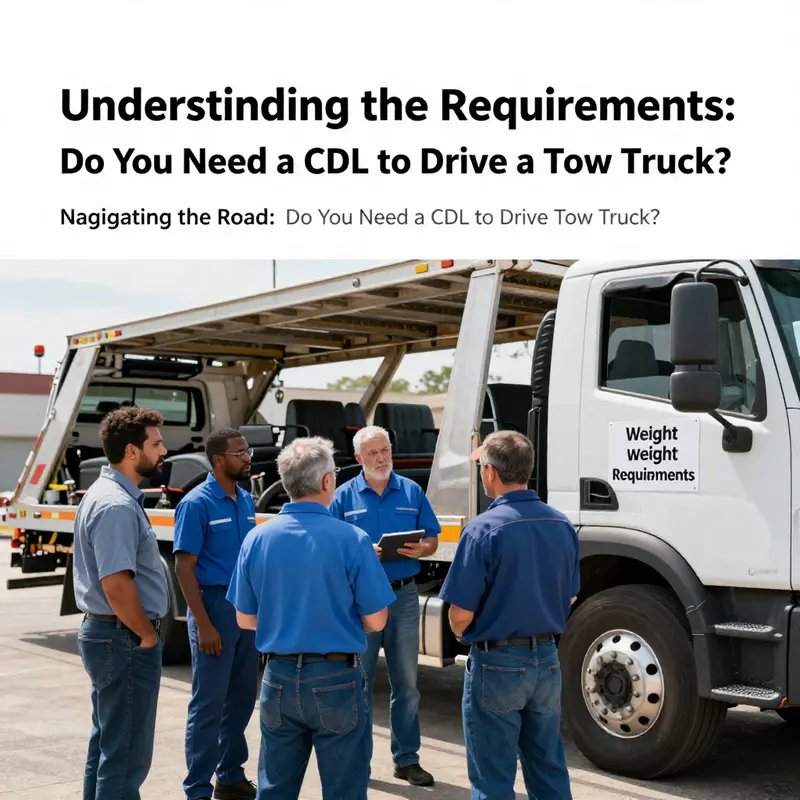
When a tow truck is called to clear a roadway incident, the operator faces more than the right tools and fuel efficiency. Behind every beacon glow and wheel lift there is a precise legal framework that determines whether the driver needs a Commercial Driver’s License (CDL). The question do you need a CDL to drive a tow truck is not answered by a single line of code or a quick rule of thumb. It hinges on weight, configuration, and how the vehicle will be used on public roads. In the United States, the core principle is straightforward: if the tow truck, or the combination of the tow truck and any trailer it might pull, pushes past a defined weight threshold—typically 26,001 pounds gross vehicle weight rating (GVWR) or higher—the operator should hold at least a CDL. Yet the reality is more nuanced. The threshold can be expressed in terms of GVWR or GCWR (gross combined weight rating), and the exact enforcement varies by state as DMVs translate federal guidance into local licensing rules. This layered structure is not an exercise in bureaucratic pedantry; it is a safety framework designed to ensure drivers possess the skill and judgment required to manage heavy, complex vehicles on busy highways, under variable weather, at night, and in tight recovery scenarios. Those realities are why many heavy-duty wreckers and highway recovery units fall squarely under CDL requirements, while lighter, municipal, or non-tow configurations may ride under a different set of rules. The FMCSA provides federal guidance that outlines vehicle classifications and endorsements, but the state’s DMV is the ultimate authority on what a driver must hold to legally operate in a given jurisdiction. The practical implication for anyone considering a tow-truck career is simple in intent but rich in detail: start with the vehicle’s ratings, then map those ratings to the required license class and any endorsements, and finally verify this map against the rules in every state where you plan to operate. A careful approach to licensing reduces the risk of penalties, ensures regulatory compliance, and supports safer operations across the entire fleet. The weight-based threshold matters not only for the license decision but also for how training is framed. Heavier units impose greater braking demands, longer stopping distances, and more complex handling, all of which must be reflected in the driver’s education and ongoing skill maintenance. In practice, this means CDL-qualified drivers often receive additional training on braking dynamics, load handling, securement practices, wheel lift operations, and the particular challenges of highway towing. A driver who understands inertia, momentum, and the physics of a loaded vehicle can anticipate issues before they arise, making the difference between a mission-critical recovery and a preventable accident. The connection between licensing and safety becomes especially evident on routes that demand high-speed maneuvering or rapid incident response. A CDL driver brings with them a tested baseline for vehicle control, including awareness of stopping distances with the heavier mass at play, the ability to coordinate with other responders, and the discipline to adhere to procedures that limit risk to bystanders and other motorists. For operators who plan to work across multiple states, the complexity increases. State rules can diverge on what counts as a “class” of license, what endorsements map to particular configurations, and how exceptions apply to special equipment. In one state, a heavy wrecker may require a Class B CDL with a Tow Truck endorsement; in another, a Class A CDL with the same endorsement could apply when a large trailer is involved. It is not unusual for a single company fleet to maintain multiple license configurations to meet the needs of different job profiles, as long as the drivers hold the correct endorsements for the trucks they operate on the roads. This state-to-state variability underscores the importance of proactive licensing audits within fleets. Fleet managers and owner-operators should build a licensing roadmap that reflects the actual equipment deployed, the typical routes, and the usual tow loads. The roadmap should be revisited whenever the fleet acquires a new vehicle with different ratings or when the company expands into a new service area where different state rules apply. The most reliable source of truth on these questions remains a combination of federal guidance and state regulations. The FMCSA’s official materials outline the core categories and the endorsements that commonly accompany tow operations, while the state DMV provides the exact licensing requirements for each jurisdiction—and this can evolve with regulatory updates, safety studies, and policy changes that respond to new vehicle designs and towing practices. For those who want a practical baseline, the federal framework sets a clear expectation: equipment that exceeds certain weight thresholds typically requires a CDL, and specialized towing tasks often require endorsements that validate the driver’s competence to perform those tasks safely. It is this alignment of license, truck, and task that forms the backbone of compliant, professional tow service. Within fleets, the conversation about licensing also touches on the broader world of emergency response and fleet resilience. In times of crisis, a well-credentialed driver can be a critical asset, able to maneuver through congested corridors, coordinate with responders, and recover vehicles that are obstructing essential routes. That is not speculation but a lived reality for many operators whose duties extend beyond simple roadside assistance. When a truck is part of a larger emergency response system, the license becomes a bridge between regulatory compliance and operational readiness. A driver’s ability to perform under pressure, communicate clearly with other agencies, and execute complex maneuvers with heavy payloads is closely linked to the depth and recency of training. The licensing framework, then, supports a professional practice that extends into emergency preparedness and response strategies. It helps ensure that the people who answer the call to aid a stranded motorist or clear a crash scene have the knowledge and the authority to act swiftly and safely. For fleet managers who want to connect licensing decisions with broader safety goals, there is value in aligning driver development with emergency response planning. This is where a link to practical resources becomes meaningful. For example, fleets can consult internal materials that discuss emergency readiness and how licensing choices influence response capabilities. A practical anchor for this discussion can be found in a resource that focuses on essential fleet emergency response strategies. The linked guide, essential fleet emergency response strategies, provides a real-world perspective on how licensing, training, and operational readiness intersect in time-critical scenarios. This internal reference emphasizes that licensing is not an isolated requirement but a foundational element of a broader approach to safety, preparedness, and reliability. At the same time, operators should consult the FMCSA for authoritative guidance on licensing. The FMCSA’s portal offers the federal baseline for CDL classes and endorsements, clarifying general expectations across the country. It is important to remember that while the FMCSA provides the umbrella framework, the actual licensing details—such as which class applies and which endorsements are needed—are determined by each state’s DMV. If a driver plans to operate in multiple states or anticipates expanding into new service areas, it becomes even more critical to verify, before purchases or enrollments, that the intended license aligns with the laws in all those jurisdictions. This diligence mitigates downstream headaches, such as being unable to operate a newly acquired wrecker on a given route or facing delays in obtaining required endorsements during peak demand periods. The interplay between GVWR, GCWR, vehicle configuration, and end-use also invites drivers to think about safety and service quality in a holistic way. A heavy tow truck is not just a vehicle with more horsepower or a bigger wheelbase; it is a tool that changes the dynamics of a recovery, the spacing required around the scene, and the strategies employed to secure loads. The heavier the vehicle and the more complex the operation, the more critical it becomes to have a driver who has not only passed the right tests but has internalized the safety and procedural discipline that those licenses imply. This is why ongoing training matters as much as initial licensing. A well-designed program should combine classroom instruction with street-level practice, including controlled exercises on load securement, wheel lifts, and hitching procedures under varied conditions. It should also incorporate periodic refreshers and scenario-based drills that reflect real-world incidents, from minor towing in tight urban streets to multi-vehicle recoveries on congested interstate ramps. In practice, the best way to avoid ambiguity about what license is needed is to take a proactive approach: build a licensing plan around the actual fleet and routes, verify the requirements with the state DMV, and document the endorsements tied to each vehicle. This approach reduces the risk of regulatory missteps and demonstrates a commitment to safety and compliance that can be especially important in today’s liability-aware environment. The bottom line remains clear: if a tow truck, in combination with any trailer, or the configuration of the vehicle itself, reaches 26,001 pounds GCWR or GVWR, the operator should hold a CDL. If the job involves transporting hazardous materials, carrying passengers, or towing a load that exceeds roughly 10,000 pounds in many jurisdictions, expect additional endorsements. Because state variations exist, the only reliable method is to verify the requirements in the state where the vehicle will operate, and to anticipate possible differences when crossing borders or managing a diverse fleet. The practical impact of these rules is not only about compliance but about building a safer, more capable, and more dependable towing operation that serves the public well under ordinary and extraordinary circumstances alike. For readers who want to anchor their next steps in credible sources, formal references should be consulted: the FMCSA’s official site for federal guidance and the state DMV for local implementation, plus internal best-practice resources that help translate licensing into safer, more efficient field work. In conclusion, the licensing landscape for tow-truck operation is best navigated through a structured, variant-aware approach. Start with the vehicle’s GVWR and GCWR, consider whether end-use requires endorsements such as a Tow Truck designation, and then verify the exact licensing requirements with the state DMV. Add an emphasis on ongoing training and safety culture, and you have a robust framework that supports reliable service, regulatory compliance, and public safety. For those who manage fleets, tie the licensing decision to broader emergency readiness and service capabilities. The result is a workforce that can respond swiftly, safely, and professionally to roadside incidents wherever the job may take them. To stay informed and aligned with evolving standards, consult the FMCSA for federal guidance and your state DMV for local rules, and remember that licensing is a foundation that supports a broader commitment to safety, capability, and dependable roadside service. For further reading on emergency readiness and fleet strategies, you can reference the internal resource linked above, and for external regulatory guidance, the federal CDL framework and endorsements are accessible at https://www.fmcsa.dot.gov.
Steering by the Letter of the Law: Regulations and Safety in Tow-Truck CDL Operations
Steering by the Letter of the Law: Regulations and Safety in Tow-Truck CDL Operations
State Lines and Tow Lines: Navigating CDL Requirements Across America
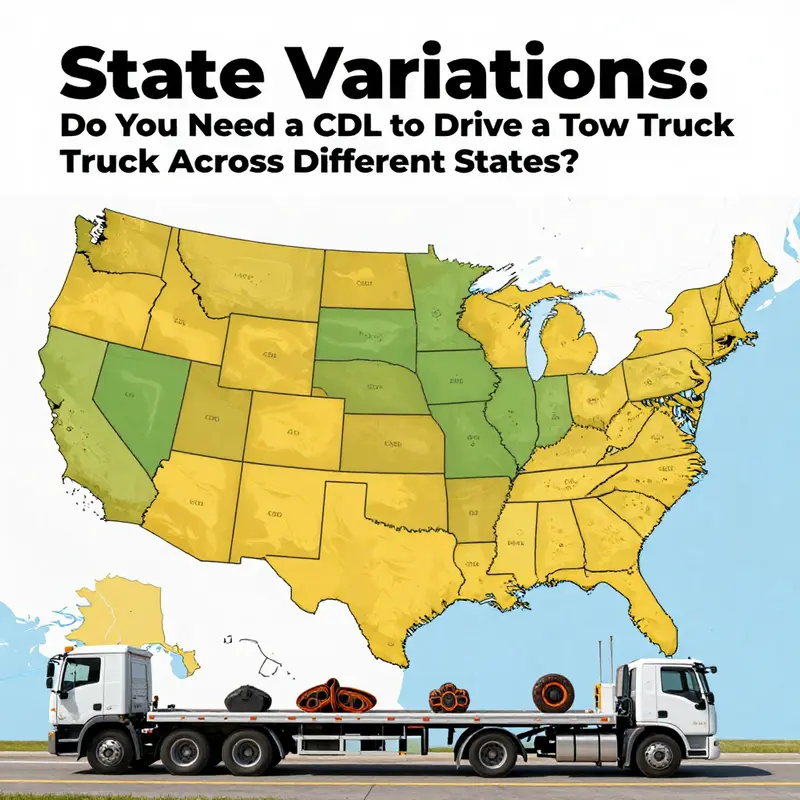
When people ask whether a CDL is required to drive a tow truck, the honest answer is that it depends. Across the United States, the rules are not uniform, and they hinge on weight, vehicle configuration, and how the vehicle is used. The core test is straightforward in theory: if the vehicle and any trailer it pulls push beyond a weight threshold, a Commercial Driver’s License is required. In practice, the threshold commonly cited is a gross combination weight rating (GCWR) of 26,001 pounds or more. This number acts as a dividing line between standard operator licensing and the more stringent CDL regime. Yet the story does not end there. The exact class of CDL, any endorsements, and even exceptions can diverge from one state to the next, and those differences matter for everyday work on the road, in repair yards, and during on-call emergency recoveries. As a result, the practical path to compliance begins with a careful assessment of the specific tow rig in question, including both the truck and any trailer involved, and then shifts to a check of the state you operate in or plan to operate in. It is a topic where the person behind the wheel must assume a proactive stance, because state regulations can and do change, and the penalties for noncompliance can be severe, including fines, license suspensions, and disruptions to an entire fleet’s ability to respond when people are stranded on the side of the road or in the middle of a city street during a crisis.
The weight-based framework is easy to describe, and it is also practical in day-to-day fleet planning. If a tow truck is engineered so that its GVWR, when loaded, pushes the vehicle’s own weight past certain thresholds, many states require a CDL. When a trailer is attached, the relevant metric becomes the GCWR, which combines the weight of the tow vehicle and the trailer together. If that combined rating reaches or exceeds 26,001 pounds, a CDL is generally in order. The implication is that heavy-duty wreckers used for highway recovery, or those designed to haul large disabled vehicles, almost always fall squarely into the CDL category. Operators of such trucks may find themselves dealing with Class A CDL requirements when the vehicle configuration is complex, and with Class B in simpler, straight-cut setups. The exact endorsement is tied not only to the weight but also to what the vehicle may be allowed to haul or to whom it may transport. In states with stricter line items, even a tow truck below the weight threshold but used to transport goods or people can trigger additional licensing considerations. If the vehicle is used to move hazardous materials or to carry passengers, the licensing requirements become more stringent, sometimes slipping into the realm of mandatory CDL operation regardless of the weight of the vehicle alone. This layered reality means that for many operators, the best route is to map out the licensing implications early in the procurement or deployment process, before a single mile is logged under the wheel of a new tow truck.
Weight is only one piece of the puzzle. The configuration of the tow truck matters just as much. A simple light-duty wrecker that tows a wrecked car from a shopping center to a repair shop might be treated differently by the licensing authorities than a heavy-duty rotator or a multi-vehicle carrier designed to recover semis on a highway. When a trailer is involved, the assessment becomes even more nuanced. If the combination of vehicle and trailer exceeds the state’s weight thresholds, the operator typically must hold a CDL of the appropriate class. In many places, Class B is associated with a single heavy vehicle or a vehicle with a heavy trailer, while Class A covers a combination of vehicles with a higher GCWR. It is common for heavy-duty tow trucks, especially those that operate on interstates or in large metropolitan areas, to require Class A CDL credentials. But the specifics can shift with state lines, and a tow truck that is marginally over a threshold in one state may be treated differently in a neighboring state where the same truck is used in a different context.
There are notable state-by-state contrasts that illuminate why the generalized rule needs local verification. California, with its large market and unique regulatory landscape, provides one of the clearer examples of a flexible framework. In California, non-commercial tow truck operators may be able to drive under a regular driver’s license if the vehicle is used exclusively for towing and not for transporting cargo. This non-commercial exception is conditioned on careful adherence to defined criteria, and it does not grant immunity from other regulatory requirements. The state emphasizes that the non-commercial allowance applies only when the operation stays within the strict confines of towing and is not involved with goods transport. In practice, this means a tow company that relies on non-commercial towing activities, such as helping stranded drivers or assisting with minor roadside recoveries, may operate without a CDL so long as the operation remains narrowly defined and compliant with California’s rules. This carve-out, however, is not universal, and it is a reminder that state regulatory palettes can include exceptions that reflect local needs and traffic realities.
In contrast, other states take a more conservative stance that leaves less room for interpretation. Texas and New York are frequently cited as examples where the CDL requirements are more pressing, with weight thresholds and vehicle configurations that drive CDL necessity even for non-commercial operations if the vehicle crosses the critical weight boundary. In these jurisdictions, a tow truck that exceeds the 26,000-pound GVWR or GCWR threshold is commonly bound to hold a Class A or Class B CDL, depending on how the trailer is configured and what is being towed. The practical upshot is that a tow operator working across multiple states must be prepared for this patchwork of rules. A driver who is licensed under one state’s framework might find themselves needing to adjust licensing or secure additional endorsements when moving into another state with stricter requirements. This is not just a theoretical possibility; it is a reality that many fleets navigate as they plan coverage, dispatch routes, and training budgets.
The guidance from regulatory authorities consistently emphasizes due diligence. The best practice for anyone operating a tow truck is to determine the exact weight of the rig as designed, and then confirm how that weight is calculated in their state’s regulatory framework. This involves looking up the GVWR of the tow vehicle, the GVWR or gross vehicle weight of any attached trailer, and the GCWR if available. With those numbers in hand, the next step is to consult the state’s Department of Motor Vehicles or its equivalent, and to review the official tow-truck or commercial vehicle regulations for the relevant class of license and any endorsements or restrictions. In many states, the DMV’s website or customer service lines provide the authoritative criteria for licensing, including whether a vehicle qualifies for a CDL, what class of CDL is required, and what additional endorsements might be necessary for specialized operations such as heavy-duty towing, multi-vehicle recovery, or operations that involve passenger transport or hazardous materials. The rule of thumb is clear: do not rely on word of mouth or second-hand summaries. Regulatory language changes, and a single updated page on a DMV site can alter what counts as a CDL-worthy operation.
The practical consequences of these rules ripple through every aspect of towing work. Fleet owners must account for licensing costs, employee training, and ongoing medical and knowledge testing if a CDL is required. The decision to outfit a fleet with heavy-duty wreckers or rotators is no longer just about engineering and equipment. It is also about ensuring the people who operate that equipment are properly credentialed and backed by the right endorsements and medical clearances. Operators who do not meet the state’s licensing requirements risk penalties and may be barred from legally operating until compliance is achieved. The financial and operational implications can extend to insurance costs, the ability to bid on municipal contracts, and the capacity to respond to large-scale incidents that require certified CDL operators. In short, licensing is not merely a bureaucratic checkbox; it is a practical foundation for safe, lawful, and reliable tow operations.
Within this framework, one often-overlooked dimension is how the licensing landscape intersects with daily dispatch decisions and fleet composition. For example, a small-town tow company with a compact fleet may find that most operations fall under the non-CDL or lighter CDL category, particularly when the trucks and trailers stay within California’s narrow definitions. A regional operator that routinely handles intercity or highway recoveries, or that serves a multi-state corridor, will encounter a different calculus. In such cases, the dispatcher must be aware of each vehicle’s licensing status and the legal allowances that apply to on-road actions and dispatch destinations. The human factor cannot be ignored. A driver who lacks the proper CDL may not only face legal exposure but also risk personal safety and public safety if they attempt tasks that exceed their training and licensing scope. This is why many operators adopt conservative policy: if there is any doubt about whether a given job falls under CDL requirements, they escalate to a licensed driver with the appropriate endorsement, or they re-route the job to a properly licensed teammate. The result is a safer, more compliant operation that reduces the likelihood of inspections, penalties, and red flags on audits.
The landscape also invites a practical question about how to stay compliant while avoiding unnecessary licensing burdens. This is where the nuance of state exceptions and the realities of vehicle configuration intersect with business strategy. A tow company might decide to limit certain high-weight operations to locations where a CDL is clearly mandatory, or they might adjust the fleet mix to ensure the majority of daily recoveries can be performed with drivers who hold the appropriate license without placing the organization at risk during inter-state tasks. In some cases, operators restructure how they bill for services or how they document the work performed to reflect the licensing posture of the driver. The overarching objective is not to trap operators in a maze of rules, but to align licensing, training, and vehicle configurations with the actual work performed, so that drivers can respond quickly and legally when customers need help most. This alignment becomes especially important for fleets that operate in regions with high traffic, complex road networks, and a diverse mix of on-call scenarios that demand rapid response with maximized safety and compliance.
For readers who want to connect the regulatory dots to practical, real-world guidance, there are multiple sources of information that can illuminate the path. In addition to state DMV pages, industry forums and operator manuals can offer insights into how peers interpret and apply the rules in everyday situations. It can be helpful to review case studies or fleet profiles from operators who work across state lines, to understand how licensing decisions shape dispatch patterns, training budgets, and maintenance planning. For those who are curious about how these issues play out in broader contexts, there is value in tapping into general tow industry perspectives and best practices through reputable industry blogs and resources. In that spirit, for broader context on tow truck operations and fleet readiness, consider exploring the Island Tow Truck blog. This resource offers a sense of how a mid-sized operation structures its licensing and training in relation to day-to-day responding and maintenance cycles. You can learn more at the Island Tow Truck blog. the Island Tow Truck blog.
Ultimately, the central takeaway is clear. Yes, you typically need a CDL to drive a tow truck when the vehicle setup exceeds the weight thresholds defined by state law or when the operation involves certain uses such as transporting passengers or hazardous materials. Yet the exact requirements are not uniform across the country. Different states apply the rules with varying degrees of flexibility, and exceptions exist that reflect local conditions and the realities of traffic and safety. What remains constant is the responsibility to verify each vehicle’s licensing needs before any assignment, to maintain an up-to-date understanding of local regulations, and to ensure that every operator on the road holds the appropriate license, endorsements, and medical clearances for the task at hand. The cost of this diligence is offset by the confidence it provides—confidence that a tow operation will be conducted legally, safely, and with the readiness to respond when people rely on a tow truck in moments of need. In the end, licensing is not a single checkbox. It is a living standard that guides how fleets are built, how drivers are trained, and how communities receive timely, lawful assistance during roadside emergencies.
For anyone who wants to verify the most current state-specific rules, the best route is to consult the official DMV page for the state in question and to reach out to local authorities if there is any ambiguity. Regulations evolve, and a yearly refresher can be essential for maintaining compliance across a diverse operating area. The knowledge you gain today can prevent penalties tomorrow, while also ensuring that the people who rely on tow services can count on safe, professional, and legally compliant help whenever and wherever they need it. This is the practical bedrock of a resilient tow operation—one that respects the weight of the law as surely as it respects the weight ratings of the machines you operate. External resources can provide additional clarity, such as California’s DMV Tow Truck Information guidance, which offers state-specific detail and official interpretations of how these rules apply in practice. External resource: https://dmv.ca.gov/portal/vehicle-and-driver-licensing/tow-trucks/.
Final thoughts
Understanding the CDL requirements for driving a tow truck is vital for compliance and safety in your operations. Whether you’re an auto repair shop, a car dealership, or managing a fleet, being informed about the regulations protects not only your business but also the safety of your employees and customers. As regulations can differ from state to state, staying updated on these laws ensures that all operations run smoothly and legally on your island.