
One-ton trucks are the workhorses behind many critical operations across island communities. Whether you manage a commercial fleet, run a local auto repair shop, operate a resort, or oversee diverse properties, understanding exactly how much a one-ton truck can tow equips you to make smarter decisions for daily demands and heavy-duty hauling. While commonly known for their payload capabilities, their towing potential often exceeds those limits but varies widely by make, model, and configuration. This guide addresses towing capacity from every angle, kicking off with how towing limits shift depending on the truck’s brand and build. We then dig into how towing capacity ratings are defined and what they mean in real-world terms. Next, we’ll explore the critical factors that influence towing ability—from engine options to suspension upgrades. And finally, you’ll get a clear comparison between standard heavy-duty one-ton trucks and their lighter counterparts, enabling you to align your equipment choices with your island-specific hauling challenges. Being equipped with this knowledge helps optimize fleet efficiency, maintain vehicle safety, and safeguard both your investment and those you serve in island settings where reliability is non-negotiable.
Tow Truths: How Much a One-Ton Truck Can Really Tow Across Configurations
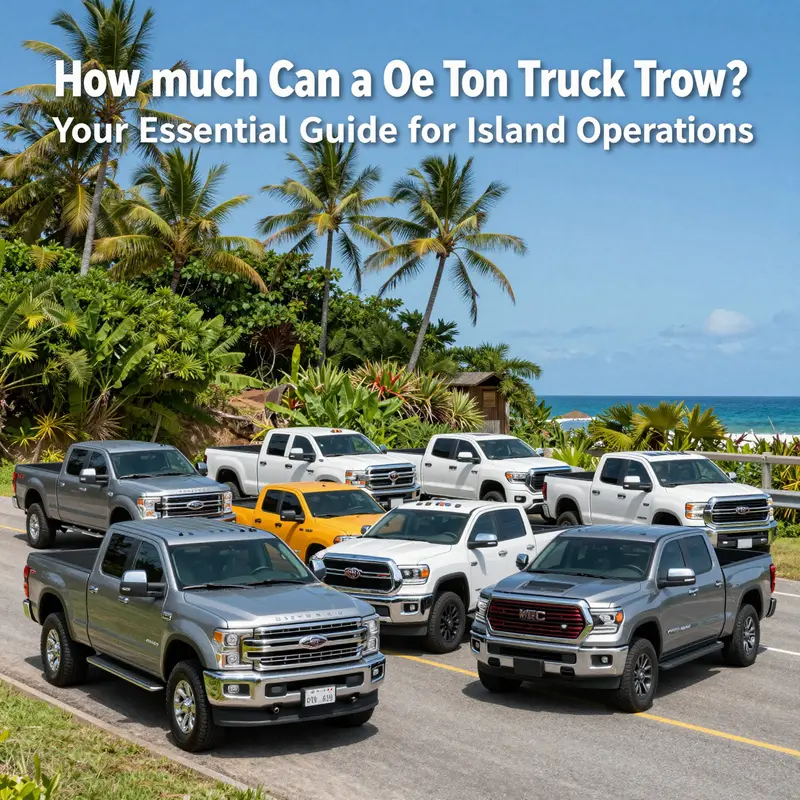
The phrase “one-ton” suggests a hard limit, a simple yardstick for what a truck can carry or pull. Yet when you translate payload class into towing capacity, the number you see in a spec sheet becomes only part of the story. Towing capacity is not a single, universal figure. It hinges on a carefully choreographed set of forces within the vehicle’s drivetrain, its suspension, and the trailer it is asked to haul. In practice, a one-ton pickup’s ability to tow is a dynamic balance among engine torque, transmission behavior, axle gearing, and the additional loads we never quite anticipate when we first glance at a maximum tow rating. The result is a spectrum rather than a single line: while the label might imply one thing, the real pulling power depends on how the vehicle is equipped and how the trailer is prepared for the journey ahead.
To understand why, it helps to separate two related ideas that are often confused: payload capacity and towing capacity. The payload rating tells you how much weight the truck can hold inside its cabin and bed, including passengers, cargo, and any installed gear. Towing capacity, by contrast, is the maximum weight the truck can pull behind it, through the hitch, with all the weight-transfer dynamics that entails. Those two numbers live in the same family, but they are not identical siblings. A heavy payload in the bed or passengers in the cab reduces the available margin for towing because it consumes part of the vehicle’s overall weight capacity. And there’s a third piece of the puzzle that many owners overlook: the gross combined weight rating, or GCWR. This figure caps the total weight of the tow vehicle and the trailer together. Stay within the GCWR, and the vehicle’s brakes, frame, suspension, and steering are working within a design envelope. Exceed it, and even the most capable truck loses stability and braking authority. The result is a simple, practical rule: don’t treat the towing number as a standalone target. Regard it as the ceiling you reach only after you have accounted for the payload you must carry and the weight your trailer brings along.
In the modern market, the typical heavy-duty pickup aimed at serious towing resides in a broad band. A conventional, well-equipped one-ton configuration can offer towing ratings that generally fall in the range of roughly fourteen thousand pounds up to twenty thousand pounds and beyond. With the right combination of engine output, transmission behavior, and rear-end gearing, capacities can push into the low twenty-thousands. In some configurations—particularly those that pair a robust, turbocharged diesel-like option with an enhanced towing package and a strong axle ratio—the ceiling can edge toward or past twenty-three thousand pounds. These figures reflect the best possible outcomes offered by factory configurations that optimize traction, braking, cooling, and stability for heavy trailers. They are not universal across all trucks in the same class, but they establish a credible ceiling for the kind of work one-ton pickups are engineered to perform when they are properly equipped.
The character of that ceiling depends on a few critical variables. The engine or powertrain architecture matters, of course, but it is not the whole story. A capable engine must be paired with a matching transmission that can hold lower gears long enough to deliver torque at the wheels during acceleration from a dead stop or when climbing a grade. A rugged, well-matched axle ratio can make the difference between a confident pull and a sluggish one, particularly when lugging a heavy trailer up a hill where torque conversion and gear multiplication matter. The presence of a factory towing package also matters. These packages typically bundle a higher-capacity cooling system, upgraded brakes, an integrated trailer brake controller, sway control features, and hitch anchors designed to distribute tongue weight more effectively. In practice, the same base chassis with and without a towing package will show a noticeable disparity in usable towing capacity. The message is simple: if your plan is to move genuinely heavy trailers, the right package is not optional; it is essential.
To give shape to these ideas without naming specific models, imagine two general configurations. One is a heavy-duty pickup equipped for diesel-like torque, a towing-focused transmission, and a reinforced suspension. The other is a similar chassis with standard gasoline power and a more modest gearing setup. Both sit in the same class by payload, yet their maximum tow figures diverge because of the deeper engineering choices behind the ride. In the diesel-oriented setup, you tend to see higher tow numbers because of the broad torque curve and more robust low-end acceleration. The gasoline setup can still pull substantial loads, but it typically does so with a smaller weight margin before the engine runs out of breath or the brakes begin to overheat on a long incline. This contrast is not about one being “better” than the other; it is about how the intended job shapes the configuration. A fleet that routinely hauls large trailers to remote sites will gravitate toward the diesel pathway and the associated heavy-duty gearing, even if the truck is formally categorized as a one-ton.
The performance you experience on the road also hinges on how you plan the load. Tongue weight—how much of the trailer’s weight sits on the hitch—needs to be managed with care. For many trailers, tongue weight sits in the range of about ten to fifteen percent of the trailer’s gross weight. Pushing tongue weight too high or too low alters steering response, braking stability, and suspension behavior. A trailer that is too light relative to the hitch can wag under crosswinds or during abrupt maneuvers; a trailer that is too heavy for the hitch can push the tail of the truck, reduce steering precision, and strain the powertrain and brakes beyond their intended design. The towing rating typically assumes a properly matched trailer with an appropriate hitch, stabilized through the vehicle’s towing aids. This is why the recommendation remains steadfast: always verify the exact numbers for your year and configuration, and never exceed them, even if the trailer looks modest at first glance.
Beyond the numbers, there is a practical dimension to consider. A one-ton truck is built for heavy tasks, but its ability to pull is not unlimited. If you are packing the bed with heavy tools, spare parts, or passengers, you are eating into the payload margin, which in turn reduces the allowable trailer weight you can haul safely. If you are towing over long grades, you are taxing cooling systems and brakes, increasing the likelihood of heat-related performance, especially in hot weather or during repeated hill climbs. In short, the real-world towing experience comes down to careful matching of the truck’s configuration, the trailer’s weight, the load distribution, and the seasonal and terrain conditions under which you operate.
For those who want to connect this understanding to practical decision-making, a useful compass is the official specification sheet for the exact year and configuration you are considering. It is tempting to treat maximum tow rating as a goal, but the prudent approach is to view it as a ceiling that becomes reachable only when the engine, transmission, gearing, and towing equipment align with the trailer’s weight and distribution. When you plan a heavy tow, calculate not only the trailer’s unloaded weight but also its loaded mass, including gear and cargo, and cross-check with the GCWR for the combination you intend to tow. If you are approaching the upper end of the rating, you should also scrutinize the braking capacity and the trailer’s own braking system, as well as the tongue weight, to ensure safe control during braking, cornering, and lane changes.
For readers curious about the broader picture—how fleets think about heavy towing in real-world operations—there is a resource that discusses emergency readiness and the way fleets deploy heavy-duty pickups and trailers in critical scenarios. It offers context on how these vehicles perform under stress and how proper planning influences outcomes. essential fleet emergency response strategies
When you step back, the central point becomes clear. A one-ton truck’s towing capability is a product of its configuration. The label points to a ceiling, not a guarantee, and the actual pull you can rely on depends on the chosen engine and transmission pairing, the rear-end gearing, the presence of a factory tow package, and the trailer’s weight and balance. The higher the configuration is tuned for maximum tow, the more you must respect not just the weight on the hitch but the weight in the bed and cab, the trailer’s own weight distribution, and the downhill and uphill forces that come with the road you travel. In practice, a one-ton pickup can deliver exceptional towing performance—often in the range of fourteen to twenty thousand pounds with the standard setup and up to the mid-twenties for specialized, well-minned configurations—yet those figures remain bound to the precise build and the careful preparation behind every journey. This is the essence of why the maximum tow figure is a guide for planning and safety, not a casual target for the impatient operator. A well-informed buyer, a careful driver, and a properly equipped vehicle together create the conditions under which the one-ton designation truly translates into reliable, controlled pulling power.
External reference: Official towing specifications
null
null
Tow Weight, Torque, and the Real Answer: Unlocking How Much a One-Ton Truck Can Tow
When people ask how much a one-ton truck can tow, the first impulse is to quote a single number. In practice, the answer unfolds like a careful balance sheet, with weight, power, and purpose all playing their parts. The term “one ton” is most often a nod to payload capacity—the amount the truck can carry in its bed and cab. Towing capacity, however, is a separate metric. It reflects how much weight the truck can safely pull behind it, and it can vary widely from one build to the next. In the current landscape, most heavy-duty one-ton pickups sit in a broad band: roughly 15,000 to 20,000 pounds of trailer tow capacity, with certain configurations capable of exceeding 20,000 pounds under favorable conditions. The numbers aren’t arbitrary; they emerge from the interaction of engine, transmission, drivetrain, gearing, suspension, and the chassis layout chosen by the manufacturer. To fully understand why one ton trucks tow as they do, it helps to trace the different moving parts that set a practical limit to what can be pulled behind the vehicle without compromising safety, stability, or durability. For readers who want a broader perspective on how fleets leverage these capabilities in real-world operations, the industry’s practical chatter often centers on how a truck’s towing figure translates into daily tasks, schedules, and risk management. You can explore practical insights from industry sources at the The Island Tow Truck blog, which dives into fleet-oriented uses and planning considerations. To read more, visit this internal resource: The Island Tow Truck blog.
The most important distinction to keep in mind is that the “one-ton” label is not a universal towing cap. It is a label tied to payload—how much cargo the chassis and bed can carry. Towing capacity is about the trailer’s gross weight and how the truck’s drivetrain can handle it. And that distinction matters when you’re sizing a trailer, planning trips, or calculating required braking, steering response, and acceleration. A truck that is loaded heavily in the rear or that carries a tall, wide, or long trailer will behave differently from a lighter, compact setup. The key takeaway is clarity: do not conflate payload with tow capacity. They are related but governed by different sets of constraints.
From the manufacturer’s side, the numbers you see are the product of a precise engineering calculus. A heavy-duty one-ton pickup can deliver substantial towing performance, but the upper bounds emerge only when several factors align: there is strong torque, a robust transmission, a suitable rear-end gear, and a drivetrain configuration that supports heavy pulling loads. Diesel engines, with their characteristic high low-end torque, are frequently favored for towing because torque is the true workhorse behind a heavy trailer. Gas engines, while capable, often need different gearing and cooling to sustain similar performance under long pulls. The drivetrain layout—whether two-wheel drive or four-wheel drive—also plays a critical role. A 4WD system adds weight and friction but improves stability and traction in challenging conditions, which can indirectly influence practical towing limits.
Consider the transmission as the vehicle’s nervous system under load. A transmission designed for heavy towing is built to manage sustained heat, torque, and the fluctuating demands of moving a heavy trailer through grades, wind, and road irregularities. A rugged, purpose-built unit helps prevent overheating and maintains predictable shift points when the trailer’s weight shifts as the vehicle traverses hills or makes abrupt changes in speed. This is not merely about getting up to speed; it’s about keeping the drivetrain within safe operating temperatures and preserving the life of components that bear the brunt of heavy towing.
Axle ratio is another subtle but potent lever. A higher numerical ratio—such as 4.10 or 4.56—shifts the engine’s power curve toward higher torque at lower speeds. That matters when launching a loaded trailer from a stop or climbing a grade. In practice, drivers may notice quicker engine response at the cost of higher engine RPM in cruising. The right balance depends on the trailer’s weight, the terrain, and the driver’s need for speed versus pulling power. When you mix in the model year and the chassis configuration, the same general axle ratio can interact differently with a particular engine and transmission, producing a different usable tow rating.
Suspension and chassis stiffness complete the picture. Heavy-duty suspensions are engineered to keep the truck stable with a heavy payload and a trailing load. They resist sag, control sway, and preserve steering precision as the trailer’s weight makes its presence felt on the rear axle. The chassis itself—the frame rails, mounts, and crossmembers—must handle the additional bending and torsion that come with a large trailer. The result is a vehicle that can tow more robustly, with a more predictable handling profile, but only when the rest of the system is tuned to support those loads.
Truck configuration matters in a way that is easy to overlook. The cab style, bed length, and whether the chassis rides as a single-rear-wheel or a dual-rear-wheel setup create meaningful deltas in tow capacity. DRW configurations can provide greater stability and higher max trailer weight ratings, but they also add unsprung mass and complexity. Regular SRW layouts may excel in daily usability and maneuverability, especially in urban or tighter-lot applications, yet their tow ratings can differ significantly from their DRW counterparts. The vehicle’s Gross Combined Vehicle Weight Rating (GCVWR) ties all of this together. GCVWR is the maximum permissible sum of the vehicle’s weight, its cargo, its occupants, and the weight of the trailer. Towing capacity is effectively the amount of weight you can subtract from that total after accounting for the truck’s own curb weight and payload. In other words, if you know your GCVWR, your curb weight, and your payload, you can estimate how much trailer weight remains for towing. This calculation may not be published as a neat number in every brochure, but it is the underlying logic that manufacturers use to ensure you stay within safe limits on the road.
If you are planning to tow heavy loads, the most prudent rule is to consult the official specifications for the precise model and configuration you are considering. The exact combination of engine, transmission, axle ratio, and suspension package matters. A single configuration tweak can push the towing limit up or down by thousands of pounds. In practice, the published figure is the ceiling. Real-world towing also depends on trailer brakes, tongue weight, load distribution, and actual road conditions. A trailer that isn’t braked or that distributes weight poorly can feel lighter than its label suggests, while a well-balanced, properly braked setup can behave much closer to the rated capacity. This nuance makes the difference between a planned trip that runs smoothly and one that trips up every safety valve along the way.
For readers who want to translate these principles into practical planning, the approach is to match the tow rating to the task, then verify every piece of a potential load. Start with the trailer’s gross weight, then subtract the truck’s curb weight and payload to arrive at a theoretical towing number. Add a margin for partial loads, passengers, and fuel. Finally, ensure the trailer and vehicle together remain within the GCVWR by checking the manufacturer’s spec sheet. This careful accounting guards against overloading the drivetrain, reduces wear, and preserves handling characteristics under dynamic conditions like braking and cornering.
Beyond the numbers, real-world towing is a discipline of ongoing assessment. The road remains the ultimate test, not the brochure. It is wise to start with conservative loads on familiar routes, observe how the truck behaves on grades, and monitor engine temperature, transmission heat, and braking performance. For fleets, the discipline scales: a well-documented approach to towing includes load monitoring, periodic maintenance on the drivetrain, and a clear protocol for when to downgrade or upgrade equipment based on task changes. In this context, the identity of a one-ton pickup becomes a matter of reliability as much as capability. The goal is to align capability with duty, ensuring that every assignment is completed safely and efficiently, without compromising long-term durability.
In sum, the towing capacity of a one-ton truck is substantial yet nuanced. It sits in a range shaped by engine torque, transmission resilience, axle gearing, and chassis tolerance, then refined by the specifics of the configuration. The same class of vehicle can deliver very different performance depending on whether it is a heavier DRW layout, a diesel-powered powertrain, or a particular gear ratio chosen to meet a targeted set of tasks. The practical takeaway is that anyone shopping in this segment should examine the full spec sheet, rather than fixating on a single number. A thoughtful comparison—one that weighs engine torque against trailer weight, considers the role of gearing, and accounts for how the trailer will be used—will lead to a selection that reliably meets daily needs.
For readers who want a quick reference and an accessible starting point, consider exploring practical fleet planning resources and case studies that discuss how one-ton pickups are deployed in real-world missions. These narratives often illuminate how a truck’s towing capacity translates into scheduling, route planning, and emergency response readiness, rather than simply presenting a theoretical maximum. If you’re curious about how these principles connect to broader fleet strategies, you can visit the internal resource linked above for further reading. And for a broader, industry-standard perspective on how these capacities are framed by manufacturers, an external reference offers a detailed look at published specs and typical ranges: https://www.ford.com/trucks/f-350/overview/.
In the end, the right answer about how much a one-ton truck can tow is a blended judgment. It relies on precise configuration and correct interpretation of the GCVWR formula, plus a practical sense for how the trailer will be used. The numbers matter, but so do the conditions under which those numbers are tested. With careful planning and a disciplined approach to matching task to capability, one-ton pickups remain exceptionally capable tools for moving heavy trailers, supporting demanding work, and contributing to the reliability of fleets that must perform when it matters most. For readers seeking a concise entry point into the practicalities of towing and the fleet implications, the internal link provided offers a helpful starting point for further exploration, while the external reference anchors the broader, standards-based context of these capabilities.
Tow Limits Revealed: Understanding How Much a True One-Ton Truck Can Tow, From Heavy-Duty Workhorses to Near-One-Ton Contenders
The phrase one-ton truck carries more myth than statute in the world of pickup trucks, yet it remains a practical shorthand for a very real class of vehicles designed to haul heavy loads and pull sizable trailers. The confusion often starts with payload talk—the bed and cab’s carrying capacity—while the towing capacity sits on a higher plane, sometimes peaking in ways that surprise casual buyers. The truth is more nuanced than a single number. Towing capability depends on a matrix of factors: the engine and its torque, the transmission and its gearing, the rear-end ratio, the suspension, the availability of factory towing packages, and even the specific cab and bed configuration. In the real world, a true one-ton pickup can tow well into the teens of thousands of pounds, but only under ideal conditions and with the right equipment. It can also sit at a much more modest level when constraints change, such as a lighter-duty variant that shares a name with its heavier siblings yet carries a different performance profile. The lesson for anyone evaluating how much a one-ton truck can tow is simple: you must read the exact specification for the precise model year and trim, and you should understand the surrounding factors that influence the rating in everyday use.\n\nIn the realm of heavy-duty towing, many 1-ton class trucks are built to command serious loads. When a chassis bristles with a robust diesel engine, a heavy-duty suspension tuned for stability, and an axle ratio designed to maximize torque at the wheels, peak towing figures can exceed twenty thousand pounds. In practical terms, this means a well-configured one-ton workhorse with the right towing package can approach or surpass 21,000 pounds when a gooseneck or fifth-wheel setup is used. The gooseneck option, as a method of hitching a trailer to the truck, leverages a concentrated pull from the trailer’s kingpin area, translating into a higher payload of towing capability. This is not a universal guarantee, of course—the precise number depends on the exact drivetrain, the cab configuration, and how the load is distributed. The manufacturers often caveat these figures as “peak” or “under ideal conditions,” acknowledging that real-world conditions, such as wind, grade, air temperature, altitude, and the need for safe operating margins, will lower the sustainable towing capacity. Still, the undeniable point stands: in the standard one-ton category, top-tier configurations routinely push toward or beyond 20,000 pounds with the right equipment and trailer type.\n\nBeyond the peak numbers lie the more practically realized figures for what many readers will encounter day to day. For a substantial portion of the market that identifies as “1-ton” or near-1-ton, the towing ceiling drops into the mid-teens or lower, with a more modest but still commendable range around 14,000 to 18,000 pounds in typical configurations. This distinction matters because the very identity of a “one-ton” name pack can be misleading if one assumes all such trucks tow the same. The reason is straightforward: the classification is tied to payload capacity—how much weight a truck can carry in its bed and cab—not a fixed towing ceiling. A truck can be built on the same broad platform as a true heavy-duty model but configured with lighter axles, a less aggressive suspension, and fewer towing optimizations. The result: a vehicle that wears the 1-ton badge in the marketplace but whose towing performance sits in a more conservative range. For those planning frequent heavy hauls or long-distance towing, these differences are not just academic. They shape the planning, the required trailer equipment, and, crucially, the driver’s approach to load management, braking, and fuel planning.\n\nA central thread in understanding these numbers is the relationship between power and control. Torque, not raw horsepower, is the key in towing. A diesel engine, especially in a heavy-duty setup, delivers high torque figures at low RPMs, making it easier to move a heavy trailer off the line and maintain speed on grades. But torque must work in concert with a transmission that can hold the right gear across varying loads and terrains, and with an axle ratio that ensures the engine operates in a range where torque is most effective. The rear-end gearing ties the trailer’s demand to the engine’s output, and a higher numerical ratio often translates to more pulling power, particularly at lower speeds, which is exactly when heavy trailers demand extra oomph. Add a gooseneck or fifth-wheel hitch into the mix, and the rating can climb further, because those hitch types distribute the load in a way that optimizes stability and control. Yet these high figures come with caveats: the trailer’s own weight, length, and tongue weight must be carefully managed, and the combined mass must stay within the truck’s gross combination weight rating. In other words, the star players—the engine, transmission, and rear-end—only reach their potential when the entire system is harmonized around safe, prescribed limits.\n\nOn the other end of the spectrum, there are vehicles marketed as “one-ton” that do not perform at the same heavy-duty level. In this class, some models emphasize efficiency, maneuverability, and lower operating costs over maximum interchangeability with the heaviest travel trailers and commercial loads. In practice, these lighter models can tow significantly less than their heavy-duty counterparts: commonly, they fall in the range of around 10,000 to 12,000 pounds under the right engine and package. It’s a reminder that the number printed on a window sticker or a spec sheet isn’t a universal license to haul beyond what the rest of the truck’s systems can manage safely. The difference is not merely academic: it defines the tasks you can tackle, the routes you can plan, and the confidence you can bring to a highway descent or a mountain-grade ascent with a heavy trailer in tow. These lighter models often bring other advantages—improved real-world fuel economy, tighter turning radiuses, and a more forgiving ride—at the expense of some towing headroom. For a family planning occasional recreational towing or a business that doesn’t require the heftiest hauls, these 1-ton equivalents are compelling, though they still demand respect and careful assessment of the trailer’s weight, hitch type, and the truck’s available powertrain options.\n\nTo make sense of all of this, a practical frame of reference helps. If you are evaluating a one-ton pickup for a specific use, you should balance three questions: What is the true maximum weight the trailer can legally and safely carry? What is the combined load the truck can pull, including the trailer, without crossing the vehicle’s gross combined weight rating? And how does the trailer’s dynamic weight change as you travel—consider winds, hills, and road conditions? The correct path is to consult the manufacturer’s official specifications for the exact model year and trim level and to factor in the available towing package as a critical option. The manual, the manufacturer’s official site, and the trailer’s own weight and distribution characteristics all play essential roles in determining a sane, safe maximum. This is not merely about finding a number to brag about; it’s about engineering a pairing that remains stable and controllable across the full range of operating scenarios, from a quiet morning haul to a windy cross-country journey.\n\nFor readers who want more practical context on towing in fleet and emergency scenarios, The Island Tow Truck blog offers broader coverage that helps translate the numbers into real-world decisions. You can explore related topics and case studies at that resource to see how professionals approach heavy towing in demanding environments. Such perspectives illuminate how the theoretical ratings translate into tasks, routes, and rescue or recovery operations that demand dependable performance even when conditions are far from ideal. This is not a substitute for the official numbers, but it is a useful companion that frames the problem in a way that is accessible to fleets and owners planning practical, day-to-day operations.\n\nAs you finalize a towing plan, keep in mind that the exact figures depend on the precise combination of drivetrain layout, engine choice, gearing, and hitching method. Where you drive, how far you go, and what you attach all matter. The most responsible path is to err on the side of caution, document the official towing specifications for your specific configuration, and verify the load with a licensed professional if your application is on the edge of the capability threshold. In the end, a true one-ton pickup’s towing capacity is not a single, universal ceiling but a spectrum shaped by the truck’s architecture, the trailer’s characteristics, and the conditions under which the truck operates. When respected, that spectrum empowers confident hauls, whether you are hauling construction gear, a heavy utility trailer, or a substantial recreational setup.\n\nFor a deeper dive into the official maximums associated with heavy-duty configurations and to compare the kinds of loads that are realistically within reach, refer to the external resource that documents the capacity guides used by manufacturers to communicate capabilities to buyers. External resource: https://www.ford.com/trucks/f-series/towing-capacity/
Final thoughts
The towing capacity of one-ton trucks is a crucial factor that directly impacts the efficiency and safety of island businesses and operations. From robust heavy-duty models that can haul over 20,000 pounds to lighter one-ton variants capable of dependable towing between 12,000 and 18,000 pounds, the options are diverse and must be chosen thoughtfully. Understanding how make and model affect towing capabilities, being familiar with the detailed towing capacity ratings, and recognizing the technical factors that influence these numbers will ensure you are well-prepared for your island’s unique transporting demands. For property managers, resort operators, commercial fleet owners, and local auto shops, this knowledge not only protects your investments but also enhances operational reliability in island environments where every load counts and resources can be limited. Equipped with these insights, your selection and maintenance of one-ton trucks will become an informed strategic asset in your day-to-day success.