
Towing practices in apartment complexes often raise questions about timing and regulations. Knowing when tow trucks typically operate and the reasons behind towing can assist property managers, auto repair shops, and commercial fleet operators in making informed decisions. This article will explore regular towing hours, the specific circumstances leading to towing events, local regulations, the role of property management, and how weekend or after-hours towing works – empowering readers with the knowledge needed to navigate these situations effectively.
The Unpredictable Clock: How Tow Trucks Reach Apartment Complexes and What It Means for Residents
Ask most apartment residents what time tow trucks arrive, and you’ll hear a scattershot mix of answers. The reality is that tow operators do not keep a universal schedule, and there is no single clock that governs every parking removal across every complex. Timing is a product of the moment: the violation that triggers action, the enforcement policy of the property, and the regulations that govern a given city or town. In many places, people assume that enforcement mostly happens during regular business hours when management offices are staffed and signs are easy to reference. Yet the exact minute a tow truck pulls away with a vehicle can be unpredictable, because the sequence starts with a problem, not a time. The practical takeaway for residents is simple: it is not enough to know when management is open; you need to understand the constellation of factors that can push a tow from intent to execution and how those factors play out in your own community.
Illegally parked vehicles and places that block essential access are the most common triggers that set the clock in motion. Fire lanes, emergency routes, private driveways, and spaces restricted to permit holders are frequent flashpoints. When a vehicle obstructs egress or blocks access for emergency responders, the responsibility to act lies with a property manager, and sometimes with law enforcement. The response is not purely mechanical; it involves verification, notice, and safety checks before the tow is permitted to proceed. In practice, this means a tow can appear during normal business hours, but it can also come after hours, especially if the violation is persistent or if a resident repeatedly ignores posted rules. Weekends, too, can present the same tension: demand for access does not pause simply because the calendar marks Saturday. The result is that residents may experience enforcement at times that feel irregular, yet the decision to tow sits at the intersection of safety, policy, and the enforcement posture of the locality.
The shape of these arrival times is further influenced by regulations at multiple levels. Some cities draw explicit lines around private-property towing, creating defined hours—often referred to as “tow windows”—that extend into the late afternoon and sometimes beyond. In other places, towing on private property is governed more by private contracts between the property manager and the licensed towing company, with hours that reflect staffing patterns rather than a public schedule. A few jurisdictions permit 24/7 towing, treating certain hazards as nonnegotiable no matter what hour it is. The implication for residents is clear: you cannot rely on a vague sense of routine. You must check the city ordinance or municipal code, then review the apartment’s posted rules and the terms of the tow company’s service. The cross-talk between official rules and property policies means the exact timing of a tow may differ not only from complex to complex but from one violation to the next.
Where times feel more open-ended is in rural or tightly managed private communities. In such settings, the absence of a formal enforcement window is often offset by a heightened emphasis on safety. If a vehicle blocks a shared driveway, creates a hazard in a fire lane, or appears abandoned, the tow may be called swiftly, even at unconventional hours. Conversely, some properties choose to sequence enforcement alongside cautionary notices, issuing warnings during the day and reserving late-hour removals for severe or repeat violations. In these environments, residents can still experience rapid removals, but the pace is driven by risk assessment rather than the clock on the wall. The fundamental principle remains: the clock is subordinate to the space’s operational needs. Access, safety, and the ability for residents and service providers to move freely ultimately govern when a tow happens, not merely when the office is open.
For residents, the practical steps start with reading the landscape around a parking area. Postings matter. Signs should spell out when enforcement is active, how long a driver has to move a vehicle, and what process governs retrieval or dispute. Lease provisions and parking rules are not decorative paperwork; they frame real-world outcomes. Rules regarding guest parking, temporary restrictions during renovations, and seasonal changes all influence when removals may occur. If a vehicle is towed, documentation becomes essential: what violation was observed, who authorized the tow, and when the notification occurred. Residents should avoid trying to move a towed vehicle en route to the tow, as this can cause damage or legal trouble for all involved. When in doubt, ask management to explain how local ordinances intersect with the complex’s policies, and what notices were provided before removal. The goal is clarity, not surprise, and that clarity is best built from a transparent, documented process.
From the management and enforcement side, the aim is to keep spaces safe and usable while honoring residents’ rights. The dispatch workflow hinges on three inputs: the observed violation, the authority under which towing is authorized, and the readiness of a licensed operator to respond. In busy urban environments, enforcement may be more dynamic, with a tow ordered in the late afternoon as parking demand shifts and the potential hazard of a blocked exit becomes pressing. After-hours removals are not rare when the risk of obstruction is acute. Even within regular hours, a violation may be deemed urgent enough to justify a near-immediate response. For readers curious about how towing operations tie into broader fleet management and emergency readiness, a practical resource explores essential perspectives on coordination and readiness: essential-fleet-emergency-response-strategies. This kind of resource helps explain why timing can vary so much from one scenario to another and why a tow might arrive quickly in one complex and take longer in another, depending on the interplay of policy, perception of risk, and operational constraints.
Residents often ask how to distinguish legitimate enforcement from what might feel like overreach. The best approach is to couple vigilance with knowledge. Begin with city codes and municipal towing ordinances, which set the boundaries for how and when removal is permissible and outline the procedures for notices and disputes. Then turn to the property’s own documents: signage, parking permits, guest-space rules, and any temporary restrictions during holidays, events, or renovations. If a tow occurs, contact the management office to verify the action and to locate the vehicle. Keep a record of the violation and the timeline of notices, as this will support any dispute or appeal if you believe the tow was improperly issued. It is also prudent to avoid confrontations or attempts to move the vehicle during the tow—safety and legality demand restraint and proper channels for recovery.
In practice, the variance in arrival times reflects a balance between maintaining order and respecting residents’ circumstances. The clock is not a single, universal measure but a spectrum shaped by the street-level realities of each apartment community, the gravity of the violation, and the local legal framework. If you want to see how these variables are managed in a broader context, consider examining resources that address fleet coordination and emergency response strategies, which illuminate how tow operations fit into larger safety and traffic-management ecosystems. For authoritative, city-specific guidance on towing procedures, hours, and disputes, consult official municipal resources such as the City of Los Angeles Towing and Vehicle Removal page. City of Los Angeles – Towing and Vehicle Removal.
When the Tow Trucks Roll In: Timing, Triggers, and the Quiet Cadence of Apartment Towing
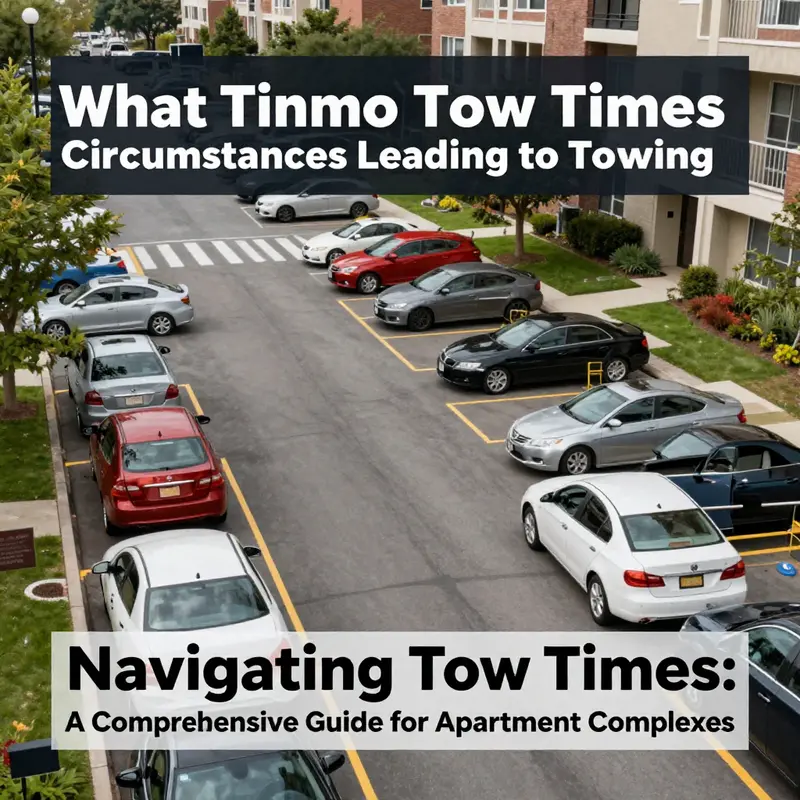
In apartment life, timing rarely looks like a switch you can flip on a clock. Tow trucks arrive not on a timetable but in response to a web of signals: a vehicle out of place, a rule violated, a safety concern raised, or a property manager’s policy activated by a specific incident. The typical business hours one might assume—8:00 AM to 6:00 PM on weekdays—often feel like a practical baseline rather than a guaranteed schedule. In practice, the arrival of a tow truck hinges on conditions, not a calendar. A car parked in a fire lane, a vehicle blocking a common path, or a registered but unpermitted car in a restricted zone can trigger a tow at the very moment those violations are observed or reported. Some cities even have “tow windows” that extend into late afternoon or evening, but these windows vary from place to place and from one property to the next. The real rhythm, then, is dictated by enforcement realities, not by the clock.
To understand why a tow truck might pull into a particular apartment complex at an unexpected hour, it helps to start with the common triggers. One of the most straightforward is misplacement or misregistration. A vehicle that sits in a restricted area—fire lanes are the clearest example, but so are disabled parking spaces without proper permit, private driveways, or reserved spots that require a permit the driver does not possess—will usually meet a swift response. In these cases, the call to the tow company can come from a resident, a security team, or even a building’s management software that flags repeat offenses. The critical element is that the vehicle is impeding access or violating posted rules; the time becomes incidental to the violation itself. A car may be parked legally elsewhere, but if it violates the property’s policy in a way that obstructs safety or movement, it becomes a candidate for removal, often without a long grace period.
Another frequent trigger is the status of the vehicle itself. Abandoned or non-operational cars—those left unattended for days or weeks and visibly deteriorating—draw attention. A car that appears neglected, with flat tires, fluids leaking, or tires slashed, signals a potential hazard or nuisance. In such cases, management may not wait for the legal clock to tick through a typical notice period. They may commission a tow as soon as it is feasible, especially if the vehicle occupies space that could be used for guest parking, emergency access, or daily resident needs. The underlying logic is practical: a vehicle that compromises safety or curtails usable space for long periods deserves removal to reclaim the property’s functionality.
Beyond the physical layout and the car’s condition, lease and HOA rules shape the timing. Parking regulations—limits on how long a car can stay in certain areas, bans on guest parking during peak times, and rules about parking in common areas—create a pattern of enforcement. When a vehicle violates these rules, especially repeatedly, towing becomes part of a broader strategy to maintain order and access. The enforcement logic here is reactive: when violations accumulate or when a single incident creates a bottleneck for other residents, towing may be initiated promptly to restore normal operations. In many apartment communities, this means that a tow is not tied to a fixed hour; it follows the sequence of observed noncompliance and the property’s policy cadence.
In emergency situations, the timing becomes even more fluid. An accident within the property, a vehicle leaking fluids into the thoroughfare, or any scenario that creates a safety hazard can trigger an immediate tow, regardless of the hour. The priority in these moments is clear: remove the obstacle, reduce risk, and reopen access for pedestrians and other drivers. The sensory cues are not time-based; they are danger- or obstruction-based, which often places tow activity in the dim hours as readily as it does in daylight. A tow truck can arrive at a moment’s notice when the situation demands rapid clearance, underscoring the idea that the clock takes a back seat to safety and mobility.
The broader regulatory landscape feeds into this pattern as well. Municipal rules can permit towing 24/7 in some places, while others limit removals to business hours or extend enforcement into evenings and weekends. Because municipalities diverge in their allowances, property managers must navigate a patchwork of rules, signage, and notices. Within a complex, management or the contracted tow partner will align the practical hours with local law and with the complex’s own policies. The consequence is that two adjacent properties can have markedly different towing rhythms, driven by ambiguities in local code, the property’s own parking plan, and the day’s observed violations. This mosaic is precisely why tenants who assume a predictable schedule can find themselves surprised by a tow at an hour outside typical business times.
This reactive rhythm is not just a theoretical point. A recently reported article, noted in discussions about the recurring patterns of towing in certain neighborhoods, highlights how repeated violations can create a persistent enforcement loop. When violations appear frequently in a given area, police and tow operators become accustomed to responding more quickly, and enforcement can become a sustained, ongoing process rather than a sporadic event. The implication for tenants and visitors is simple: in neighborhoods with chronic parking issues or lax enforcement, the cadence of towing can seem almost continuous, punctuating daily life with unexpected removals. The timing, in these cases, is less about when you park and more about how consistently rules are violated and how effectively the property enforces them.
Given this complexity, the practical question for residents is how to avoid a tow and what to do if it happens. The first line of defense is awareness: read the posted signage, understand the designated parking zones, and know where to park legally, including any guest or temporary parking options. This is not merely a matter of courtesy; it is a critical risk management step. If a vehicle must be placed in a temporarily restricted area, the prudent move is to secure permission from management or to relocate promptly if asked. An important consequence of misreading or ignoring rules is losing access to a parking space that can be costly and time-consuming to regain.
To deepen the practical understanding, consider the kind of industry context that often informs these decisions. For those who want to explore how tow operations are planned and coordinated in real-world settings, a respected industry resource provides a grounded view of the factors that determine when a tow truck is summoned and how operators manage complex property policies. The Island Tow Truck Blog offers a window into day-to-day decision making, policy interpretation, and the logistical considerations that underlie towing in residential settings. Reading these insights can help residents and managers alike align expectations with real-world practice. The Island Tow Truck Blog provides a sense of how professionals think about enforcement, timing, and safety in shared living spaces.
For tenants, the practical takeaway is straightforward: do not rely on a clock. Instead, rely on clarity of rules, proactive communication, and timely response. If you receive a warning or notice about a potential violation, act quickly. If you believe a tow was mistaken or overly aggressive, request a review through the management office and document your parking information, including where you parked, when, and for how long. Even a small record can make a difference in disputed cases. And if your vehicle is towed, you will want to know the steps: where the tow yard is located, what fees apply, how to retrieve the vehicle, and what documentation will be required. The road back from a tow is often not a simple reset of hours but a process that involves understanding the rules, communicating with the property team, and navigating the logistics of the tow company.
The timing of tow truck arrivals, then, is less a matter of a fixed schedule and more a map of incentives, violations, and safety priorities. It is a quiet, continuous cadence that emerges wherever rules govern parked vehicles, access routes, and common space. In this sense, towing is less about the hour on the clock and more about the day-to-day maintenance of order in a dense living environment. When residents keep to designated spaces, respect the rules, and respond promptly to notices, they reduce the chances of seeing a tow truck roll into the lot at an unexpected moment. When violations do occur, the response is a reminder that the system is in place to protect safety and accessibility, not to punish inconvenienced drivers.
External resource: Municipal and regulatory contexts can provide additional clarity on when removals are permissible. For a concise overview of legal frameworks surrounding towing charges and regulations, see the overview here: https://www.nolo.com/legal-encyclopedia/parking-tow-charges.html
Tow Windows and Quiet Hours: How Local Rules Decide When Tow Trucks Reach Apartment Complexes
When residents ask what time tow trucks arrive at apartment complexes, the answer is rarely a single clock time. Instead, the arrival window unfolds through a patchwork of local rules, property policies, and practical safety concerns. The timing hinges on where the building sits in the regulatory landscape, what triggered the tow, and how the management team coordinates with the company contracted to enforce parking rules. The result can feel inconsistent from one property to the next, even within the same city, but there is a logic behind the pattern. Understanding that logic helps residents anticipate when a tow might occur and gives managers a framework for conducting removals without unnecessary disruption.
At the core of timing is local municipal regulation. Cities and counties regulate when towing is permitted and under what circumstances. These rules are not just bureaucratic niceties; they are designed to balance two competing priorities: the need to keep frequent traffic lanes open and accessible—especially in emergencies—and the desire to minimize noise, disturbance, and unfair disruption to everyday life. In many jurisdictions, towing operations are restricted during late-night hours to reduce the impact on sleep and routine. A common guideline across several municipalities is a quiet-hour window that runs from roughly 10 PM to 7 AM. Within this window, tow operations are either prohibited or require special justification, heightened notice, or explicit authorization from a supervisor. The practical effect is that a vehicle reported as illegally parked or obstructing an entry during the day or early evening may be towed promptly, while the same issue raised after dark could trigger a different process entirely.
Beyond the clock, the reason for the tow often dictates the schedule. Vehicles blocking fire lanes, obstructing access for emergency responders, or posing a hazard to pedestrians can be targeted immediately, regardless of the hour. In these situations, municipalities sometimes allow enforcement to proceed outside regular hours because the safety risk overrides standard time restrictions. Conversely, simple parking violations may adhere to stricter hour rules, with advance notice and a staged removal approach that respects residents’ nightly routines. The property’s own rules and the towing agreement with the contractor interact with these municipal standards. Management may require that a vehicle be left in a designated enforcement zone until a certain time, or that a tow company informs building security before taking a vehicle to ensure orderly operations and to minimize confrontation at the curb.
Property management policies play a crucial mediating role. Apartment complex operators are not passive observers in this process; they set the day-to-day protocol for identifying violators, communicating with residents, posting signage, and coordinating with the towing firm. Some properties establish specific hours during which they authorize towing for certain violations, particularly after repeated offenses or in sections of the lot where resident parking is already tightly allocated. Others implement a staged escalation: a warning notice, a courtesy call to the resident’s unit, and then a tow if the vehicle remains in violation. This approach can lengthen the window before a tow actually occurs, yet it also provides transparency and reduces the risk of surprise removals for residents who thought they were following posted rules.
Signage and posted rules contribute to the predictability of tow timing. Clear, visible signs indicating no-parking zones, loading zones, reserved spaces, and hours of enforcement help residents understand when a tow is permissible. Some complexes simultaneously deploy alternate-day enforcement or zone-specific rules, so a car in a violation one week may escape a tow if that area isn’t under enforcement during a given period. Because signage must be accurate and up-to-date, managers frequently coordinate with the towing partner to ensure the posted hours align with the company’s operational guidelines. The alignment is critical not only for compliance but also for reducing disputes between residents and contractors.
Residents who want to anticipate tow timing should take a few practical steps. Start with the posted rules around the parking areas you use most. If you see a no-tow designation for late hours or a rule about notifying management before removal, you’ll know what to expect should a violation occur. It helps to keep a copy of the building’s parking policy handy and to check for any recent amendments announced by management. If you are uncertain, a quick call to the management office or the security desk can clarify whether a particular area is under active enforcement and during what hours a tow is likely to happen. When a tow is anticipated due to a known violation, residents can prepare by moving their vehicles before the enforcement window closes, potentially avoiding the disruption and the cost of retrieval.
Another layer of complexity comes from municipal enforcement practices and the rights afforded to vehicle owners. In many places, the towing company must provide reasonable notice before removing a vehicle, especially if it is parked in a zone where enforcement is contingent on specific conditions. The concept of “advance notice” is more than a courtesy; it is a procedural safeguard designed to prevent accidental tows and to permit a resident to move the vehicle if possible. This notice can be delivered in several ways—through posted signs, letters from management, or direct notifications from the towing contractor when feasible. In some jurisdictions, the notices are tied to an abatement process for abandoned vehicles or vehicles found in violation for extended periods, which further shapes when and how quickly a tow occurs.
Legal compliance matters on both sides of the curb. Towing companies must adhere to licensing, insurance, and procedural rules designed to protect property owners and residents. Failure to comply with local towing regulations can lead to fines for the contractor and potential liability for damages or disturbances. For residents, understanding their rights means knowing whom to contact when a tow seems improper or when a vehicle is removed without sufficient notice. While the specifics vary by city, the underlying principle remains constant: enforcement should be predictable, lawful, and minimally disruptive to those who live and work in the complex.
For those seeking practical guidance beyond general principles, a broad spectrum of sources can illuminate how rules are applied in real-world settings. The Island Tow Truck blog offers practical perspectives from practitioners who regularly navigate parking enforcement, towing operations, and fleet management in dense urban environments. The content there can help readers translate hard regulatory language into actionable steps for tenants, property managers, and neighbors who want to minimize disputes while maintaining safety and orderly access. To explore more, visit the Island Tow Truck blog for practitioner-oriented insights and case studies that connect policy to pavement. the Island Tow Truck blog.
Ultimately, the question of what time tow trucks come to apartments is best answered by consulting both the local code and the building’s own enforcement calendar. Residents should know that some areas tolerate 24/7 tow operations in response to serious violations, while others enforce a tighter daytime window to protect the quiet enjoyment of residents. The safest approach is to stay informed about the specific jurisdiction and the property’s policies, and to coordinate with management when a potential violation arises. In parallel, service providers and property teams can work toward transparency by aligning posted hours with actual practice, communicating clearly with residents, and maintaining open lines of contact among security personnel, management, and the towing contractor. This cooperative approach reduces the likelihood of miscommunication and ensures that towing—when it does occur—serves public safety and fair property management without turning the hallways into stages for cross-accusations.
For authoritative guidance on local towing regulations, readers can consult official municipal resources. A representative and comprehensive resource is the City of Los Angeles Department of Transportation’s Towing and Impoundment page, which details permitted towing hours, procedures for vehicle removal, and resident rights within city limits. https://www.lacity.org/transportation/towing-and-impoundment
null
null
Timing the Tow: Decoding When Apartment Tow Trucks Arrive, Weekends, and After-Hours Enforcement
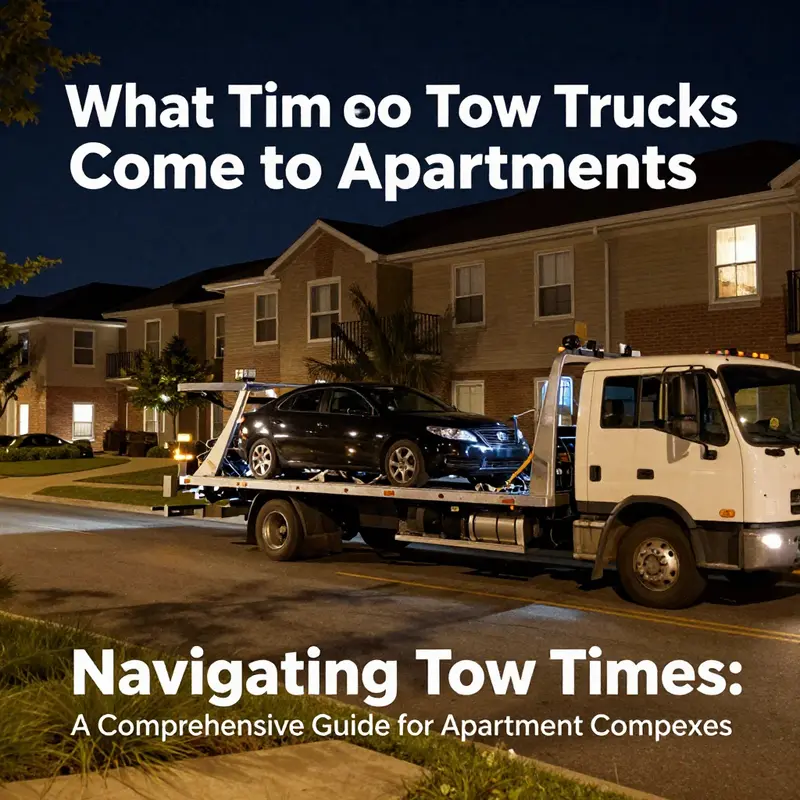
On a quiet morning in a crowded parking lot, the arrival of a tow truck can feel like a sudden interruption to a routine that most residents treat as a personal space. Yet the timing of those arrivals is rarely random. It sits at the intersection of policy, law, and the unpredictable patterns of daily life inside an apartment community. Understanding when tow trucks are most likely to appear helps residents navigate the calendar of fines, permits, and posted rules, and it helps managers design fair, enforceable parking programs that keep essential paths clear without turning every vehicle into a target. The clock, in other words, governs more than a single car; it frames daily life in shared spaces and shapes how people think about responsibility, compliance, and coexistence within a building’s walls and asphalt. Most tow activity tends to cluster within regular business hours. In many cities and with many management teams, weekday towing follows a fairly predictable pattern: enforcement begins when offices open and ramps up during the late morning, continuing through the afternoon as vehicles that violate posted rules accumulate. A typical window cited by property operators and enforcement partners is roughly 8:00 AM to 5:00 PM or 6:00 PM on weekdays. Within that window, tow operators may respond to violations such as unregistered vehicles or expired permits, or to obstructions that block access for residents, visitors, or emergency responders. The aim is not to chase every minor infraction but to remove or deter chronic problems—cars that repeatedly ignore posted permits, vehicles parked in access aisles, or cars that block disabled-access routes. Those scenarios demand timely action to restore safe circulation and to preserve access for maintenance, deliveries, and service vehicles. But the day is rarely always predictable, and the role of the weekend and after-hours towing cannot be discounted. In apartment complexes, enforcement often expands beyond the standard daylight hours when the risk of disrupting daytime traffic is lowest or when violations are persistent and systemic. Weekend towing, and after-hours operations that stretch into the early evening or late night, are common tools for property managers and municipal enforcement for dealing with ongoing noncompliance. In some instances, late-night deployments are coordinated to minimize disruption to residents who might be away at work, at school, or out for the evening. In other cases, specific violations—such as a parked car in a fire lane or in a reserved loading zone—may trigger an immediate response regardless of the hour, especially if local rules designate certain areas as non-parking zones around the clock. The message is clear to residents: a rule violation can be sanctioned at nearly any time if it threatens safety or hinders critical access. A thread that runs through these timing patterns is the policy framework laid out by the property manager. Apartment communities rarely delegate towing to chance; they embed it in a written policy, signage, and a schedule that reflects the property’s layout and the needs of its residents. The policies dictate when a tow can occur, which areas are towable, and which vehicles count as violations. They may require a grace period for new permits, or they may enforce strict deadlines for permit renewals. They also set the expectations for the towing company’s response times, the process for notifying residents, and the steps for retrieving a towed vehicle. The practical effect is that time on the calendar becomes time on the curb: certain zones become no-go zones during defined hours, while others are regulated around the clock. The management team may coordinate with a contracted tow partner to optimize response times, balancing the need to keep aisles clear with the desire to avoid over-enforcement that can alienate the resident population. Local regulations further complicate the simple idea of a uniform towing window. Municipalities may impose different rules about when towing is permitted, and some jurisdictions allow twenty-four-seven enforcement, while others require business-hour restrictions. When a city restricts towing to business hours, the enforcement window expands only during the workweek; when 24/7 towing is allowed, violations in the middle of the night can trigger immediate removal. The variations matter because residents often assume 9 to 5 enforcement applies every day, only to discover a local ordinance that permits nighttime towing for specific violations or areas. Residents who want to avoid surprises should inspect the posted signage at the entrance to the lot and, if possible, review the property’s parking permit requirements and the city’s parking-enforcement guidelines. The best practice is to pair clear signage with a transparent policy document that outlines what counts as a violation, how long a vehicle can stay before towing, and the procedural steps to contest a tow if a couple of days spend in limbo seem unjust. Given this complexity, the most reliable strategy for a resident is proactive compliance rather than reactive improvisation. Read the posted signs at the entrance and around each lot, and verify that your vehicle is properly registered, permitted, and placed in an appropriate space. If your apartment complex requires permits, make sure they are visible, up to date, and tied to the correct license plate. Keep a spare permit in your glove box, if permitted, and be mindful of temporary changes—such as a guest who arrives with a visitor pass that doesn’t match the primary registration. And if you are unsure about whether a zone is towable at certain hours, don’t assume; ask. A quick call to the front desk or the property manager can save you both time and a potential tow receipt. Being proactive also means understanding the typical violations that trigger towing: unregistered cars that should be registered, vehicles with expired permits, and cars parked in restricted zones that block egress, loading zones, or access to essential services. These are precisely the cases that drive enforcement operators to act swiftly, and they underscore why a well-communicated policy matters just as much as clear signage. If you want a broader sense of how such enforcement schedules operate on larger scales, a visit to resources that discuss parking enforcement can help situate apartment practices within a wider framework. For readers seeking more practical context, the Island Tow Truck blog provides helpful perspectives on how fleets handle daily enforcement, incident response, and the communication that accompanies a tow. Island Tow Truck blog. That resource, while not a substitute for your own complex’s rules, can shed light on common patterns and the way fleets coordinate with property teams to avoid unnecessary disruptions. Finally, for broader enforcement patterns, refer to city guidelines: https://www.cityofnewyork.gov/transportation/parking-enforcement.html
Final thoughts
Understanding when and why tow trucks operate in apartment complexes not only aids property managers and fleet operators in making effective plans but also empowers residents to be conscious of their parking habits. By being aware of local regulations and property policies, all stakeholders can navigate the complexities of towing practices with greater confidence. Ultimately, fostering a cooperative environment can mitigate frustrations related to towing incidents.