The relationship between tow truck drivers and icy vehicle situations in Los Angeles often leads to misunderstandings. While the common term ‘ice vehicles’ might suggest a unique classification requiring special attention, tow truck services here primarily focus on standard vehicles facing breakdowns or accidents. This article will uncover the realities behind towing practices in LA, addressing misconceptions, vehicle classifications, and the challenges posed by winter conditions. Each chapter will not only clarify what towing entails but also highlight the invaluable role tow operators play when vehicles fail, regardless of the environmental circumstances involved.
null
null
Tow Truths in LA: Debunking the Ice-Vehicle Idea and Mapping the Real Scope of City Towing
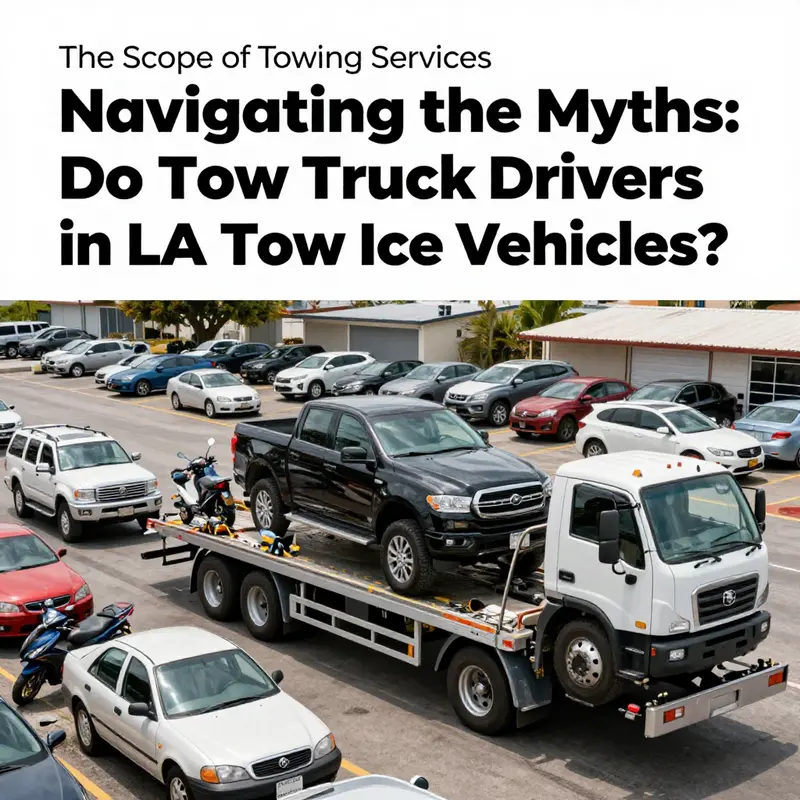
When people ask whether tow truck drivers in Los Angeles tow “ice vehicles,” they are usually chasing a slippery stereotype rather than a real category. In the everyday language of the streets and the yards where wreckers are serviced, there is no acknowledged vehicle class called ice vehicles. The professional framework that governs LA towing rests on well-established categories: standard passenger cars, light- and medium-duty trucks, larger commercial vehicles, and specialized equipment needed to recover or transport items that are immobilized by failure, collision, or illegal parking. The practical reality is straightforward: a tow operator does not sort vehicles by a frozen label but by condition, weight, wheel configuration, and the specific loading demands a given transport job presents. Even in winter storms when temperatures fall and roads glaze over, the vehicles that arrive at the tow yard or the roadside are treated as regular vehicles subjected to standard load limits, tie-down practices, and securing procedures. If someone uses the phrase ice vehicles to refer to equipment designed to operate on ice or snow—snowplows, for example—those machines are not newly reclassified; they are still considered assets that may need towing or roadside assistance if they malfunction, yet they do not earn a distinct towing category either. The absence of a formal ice-vehicle class in LA towing standards is not a gap but a reflection of how the field is organized around function, safety, and the practical realities of urban mobility.
The breadth of what LA tow truck drivers handle is substantial. A single shift can see a spectrum of needs: a commuter car with a dead battery or a flat tire, a van whose alternator has given out, a delivery truck that has stalled in a high-traffic corridor, and at times even a construction vehicle that blocks a lane and must be moved with care. Each scenario calls for a tailored approach. The goal is rapid yet safe recovery with minimal disruption to traffic flow and with an eye toward preserving the integrity of the towed vehicle. In many cases, small, local operations deploy flatbed tow trucks for the job because their design permits a clean, controlled loading process. Flatbeds provide a platform that reduces ground contact and prevents the tires from suffering additional damage during transport. They are notably effective when the vehicle’s structure must be kept in a fixed orientation, when there is a risk of leaking fluids during transport, or when loading in tight spaces is necessary. The deployment of compact flatbeds, in particular, is a response to one of the city’s enduring constraints: space. Los Angeles lanes can be narrow and curbside space scarce. A lighter, agile flatbed can weave into a tight parking scenario, secure a vehicle with careful wheel straps and guidance, and depart with a minimal footprint.
But the story does not end with compact vehicles and quick roadside fixes. For heavier, more complex recoveries—think large commercial trucks, construction machinery, or multiple-axle vehicles—the fleet leans on robust flatbed configurations designed to handle substantial weight while preserving stability. These units are built with high-strength materials and advanced hydraulic systems, engineered to keep the loaded vehicle securely anchored as it travels through urban arteries or along industrial corridors. The balance of power and precision on a heavy flatbed is delicate. The winch and the hydraulic deck must coordinate with a driver who understands weight distribution, center of gravity, and the dynamics of a long, rigid platform negotiating a turn. While heavier-duty flatbeds demand meticulous maintenance and a higher degree of technical service, their reliability makes them indispensable in environments where space is at a premium and where a standard rollback approach could fail to deliver the same safety guarantees. In other words, the capacity to adapt is as important as the capacity to endure a demanding recovery.
The concept of “ice vehicles” as a category recedes when one surveys the practical realities of the field. If the term were intended to refer to vehicles designed for icy conditions, such as snowplows, the occasional tow of such equipment might occur if it breaks down, but those are still processed as standard heavy equipment within the same overall framework. A snowplow that malfunctions on a city street is not reclassified; it is just another vehicle requiring the same attention to securing, weight limits, and transport discipline that all heavy-duty jobs demand. This perspective aligns with the broader principle that towing services are defined by the mechanics of moving a load safely and efficiently, not by speculative labels that do not carry professional standing.
Behind every towed vehicle is a chain of training, process, and precaution that makes the operation safe for the operator, the vehicle, and the surrounding traffic. Technicians and drivers in Los Angeles come to the job with a repertoire of securing strategies that includes tire immobilization, wheel chocks, and appropriately rated straps and chains. The science of securing is not a mere afterthought; it is the core of a successful tow. In the best practice, the load is stabilized before movement begins, the path is cleared, and the route is planned with awareness of road grade, potential obstacles, and alternate detours. Safety protocols influence the choice of equipment as well. For example, a sensitive or valuable vehicle might be transported on a flatbed to prevent any abrasion or scraping from contact with the road surface. Vehicles with compromised steering or suspension require additional precautions to prevent further damage during loading, transport, and unloading.
A further layer of complexity belongs to the urban and industrial landscapes in which LA tow operators operate. The city’s traffic is a dynamic system where minutes matter, and space is at a premium. The strategic use of flatbeds—especially the lighter variants—lets operators pull into tight curbside poses, strap down a vehicle, and depart with minimal disruption to oncoming lanes. In cases where a road closure or an incident creates a bottleneck, a quick, stable transport can become the difference between a minor delay and a cascading traffic jam. Equally important is the relationship between towing and fleet recovery in the broader ecosystem. When a vehicle breaks down, the dispatch mindset shifts toward liability-reducing procedures: documenting the incident, confirming the vehicle’s condition, and choosing a transport method that avoids secondary damage. It is not just about getting a vehicle from point A to point B; it is about preserving the vehicle’s value, maintaining the safety of other road users, and supporting the overall resilience of the city’s mobility network.
In this context, reference points and guidelines from the industry itself help frame what a tow operation can reasonably promise. The field maintains a set of technical specifications and performance metrics that govern the capabilities of modern flatbed tow trucks. These metrics—often published by industry resources and manufacturer literature—describe how the equipment behaves under load, how quickly decks raise and lower, and how securely the load is held during transport. They are not about elevating one category above another but about ensuring that every job, whether a small-scale roadside assistance or a heavy-duty recovery, proceeds with reliability and safety. The practical takeaway for those who manage or rely on towing services is that the right tool for the job is chosen in the moment, guided by an assessment of weight, size, and the vehicle’s condition, rather than by an outdated label that does not reflect professional practice.
The internal ecosystem of the towing world also extends to the ways in which fleets coordinate with emergency-response planning and daily operations. In many metropolitan areas, including Los Angeles, the local fleet managers and service providers work in concert with emergency-response strategies to ensure that recovery operations can be conducted without compromising public safety. A resource that highlights how fleets prepare and respond in critical situations can be a valuable guide for planners and operators alike. For instance, a well-regarded reference on fleet emergency-response strategies offers insights into rapid deployment, redundancy, and contingency measures that reduce downtime during incidents. essential-fleet-emergency-response-strategies serves as a practical reminder that the goal of towing is to restore mobility quickly and safely, without exposing people or property to unnecessary risk.
From an industry perspective, the conversation around vehicle categories, equipment capabilities, and secure transport underscores a simple truth: the landscape of towing in Los Angeles is pedestrian in its fundamentals yet sophisticated in its execution. The driver’s expertise lies not in enforcing a label but in reading the scene, selecting the correct equipment, and applying best practices for securing loads. The flatbed’s role rises or falls with the job’s demands, and the operator’s judgment about when to use a flatbed versus a wheel-lift, or when to call for additional units, remains a critical element of success. In urban centers where curbside parking is a daily chessboard and where commercial activity is intense, the ability to adapt a plan to shifting conditions is what keeps the process moving and the city’s wheels turning smoothly. Such adaptability does not hinge on a mysterious ice category; it rests on a clear understanding of the vehicles involved, the risks at stake, and the mechanics of safe transport.
Looking ahead, those who work in or alongside towing operations can benefit from consulting the broader resource pool that documents and analyzes the technicalities of modern tow equipment. The industry’s standards and performance metrics provide a framework that helps ensure consistency, safety, and interoperability across different service providers and municipal requirements. These references can guide procurement, maintenance scheduling, and operator training as fleets expand to accommodate increasingly diverse vehicle types and use cases. In the end, the real scope of LA tow truck work is not bounded by a single label but defined by the dynamic interplay of vehicle design, load management, urban constraints, and the steadfast commitment to getting people and goods back on the move.
External resource: https://www.towtruck.com/industry-resources/tow-truck-technical-specifications-and-performance-metrics/
Ice on the Road, No Ice Vehicles: Demystifying Los Angeles’ Tow Rules and What They Really Tow
Tow trucks are a familiar sight in the urban mosaic of Los Angeles, where the pace of the city and the volume of traffic create a steady demand for rapid removal of disabled, abandoned, or illegally parked vehicles. Yet when we ask a pointed question about towing “ice vehicles” in LA, the answer quickly slips into a more nuanced terrain: the term itself does not appear in standard municipal or law-enforcement language, and the rules that govern towing are calibrated around conventional road vehicles rather than exotic or non-motorized concepts. What emerges from careful reading of the regulations and from the practices described by city agencies is a simple, robust principle: towing operations are organized around vehicles that are designed to move on streets and highways, not around items or machines that lack a motorized propulsion system or roadworthiness. In that sense, the idea of an “ice vehicle” as a distinct category is more a matter of imagination or hypothetical specificity than a codified category with enforceable procedures behind it.
The core of the Los Angeles framework rests with two city pillars: the Los Angeles Department of Transportation (LADOT) and the Los Angeles Police Department (LAPD). They regulate when and how a vehicle can be towed by delineating the circumstances under which a vehicle becomes a hazard, obstruction, or violation of parking rules. The guidance they issue is pragmatic: if a car, truck, or motorcycle is parked illegally, abandoned, or obstructing traffic, it may be towed. The decisions hinge on the vehicle meeting criteria related to safety, traffic flow, and property rights—conditions that are measurable, observable, and consistently applied. In other words, a tow operator’s job is to identify the vehicle as a roadworthy device capable of transport on a highway. If the item lacks a motorized propulsion system or cannot be operated on the road, it generally falls outside the standard towing category.
From a regulatory standpoint, the absence of a specific category for “ice vehicles” is not a gap in the sense of leaving a loophole; it is a reflection of the definitional boundaries that govern what counts as a vehicle for towing purposes. The City’s Vehicle Definitions, codified in Municipal Code § 50.02, define a vehicle as “any device in, upon, or by which any person or property is transported or drawn upon a highway.” Importantly, this definition presumes road capability and motorized propulsion as part of the function of the device. Ice-themed devices—whether an ice sled designed for recreation, an ice boat, or an ice sculpture equipped with wheels as a novelty—do not typically meet this standard when they lack a functional motor or are not intended for road use. In such cases, they would not be classified as vehicles under the towing regulations in force.
The practical implication for tow operators is straightforward but worth underscoring: if an object is irregular, non-motorized, or non-roadworthy, it is not automatically synonymous with a vehicle that can be towed under ordinary municipal rules. When a scenario emerges in which a device or contraption functioning on ice appears on or near the road, the operator and the responding officers must evaluate whether the item is a hazardous obstruction or a legitimate road vehicle. Absent motorized function or roadworthiness, the item would be treated as a non-roadworthy object rather than a standard tow target. In such moments, removal may require alternative procedures, such as cleanup crews or specialized equipment not engaged in routine tows. This distinction preserves safety and ensures that towing resources are allocated to vehicles that pose a direct threat to traffic flow or public safety.
What does this mean for the everyday driver who experiences a breakdown in freezing conditions? The guidance suggests a continuity of practice rather than a refashioning of the rules. Even during unusually cold weather, when a standard car may stall or fail due to battery or engine issues, the tow operator’s classification remains anchored in the vehicle’s motorized and roadworthy status. The weather itself is not a mandate to reclassify a standard vehicle as something entirely new. Rather, it highlights the resilience of the system: it is designed to cover the broad spectrum of routine road use while avoiding the creation of ad hoc categories for extraordinary, non-standard devices. To the extent that a conventional vehicle is involved in a weather-driven incident, it remains within the ordinary towing workflow, with standard procedures for dispatch, stowage, and transport.
This approach aligns with a broader philosophy in urban traffic management. City officials strive to maintain clarity and predictability for tower operators, patrol officers, and the public. A well-defined boundary—where a vehicle is a roadworthy device capable of transport on a highway—reduces ambiguity. It minimizes disputes about whether something should be towed and how it should be handled. It also preserves resources so that tow services can be deployed efficiently to address real hazards rather than grappling with edge cases that sit outside the core remit of motorized road transport. In this sense, the concept of an “ice vehicle” remains more a curiosity than a practical concern for municipal policy.
The research materials also remind us of an important nuance: the terminology used by the public or by niche industries may borrow the word “ice” in creative ways, but the legal and regulatory lexicon does not. When people conjure images of an ice vehicle, they might imagine a snowplow or a novelty sculpture with wheels. While snowplows are indeed designed to operate in icy conditions and are often roadworthy in ordinary contexts, their towing would follow the same general rules if they become disabled or are parked in prohibited spaces. In other words, the presence of a snowplow on a street still implicates standard towing considerations if it is rendered immobile and violates parking or obstruction codes. The emphasis remains on whether the device can be transported on a highway and whether it is being used as a vehicle in the legal sense. If not, it would not become a candidate for the city’s towing regime in the same way.
The idea of ice as a distinctive classification also intersects with how other jurisdictions define and regulate unusual or non-standard equipment. Yet Los Angeles offers a telling example of how municipal codes can achieve a clean, practical standard that serves public safety without becoming tangled in hypothetical categories. The absence of explicit references to ice-specific devices in the LADOT and LAPD guidelines does not imply neglect; it signals a policy choice to govern a vast landscape of road use with a consistent, motorized, roadworthy criterion. This approach helps tow operators to operate with confidence, knowing when they should tow and when they should defer to other city processes or cleanup crews. It also helps property owners and motorists understand the expectations and consequences of violations or hazards on public streets.
For readers who want to explore the regulatory text directly, the vehicle definitions in the City Code provide the precise language that shapes everyday practice. The definitions, and the broader code sections cited by city agencies, anchor on the practical realities of street transportation and safety rather than on speculative categories. This clarity matters when disputes arise about whether a particular object qualifies as a vehicle for towing and whether it can be moved with standard tow equipment. It also matters for public communication: when city officials explain towing practices to residents, they rely on a shared, well-understood framework that can be applied consistently across neighborhoods and incidents.
Beyond the mechanics of rules and the semantics of terms, this topic touches on how communities respond to disruption. Tow trucks are not simply machines that recover cars; they are agents in the urban system that maintain mobility, reduce hazards, and support economic activity. When a breakdown occurs in a congested corridor or near a school, the speed and efficiency with which a tow operator can determine whether the situation fits within standard regulatory categories can have tangible consequences for safety and throughput. The absence of a dedicated “ice vehicle” category is not a deficiency; it is a testament to the sufficiency and clarity of the current approach, which concentrates on roadworthiness and the ability to transport on a highway. It is a reminder that policy design often favors straightforward criteria that survive the unpredictability of city life.
For readers who want to connect this regulatory portrait to practical strategies, one path is to consider how fleets prepare for emergencies in a city that values rapid response and predictable processes. A practical resource that frames the broader conversation about emergency readiness for specialized fleets can be found in the discussion of island fleet resilience and preparedness, which emphasizes planning, training, and coordination across multiple agencies. This broader perspective can illuminate how standard tow operations fit into a larger emergency-response ecosystem, especially when unusual scenarios arise in the urban environment. For further exploration of those themes, you can read about emergency preparedness for island fleets. https://theislandtowtruck.com/emergency-preparedness-for-island-fleets/ (internal link).
The bottom line remains clear: in Los Angeles, towing practice is anchored in the broad, functional definition of a vehicle and the practical needs of traffic safety. Ice-specific devices, if they exist in a hypothetical sense, do not elevate to a distinct towing category under current municipal rules. When a non-motorized ice construct appears in a roadway context, it is treated as a non-roadworthy object rather than a road vehicle, and it is handled according to the safety and cleanup priorities appropriate to that situation. This understanding helps avoid confusion about what can be towed and ensures that the city can respond efficiently to the most common and consequential incidents on its streets. For those seeking the exact regulatory language that shapes these decisions, the Governor’s map of authority and the City’s vehicle definitions provide the statutory backbone. External reference: https://www.lacity.org/portal/city-code/section-50-02
Cold Roads, Quiet Winters: How Los Angeles Tow Trucks Tackle Ice and Winter Vehicle Challenges
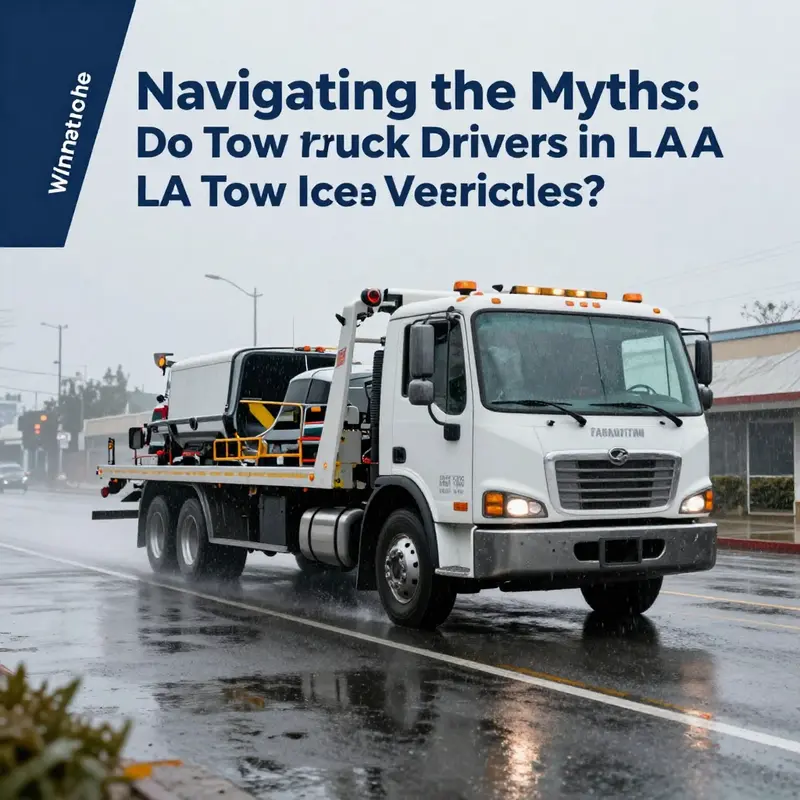
Los Angeles rarely faces deep winter conditions, but its tow operators must still be ready for the weather’s small, disruptive effects. Winters in the basin mean mild temperatures, occasional rain, and the rare cold snap—conditions that change traction, battery performance, and driver behavior more than they create sustained icing. Tow companies therefore treat winter-related calls as ordinary breakdowns or recoveries, responding with the same safety-first procedures used year-round.
The region’s climate informs operational priorities. Freezing temperatures and snow are mostly confined to nearby mountains; the urban core sees storms as short-lived events that nonetheless increase incidents such as fender-benders on slick patches and stalled vehicles on grades. These spikes are modest compared with cold-climate hazards, but they still require disciplined scene management, clear communication, and fast, careful removal of obstructions to restore traffic flow.
Because there is no separate category called an “ice vehicle,” dispatch and crews concentrate on flexibility and reliability. Fleets maintain versatile equipment—flatbeds, wheel-lift trucks with multiple configurations, robust winches, and lighting that illuminates a scene without blinding oncoming traffic. Training emphasizes risk assessment, secure rigging, and methodical handoffs to repair facilities or other next steps in the vehicle’s journey.
Winter readiness in Los Angeles is therefore condition-driven rather than equipment-driven. A light drizzle can create glare or hydroplaning risks on roadways designed for dry conditions. Cold mornings can reveal weakened batteries or hesitant transmissions after a night of low use. Tow crews need a diagnostic mindset that treats subtle mechanical quirks with the same urgency as obvious failures: inspect, secure, and move with prudence.
Urban density amplifies every incident. Congestion compresses the margins for safe recovery operations, narrows loading zones, and raises the importance of coordinated incident command. When rain reduces visibility and traction, crews must balance speed with safety—approach, align, secure, and depart in a precise sequence while coordinating with dispatch and law enforcement when necessary.
Practical readiness shows up in routine checks and planning. Pre-shift inspections of batteries, hydraulic fluids, and lights; stocking traction aids where appropriate; and maintaining route awareness for steep or narrow streets all pay dividends when weather-driven calls arrive. Dispatch systems that can reprioritize jobs during a storm and crews trained in high-traffic maneuvering are as important as any winter-specific kit.
The human element anchors this approach: the dispatcher who reads a forecast and reshuffles priorities, the driver who chooses a safer approach route, and the mechanic who verifies a battery’s reserve. Together they keep the service dependable. In Los Angeles, winter is less a special case than a reminder to practice the fundamentals of safety, speed, and reliability.
Further reading on fleet preparedness and emergency response strategies can be found on industry resources such as The Island Tow Truck blog (https://theislandtowtruck.com/blog/) and official weather guidance from the National Weather Service Los Angeles Forecast Office (https://www.weather.gov/los/). These resources underscore that even in mild climates, systematic preparation and adaptive operations sustain reliable towing services through the year’s changing conditions.
Between Weather and the Wheel: How Los Angeles Tow Truck Drivers Keep the City Moving Through Extreme Conditions
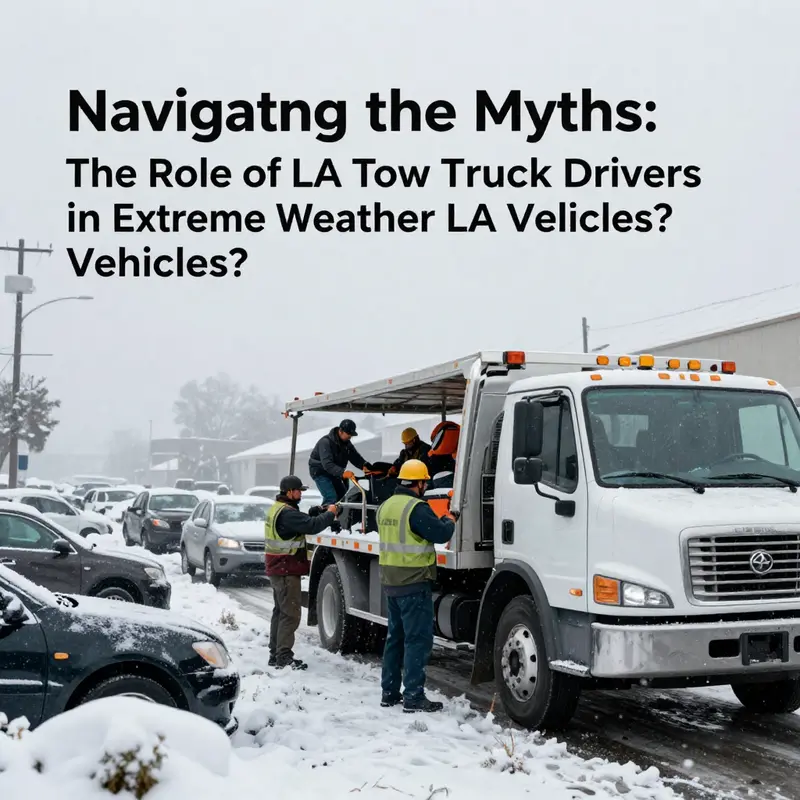
In Los Angeles, the phrase ice vehicles does not designate a distinct class of equipment or a separate calling card for tow operators. The city runs on a continuum of needs one driver can recognize in an instant: a car that won t start after a brutal downpour, a sedan that fishtails into a median in a sudden windstorm, a truck disabled on a rain slicked on ramp, or a van blocked by illegally parked cars during a heatwave. Tow truck crews in this region respond to disasters large and small with the same mix of skill, caution, and improvisation that their counterparts in colder states use when ice and snow layer the roads. The distinction between a normal breakdown and an emergency is not coded into the vehicle category but into the urgency of the moment and the risk to the traveling public. Hence, when extreme weather arrives, the work remains standard in principle yet extraordinary in execution. Vehicles are treated under the same towing categories as always, but the conditions under which those categories are executed intensify the demands placed on drivers, dispatchers, and fleets alike.
The bigger geography of Los Angeles compounds the familiar challenge of vehicle recovery. The city stretches from the ocean cliffs to inland hills, across dense urban corridors and sprawling freeways that braid into one another with little room for error. The weather can swing quickly—spitting rain that makes reflective surfaces treacherous, a heatwave that weakens batteries and tires, or an offshore wind that tilts palm trees and traffic patterns into new configurations. It is in these moments that the experience and judgment of LA tow operators come to the fore. They must forecast how a single incident can cascade into a network of delays, prioritizing calls so that vehicles blocking emergency routes or pressurized suburbs receive attention first. The job description does not change, but the stakes do, and the crew acts with the practiced calm of people who have learned to anticipate the consequences of weather-driven volatility on a sprawling, interconnected web of streets.
What emerges from the frontline memory of skilled operators is a rhythm that blends readiness with restraint. During extreme weather, demand for towing services often surges in a way that mirrors scenes from wetter climates, even if the climate here is typically drier than that stereotype would imply. A strong winter storm or an intense rainfall can push a city’s call volume into a different dimension. In places where a famous freeway map becomes a grid of potential hotspots within minutes, a single disruption can tie up lanes for miles. In these circumstances, fleets lean on rapid mobilization. Crews may be dispatched with extra hands on their days off, a testament to the collective understanding that the clock has little tolerance for delays. The goal is not just to reach the stranded motorist but to manage the chain of events that follows an immobilized vehicle: blocked bus routes, delayed commuters, and the added pressure on emergency services. This is not a feat of brute force but of disciplined coordination, where every minute saved reduces risk for everyone on the road.
Safety in extreme weather becomes the organizing principle around which all other concerns orbit. On the freeway, visibility can drop to almost ambiguous levels, while slick surfaces and gusty crosswinds create a hazard matrix that would test even the most routine recovery. The drivers in LA are trained to avoid moving a vehicle through active traffic unless the lane is completely clear of the flow. Their approach is patient rather than aggressive: they pull up to a safe distance, orient the vehicle for a controlled exit, and carefully choreograph a move that leaves room for other motorists to react. When brakes fail on a steep incline or hydroplaning threatens negotiation on an on ramp, drivers rely on the same toolkit—flashing beacons, reflective gear, a disciplined hand on the winch, and a clear line of sight to the surrounding traffic. The emphasis is on not creating a secondary problem while solving the first one. In a city that already tests the boundaries of safety margins, that discipline matters more than any single tool or tactic.
Dispatch centers in a climate of pressure during storms and heat events reveal another layer of the narrative. Thousands of emergency calls can flood the system in a matter of hours, forcing operators to execute triage with precision. Prioritization becomes a balancing act: preserving access to critical routes for emergency vehicles, keeping major corridors open for commercial traffic, and ensuring that the most vulnerable motorists receive attention first. The dispatch process has evolved beyond simple call-and-response. Real-time GPS tracking and dynamic routing software allow supervisors to allocate resources with surgical accuracy, rerouting teams as new hazards emerge and weather patterns shift. The urban landscape of Los Angeles, with its vast sprawl and heavy traffic, requires technology to translate weather data into actionable, near-instant decisions. In this sense, a tow operator is also a data steward, translating weather risk into safer, more predictable road behavior for the traveling public.
While the gear in Southern Wisconsin stories may look different on the surface, the underlying logic of mobility under duress travels well. The fleet may favor different configurations of vehicle, depending on space and typical job mixes, but the same principle endures: a versatile fleet that can adapt to any weather condition is the backbone of public safety on the move. In LA, the constraints of space and the demands of a crowded roadway network shape the equipment choices. Flatbed tugs remain common, but their roles often blend with integrated recovery units that can manage a broader spectrum of recoveries in cramped urban environments. The right tool in the right place hinges on the driver’s knowledge of terrain, traffic flow, and the subtle cues that precede a vehicle becoming a roadside hazard. Engineers and operators who understand the city’s topography—its coastal boulevards, its inland canyons, its mountain passes during inclement weather—can position themselves to minimize risk and maximize speed, a combination that becomes a quiet form of public service when storms hit. In this ecosystem, crews become not merely technicians but navigators who translate weather reports into safer travel across neighborhoods, workplaces, and schools, preserving mobility without compromising safety.
The human element remains the most enduring feature of this work. Tow drivers in Los Angeles carry a blend of street sense and formal training, a duality that can only be earned by years of work under the capriciousness of weather and traffic. They must communicate clearly with drivers and bystanders who are often stressed or frightened by the disruption. Their approach to the road is built on empathy as much as competence, recognizing that a caller is not just a vehicle in need of service but a person whose day has suddenly narrowed to a few minutes of fear and uncertainty. In the quiet moments between calls, they recalibrate for the next surge, restocking equipment, reviewing safety protocols, and sharing quick, practical tips with colleagues: keep your lights on, keep your distance, stay aware of the big picture even as you focus on a single stranded vehicle. This work is not glamorous in the sense of speed or spectacle, but it is indispensable to the city’s rhythm, a steady drumbeat that keeps commerce moving, families safe, and emergency services unblocked when the weather demands everything from a simple roadside tow to a careful extraction from a mud-filled shoulder or a fog-bound on ramp.
The industry profile that emerges from these observations is one of disciplined flexibility. Fleet operators who keep a lookout for weather alerts, who preposition crews around known choke points, and who cultivate a culture of safety and accountability can weather even the most intense events with fewer delays and less risk. The value of this approach is not measured solely in the number of calls answered or the speed of rescues but in the confidence it builds among the driving public. When a motorist sees a tow truck with reflectors flashing or a driver methodically setting up a safe work zone, they also see a symbol of competence and control in a moment when uncertainty could breed panic. In a megacity grappling with climate-driven extremes, that calm competence translates into fewer secondary incidents and quicker restoration of normal traffic flows.
As this chapter draws connections between the weather-driven demands of a Wisconsin study and the lived realities of Los Angeles roadways, a practical implication becomes clear. Fleets far beyond the Great Lakes can draw on shared lessons about emergency readiness and the choreography of response under pressure. The concept of a fleet that can rise to a crisis — by mobilizing crews, prioritizing urgent cases, and leveraging technology to optimize routes — is universal in its value. For readers who operate in other dense urban environments, the emphasis on safety, disciplined workflow, and adaptive resource management offers a blueprint that transcends geography. To explore related ideas about how fleets can strengthen their emergency response capabilities, consider a body of best practices that emphasizes coordination, training, and real-time information sharing, such as the article on essential fleet emergency response strategies.
essential fleet emergency response strategies. This anchored perspective helps situate the LA experience within a broader framework of readiness, reminding readers that the core challenges — time, risk, and mobility — remain constant even as the weather, roads, and cityscapes vary. In practice, this means cultivating a culture where drivers are trusted to make decisions at the roadside, where dispatch teams can pivot quickly as new information emerges, and where the public can count on a predictable, capable response when conditions become uncertain. It also means recognizing that every geographic city possesses its own weather story and its own version of extreme conditions. In Los Angeles, with its unusual combination of coastal fog, heat, and sudden downpours, those stories converge to shape a tense, demanding, yet ultimately life-preserving practice. The result is not a lone hero on the shoulder but a network of trained professionals who keep the city’s arteries clear and its people moving, even when the sky opens and the streets remember the days when a single storm could stop a metropolis in its tracks. The work they do daily is a quiet testament to the power of preparation, collaboration, and the disciplined craft of tow operation in the most challenging weather scenarios.
For readers seeking broader context about weather patterns and safety guidelines that frame this work, the National Weather Service California region offers resources that illuminate how storms arrive and how communities adapt in response. External reference: https://www.weather.gov/sgx/.
Final thoughts
Understanding the dynamics of towing services in Los Angeles reveals that the term ‘ice vehicles’ does not correspond to any specific vehicle classification in the region. Tow truck drivers remain dedicated to addressing the standard varieties of vehicles in distress, regardless of the environmental influences. By examining relevant vehicle categories, local regulations, and the realities of extreme weather challenges, we see the pivotal role these professionals play during breakdowns. Their expertise ensures that all vehicles, whether encountering icy challenges or regular mechanical issues, are managed effectively—demystifying the notion that ice vehicles receive special treatment. This insight empowers local businesses to engage confidently with towing services, knowing they can rely on professionalism in any situation.