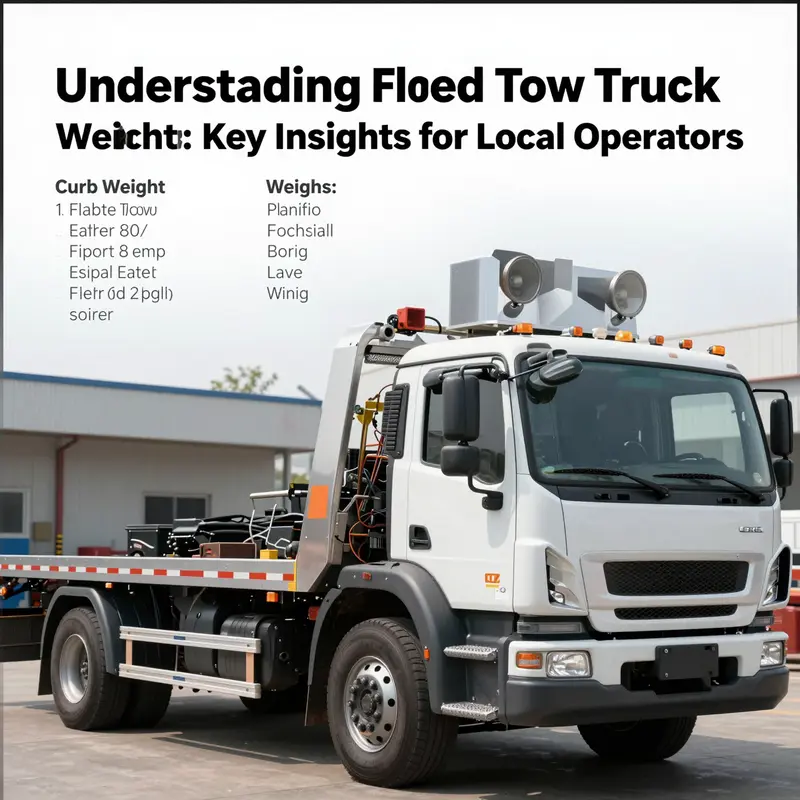
Understanding the weight of flatbed tow trucks is vital for local auto repair shops, car dealerships, and commercial fleet operators. Curb weight and gross vehicle weight (GVW) are essential measurements that not only impact vehicle performance but also dictate legal considerations, safety, and operational efficiency. This article will parse these weights, providing a clearer understanding for property managers and resort operators who rely on these vehicles for efficient operations. Each chapter will delve deeper into these weights and their significance to help you make informed decisions to enhance your operational capabilities.
null
null
Weighing the Road: GVW, Safety, and the Legal Limits of Flatbed Tow Trucks
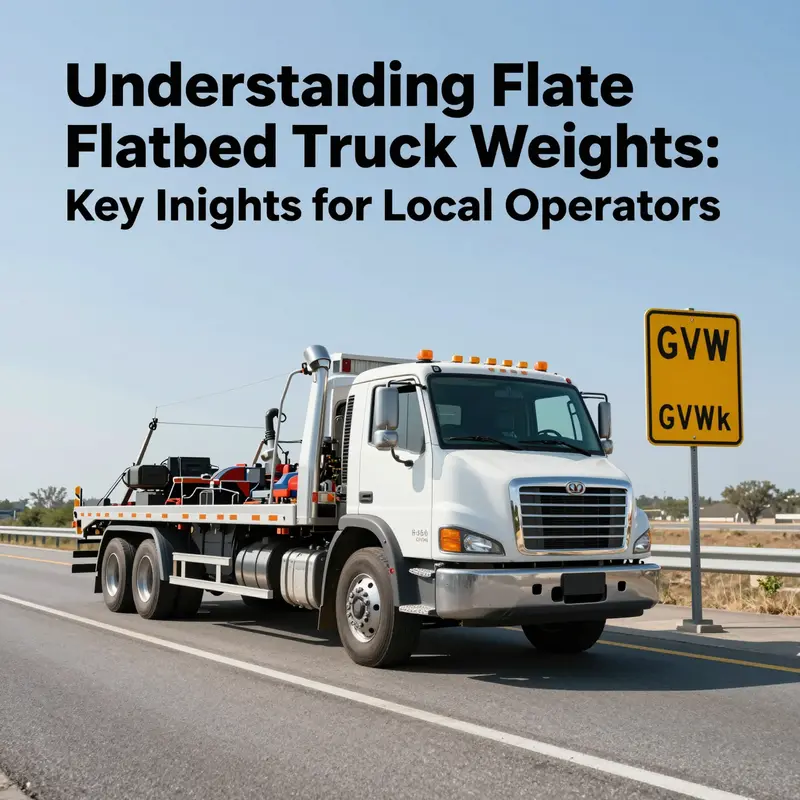
Weight is the quiet but decisive governor of a flatbed tow truck’s capabilities. When operators talk about how much a flatbed can carry, they do not mean simply the payload on the bed. They refer to the vehicle’s Gross Vehicle Weight, or GVW—the total mass the truck is certified to operate safely, including its own structure, all fluids, equipment, passengers, and any vehicle it tows. Out on the pavement, GVW is not a suggestion but a hard boundary. Understanding it—along with its corollaries, curb weight and payload—shapes every decision a tow operator makes, from vehicle selection and maintenance to route planning and emergency response. It is this boundary that ties together safety, legality, and practical performance in a way that is easy to overlook until a load is found to be too heavy for a given chassis.\n\nGVW begins with curb weight—the truck as built, empty of cargo, people, fuel, and tools. In the spectrum of flatbed wreckers, curb weights can range from relatively light configurations around two and a half metric tons to much heavier frames designed for serious recovery work that push past five metric tons. These numbers matter because they cap everything that follows: fuel, coolant, hydraulic fluids, the flatbed itself, the winch system, the tools on board, and, crucially, the vehicle being towed. The sum of those elements cannot exceed the GVW, even if every other factor seems manageable on paper. For example, a smaller 4×2 flatbed setup might present a curb weight near 2,430 kg, while a larger, purpose-built recovery vehicle could exceed 5,250 kg before any payload is added. The GVW, in turn, marks the upper limit for a single trip, including the weight of the towed vehicle and all incidental load.\n\nWhat makes GVW particularly consequential is that it translates directly into road safety and legal compliance. The GVW is the yardstick regulators use to determine whether a vehicle should be treated as a standard commercial operation or a heavier, more restricted class of vehicle. Exceed it, and the risk is not only reduced efficiency and increased wear, but also a legal exposure that can include fines, inspection requirements, and even weight-related prohibitions on certain roads or toll facilities. In practical terms, GVW governs stopping distance, acceleration, tire load limits, hydraulic system performance, and the integrity of the chassis and suspension under load. A tow truck that is pushed to the edge of its GVW can experience longer stopping distances, uneven tire wear, and greater risk of mechanical failure when a sudden maneuver or emergency brake is required.\n\nIn the United States, the weight conversation has a concrete line in the sense of classification. Vehicles with a GVW above 8,500 pounds—roughly 3,855 kilograms—are treated as heavy-duty. That threshold triggers stricter inspection regimes, more rigorous maintenance expectations, and enhanced operational rules designed to ensure road safety under higher stress. The idea is not to complicate work, but to ensure that the heavier end of the towing spectrum remains within predictable, controllable limits. Beyond the U.S. framework, weight classifications also influence taxation, licensing, and even toll categorization on certain corridors. Weight, after all, is not just a mechanical parameter—it is a regulatory signal.\n\nIf a reader is curious about how such categories translate in other markets, the same GVW concept applies, even though the nomenclature and thresholds vary. Take the Chinese GB1589 standard as an example. Here, vehicle classifications center on GVW in a way that affects licensing and road access. The N1 class covers light vehicles up to 3,500 kg, N2 covers 3,500 to 12,000 kg, and N3 covers anything over 12,000 kg. These distinctions aren’t merely bureaucratic labels; they influence how a fleet can operate on main arteries, how tolls are assessed, and what kind of maintenance and inspection regimes are required. The implication for anyone operating flatbed tow trucks in international settings is clear: GVW isn’t a single-country concern. It is a universal constraint that shapes the economics of fleet operations and the safety protocols that teams rely on daily.\n\nUnderstanding the makeup of GVW clarifies why the weight of the recovery apparatus matters as much as the weight of the vehicle being recovered. A flatbed’s mass is not only the framework you stand on; it is also a working platform that supports a host of functions essential to recovery work. The flatbed itself contributes a substantial portion of the GVW. The winch system, hydraulics, and associated control hardware add to the mass. The tools, spare parts, and equipment on board further push the total toward the GVW ceiling. Even the fuel in the tank and the coolant in the system count when the day’s load is tallied. When you combine all of these fixed elements with the ever-present possibility of a towed vehicle, it becomes clear why a seemingly large piece of equipment must be chosen with an eye to its GVW and not merely its curb weight.\n\nThe operational implications of GVW extend to performance metrics that operators track almost instinctively. A higher GVW generally means more weight to move, which translates into longer acceleration times and greater strain on the engine and transmission. It also increases the demand on the braking system and tires, especially in heavy urban environments where frequent stops and starts are common. The bed itself, along with the winch and hydraulic mechanism, must be designed to handle the expected load without flexing or overheating under stress. These engineering considerations, while invisible to many drivers, are part of what keeps the truck safe and predictable when a towed vehicle is attached and the unit is navigating slopes or crowded streets. In practice, modern flatbeds are engineered to balance durability and weight, often using a combination of steel and lightweight alloys to maintain a workable GVW while preserving the service life and structural integrity of the equipment.\n\nA practical reality for operators is that GVW and payload are distinct concepts that interact in sometimes counterintuitive ways. The GVW sets the ceiling for the total weight the vehicle can legally carry and tow. The payload, on the other hand, represents how much you can load onto the flatbed itself, plus whatever passengers and cargo are within the cab, before you must take into account the weight of the towed vehicle. In a typical mid-range setup, you might find a substantial portion of the GVW consumed by the truck’s own mass, with the remaining allowance allocated for fuel, tools, and a towed vehicle. This division matters because it informs how much recovery a single trip can safely undertake, how much time you have for restock and reconfiguration, and how to schedule multiple service calls to avoid crossing the GVW boundary during any leg of the journey.\n\nFrom a fleet-management perspective, the GVW has implications that ripple through planning, maintenance, and training. Fleet operators often require that the vehicle certification plate or registration documents reflect the GVW accurately, and that the operational team checks that the towed vehicle is accounted for in the total weight for each job. The process may seem formal, but it is a guardrail against overloading in the field, especially in high-demand periods when crews are pressured to respond rapidly to incidents. The risk of a load that breaches GVW is not simply a ticket or a repair bill; it is the possibility of mechanical failure, longer stopping distances, tire blowouts, and, most importantly, the potential for accidents that endanger crew and the public. In short, GVW is not an abstract number. It is a practical boundary that governs safety margins, maintenance schedules, and the pace at which a fleet can operate.\n\nTo connect theory with practice, consider the way the numbers translate into daily decisions. Suppose a flatbed weighs 3,000 kg empty, and the GVW rating is 8,000 kg. If the operator plans to tow a vehicle weighing 2,000 kg with a full fuel load and a full complement of tools and spare equipment, the total would approach 7,000 kg before any additional cargo or passengers come into play. This leaves a buffer for fuel expansion, hydraulics, and the inevitable wear that accrues over time. If, however, the towed vehicle is heavier or the crew carries more equipment, the payload quickly closes in on the GVW limit, altering the calculus for what can be attempted on a single run. In such cases, strategic choices about which loads to combine on a trip, or how to stagger recoveries to avoid weight creep over a week, become necessary for maintaining safety and legality.\n\nThe discussion naturally leads to a broader consideration of how GVW intersects with regulatory frameworks and industry practices. Legal considerations are not merely about avoiding fines; they are about ensuring that every component of the operation—vehicle design, maintenance, loading procedures, and driver training—supports predictable performance on the road. Regulations often specify tie-down requirements for securing cargo based on weight classes, a reminder that weight affects not only the vehicle’s dynamic response but also the integrity of the securing system throughout transit. This is particularly important for flatbeds, where a towed vehicle represents a changing load with the potential to shift during travel. In short, GVW informs the limits, while proper securing and adherence to weight-class rules ensure those limits are respected in motion.\n\nThe practical implications of GVW extend beyond national borders. For operators who run or partner with fleets that cross international boundaries, it is essential to understand how weight classifications shift with jurisdiction. In China, the GB1589 framework’s N1, N2, and N3 designations alter licensing, road access permissions, and toll classifications. Toll categories, for instance, align with weight bands that reflect the potential impact on road wear, traffic flow, and safety. The classification becomes a key consideration in route planning and in the design of cross-border service agreements. These dimensions remind us that weight is a universal constraint that threads through every facet of roadside recovery work, from the chassis under a bed to the highways and toll booths that carry a vehicle and its burden across a region.\n\nFor operators seeking further practical guidance, a closer look at fleet-management resources and industry discussion can be worthwhile. The Island Tow Truck Blog offers ongoing coverage of recovery operations, equipment utilization, and the realities of responding to incidents on diverse road networks. This kind of content helps connect the technical aspects of GVW with the daily decisions that drivers and dispatchers face. You can explore more at The Island Tow Truck Blog.\n\nWhen it comes to formal compliance, the regulatory backbone is clear and accessible. The federal framework in the United States emphasizes weight and load securing, with detailed guidance on how to calculate, verify, and enforce GVW limits across equipment and operations. The FMCSA’s vehicle-weight and load-securing standards outline the tie-down requirements and the inspection expectations that ensure that a heavy-duty tow truck can perform its mission without compromising safety. These rules are not about slowing work down; they are designed to preserve traction, control, and structural integrity when the truck is carrying the heaviest payloads it can legally handle. For a broader regulatory perspective, see the official standards and guidance at the FMCSA site: https://www.fmcsa.dot.gov/regulations/vehicle-weight-and-load-securing.\n\nThe weight conversation is not a topic to be filed away as a technical footnote. It is a living, operational discipline that shapes how tow operators select equipment, plan responses, and train teams. It influences decisions about whether to deploy a mid-range flatbed on a particular call, how to distribute weight across axles for optimal stability, and how to stage a recovery to minimize wear and risk to crew. It also informs maintenance scheduling: a truck that consistently operates near its GVW demands more frequent tire checks, brake inspections, and hydraulic system performance tests. In this way, GVW becomes a unifying thread that links engineering, safety culture, and regulatory compliance into a coherent practice that serves the public good while enabling rapid, reliable roadside assistance.
Weight by Design: How Flatbed Tow Trucks Balance Capacity, Compliance, and Real-World Use
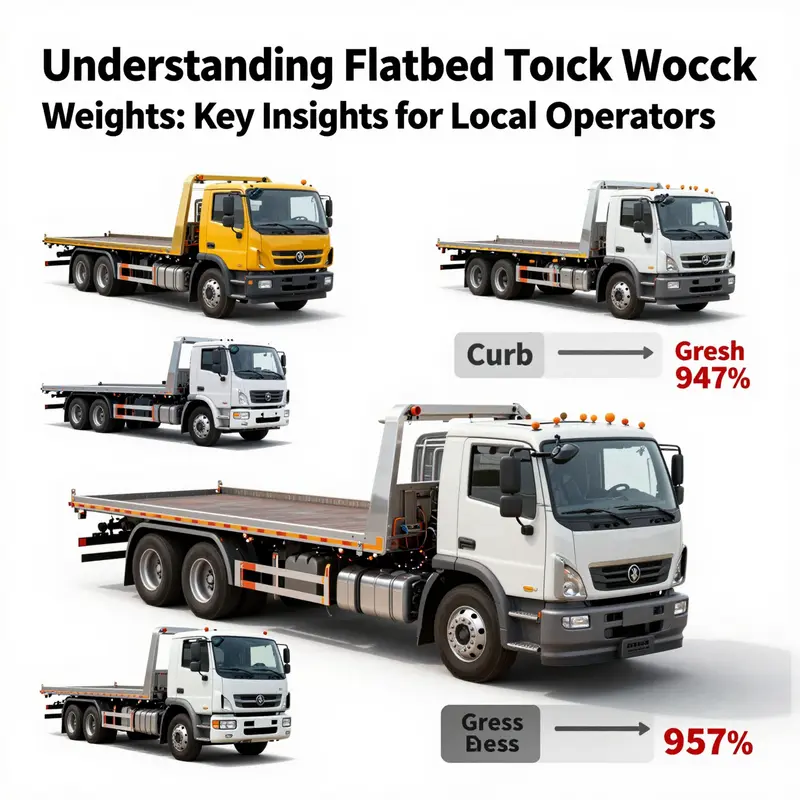
Weight is not just mass in a chassis; it is the practical hinge of how a flatbed tow truck fulfills its job. The way a flatbed is weighed reflects its purpose on the road and in the yard, guiding what it can lift, how safely it can operate, and what kind of licensing or regulation applies to its use. When a vehicle operator asks how much a flatbed tow truck weighs, the question invites a more nuanced answer than a single number. It is a story about balance: between a lightweight design that accelerates, stops, and maneuvers with ease, and a robust structure capable of absorbing the stress of heavy recoveries, hydraulic action, and long hours on duty. In practical terms, this balance shows up in two related measurements that every fleet manager and operator should understand. The first is the curb weight: the weight of the tow truck by itself, without cargo, fuel, or passengers. The second is the gross vehicle weight, or GVW, which is the maximum total weight the truck can safely carry, including its own weight, the fuel that powers it, the operator or crew, tools and equipment, and the vehicle being towed. These two values—curb weight and GVW—define a wide spectrum of flatbed configurations, and that spectrum is what yields the diverse capabilities seen in the field. On the lighter end, a compact flatbed designed for city calls can have a curb weight around 2,400 kilograms. On the heavier end, specialized recovery trucks built to haul larger or multiple vehicles can exceed 8,000 kilograms in GVW. Between these extremes lies a continuum that mirrors the variety of tasks fleets face every day: from quick, urban surface recoveries to long-haul, on-highway fleet support, and even complex roadside rescues that demand extra structural rigidity and hydraulic power. It helps to picture curb weight as the base mass of the machine and GVW as the ceiling that defines what the machine can safely carry in all conditions. Practically, this means that the payload capacity—the amount of weight the truck can carry beyond its own mass—is the difference between GVW and curb weight, adjusted for fuel, crew, tools, and the towed vehicle. If a flatbed’s curb weight is 2,430 kilograms and its GVW is 7,995 kilograms, the maximum ballast that the truck can legally bear and control is about 5,565 kilograms. That is a meaningful margin for moving a damaged car, a pickup, or a heavier commercial vehicle, but it is not limitless. The actual usable payload will vary with fuel state, passenger load, and the specific configuration of tools and stabilizers on the bed. In other words, the same GVW number can translate into different real-world payloads depending on how a particular operator budgets weight across the truck’s systems. The numbers cited in industry references, while helpful, are a starting point. They illustrate a key truth: even within a given category, flatbed tow trucks are not interchangeable. A small, 4×2 flatbed may barely scratch the surface of what a larger tow truck can confront; it is lighter, more nimble, and designed for a narrower mission. A larger, heavy-duty flatbed is built to accept a higher workload, and its weight is a direct response to that ambition. In some cases, GVWs of several models climb past 8,000 kilograms, underscoring a crucial point for operators: weight is not a nuisance to be managed but a design parameter that governs performance, safety, and regulatory compliance. The structural decisions that drive a flatbed’s weight begin with the fundamental architecture. A basic, fixed-bed design focuses on efficient load transfer and straightforward hydraulics. When the bed can tilt or slide, the hydraulic system grows more complex and heavier, but the trade-off is a wider range of recoveries and easier loading of vehicles with low ground clearance or awkward angles. A sliding bed, for instance, adds length and a series of actuators, all contributing to curb weight. Tilt mechanisms increase the bed’s range of motion and, with them, the hydraulics that power them. Rotary or rotator options—while offering near-universal payload handling—bring substantial additional mass through a combination of rotating booms, extra hydraulics, and reinforcement at the rear of the chassis. Each of these design choices shifts the weight balance in tangible ways. Materials play a role as well. High-strength steels and advanced alloys can deliver the same or greater strength with less bulk than traditional carbon steel, enabling engineers to keep curb weight lower without compromising load capacity. But the choice of material is a deliberate compromise: higher-strength metals may carry a premium price, and some configurations favor durability under the most extreme conditions rather than the lightest possible build. Beyond the materials, the specific structural layout matters. The bed thickness, the reinforcing ribs, the presence and thickness of subframes, and the geometry of the undercarriage all contribute to weight. A longer bed, a reinforced deck, and heavier cross-members increase curb weight but also distribute loads more evenly when lifting a vehicle and when braking, cornering, or braking heavily with a loaded payload. The axle configuration and drive layout likewise influence both weight and performance. A four-wheel-drive or all-wheel-drive layout offers superior traction and stability in uneven or slippery conditions, but it also adds weight and complexity to the chassis. A dual-axle rear setup can dramatically increase GVW, enabling heavier tows, but it comes with greater fuel consumption, longer stopping distances, and sometimes more stringent licensing requirements, depending on the local regulatory framework. In this sense, weight is a reflection of mission planning. Urban fleets prioritizing compact turning radii, quick response, and easier street maneuvers may favor lighter, fixed or semi-fixed beds with robust hydraulic systems that provide reliable tilt or slide features without excessive mass. On the other hand, highway-focused fleets confronting frequent long-haul calls and high-load recoveries may justify heavier constructions with stronger frames and more powerful hydraulics, accepting higher curb weight in exchange for greater confidence in performance and durability under load. The range of curb weights—down to roughly 2,430 kilograms on smaller models and climbing into the mid-fives or higher for the mid-sized configurations—illustrates how even within the same broad category, the “design-to-weight” equation is highly variable. The GVW scale reinforces that variability. Even when two trucks share a curb weight, their GVWs can diverge due to differing intended capacities and safety margins. A smaller flatbed intended for lighter payloads might carry a GVW around 7,000 to 8,000 kilograms, whereas a more robust heavy-duty model could push the ceiling past 8,000 kilograms. Those are not arbitrary numbers but a reflection of the physics of lifting and stabilizing mass on wheels. The hydraulic system itself is a principal determinant of weight. A single-acting hydraulic cylinder might offer advantages in certain operations and cost, but it can be part of a more complex system with valve control, accumulators, and safety interlocks that add weight. When designers incorporate features like a sliding bed or a tilt mechanism, the cylinder count and control systems multiply, further lifting the overall mass. At the same time, innovations in hydraulics—such as more efficient pumps, compact valve assemblies, and integrated safety features—can help offset some weight gains by enabling more effective operation per unit of weight. Materials and manufacturing standards—another major driver—shape the final mass of the vehicle. High-strength materials resist bending and breaking under heavy loads, allowing for thinner components without compromising integrity. Advanced alloys or composites can lead to meaningful weight reductions, particularly in critical areas like the bed structure or the extendable portions of the bed. Yet these materials may come with higher costs and specialized fabrication requirements. The application context is equally important. A road-speed rescue truck designed to handle rollovers or multi-vehicle incidents must withstand dynamic loads, sudden accelerations and decelerations, and lateral stresses from turning and braking with full payloads. The resulting structural reinforcement increases weight but also improves safety and resilience. In contrast, a compact unit optimized for dense urban corridors emphasizes maneuverability and rapid deployment, often trading some raw payload capacity for lighter curb weight and tighter turning geometry. The bottom line is that there is no one-size-fits-all weight profile for flatbed tow trucks. The figures that appear in catalog pages—curb weight and GVW—are not just numbers; they are signs of different roles, different engineering choices, and different expectations for how a unit will be deployed. For this reason, when a fleet or an operator evaluates a potential purchase or a rental, the weight numbers must be interpreted in the context of planned tasks. A lower curb weight is not inherently better if the vehicle cannot safely carry the intended load. Conversely, a high GVW is not a guarantee of capability if the weight of the rest of the system leaves insufficient margin for the actual pulled vehicle, fuel, and crew. In practice, this means that an operator should approach weight with the same rigor as braking performance. Reading a spec sheet should involve not only the raw numbers but also the intended deployment scenarios, maintenance needs, and the regulatory environment. A responsible decision rests on confirming that the GVW exceeds the weight of the most demanding tow and that the curb weight leaves enough headroom for fuel, operator presence, and essential equipment. It is also wise to consider the effects of aging and wear. As components wear, fuel tanks deplete, and hydraulic fluid levels fluctuate, the effective weight distribution can shift. Regular weight checks, along with maintenance of tire loads and braking systems, help preserve performance and safety over the life of the vehicle. Although there is no universal, one-page weight table across all manufacturers and models, a practical rule of thumb emerges from the collective experience of the field: the lightest flatbeds are typically the most agile and economical for city calls, but they must be paired with an adequate GVW to handle the expected payload. Heavier units offer greater payload potential and maintain stability under heavy loads, but require careful planning around licensing, fuel economy, and road usage. In any case, the weight story is a design story as well. It tells how engineers solve the tension between strength and weight, how hydraulics and deck geometry interact, and how materials enable or limit performance. For readers seeking deeper technical context on weight definitions and how they relate to road use, the external resource at the end of this chapter provides a foundational explanation of GVWR and related terms. If you want to explore more about how industry professionals interpret these numbers in practice, you can also visit the Island Tow Truck blog for practical perspectives and fleet-management insights. For additional context on the weight terminology that shapes these decisions, see the external reference: https://en.wikipedia.org/wiki/Grossvehicleweight_rating
Mass, Balance, and Mission: How Weight Shapes the Functionality of Flatbed Tow Trucks

Weight sits at the core of what a flatbed tow truck can do on any given call. It is not just a number on a spec sheet; it is the boundary between safe, effective recovery work and procedures that risk instability, mechanical stress, and unsafe loading. When we consider how much a flatbed tow truck weighs, we are really examining its capacity to perform a job. The truck’s weight, in its two most important forms—curb weight and gross vehicle weight (GVW)—determines what it can legally and safely carry, how it handles under load, and how adaptable it is to a wide range of recoveries. In simple terms, a lighter unit can move quickly and respond to a wide variety of routine jobs, but a heavier unit carries more capability for heavier tows; the trick is understanding and respecting the balance between these profiles so that the recovery operation remains controlled and predictable from start to finish.
Curb weight represents the machine in its bare form: the tow truck itself, ready to be equipped with the tools and materials needed for a recovery, with no cargo, passengers, or towed vehicle aboard. This baseline matters because it directly forms the first half of the equation for any weight-bearing task. In the spectrum of flatbed configurations, curb weight can vary widely. A compact, two-axle layout with a modest bed and limited ballast might weigh roughly 2,430 kilograms. On the other end of the scale, larger, heavier-duty models designed to haul substantial loads can push past 5,250 kilograms or more when fully rigged and ready for service. These comparisons matter every time a dispatcher assigns a job, because the curb weight combines with fuel, crew, and equipment to determine the truck’s overall mass before a single vehicle is loaded.
GVW, the maximum permissible combined weight of the truck, its payload, passengers, fuel, tools, and the loaded tow, is the critical legal and safety threshold. It is the cap that protects road surfaces, tires, brakes, and steering components from overload while preserving the vehicle’s stability during acceleration, cornering, and braking. In the published ranges for typical flatbed tow trucks, GVWs have been documented from the high seven-thousand-kilogram range up to the low eight-thousand-kilogram range. To give a sense of scale, this means that a single vehicle being recovered or transported can contribute a substantial portion of the truck’s total mass, especially in heavy-duty operations where multiple heavy items—like a damaged bus, a truck tractor, or a reinforced off-road machine—may be involved in a single incident. This is precisely why operators must never exceed the stated GVW; doing so compromises braking performance, steering feel, and the integrity of the flatbed mechanism itself. The result, in worst-case scenarios, can be a loss of control, tire failure, or a bed misalignment that makes loading treacherous and unloading hazardous.
Understanding this weight reality also helps explain why the configuration and design choices behind a flatbed are so consequential. A smaller, lighter configuration offers agility and quicker response times, making it ideal for fleet maintenance, dealership transfers, and routine road service. A larger, heavier configuration, by contrast, brings enhanced capacity for securing larger, heavier loads and for performing more demanding recoveries. The trade-off is greater mass to manage and a more pronounced impact on the vehicle’s dynamics during loading, transport, and braking. The balance is not merely about maximum numbers; it is about how those numbers interact with road grade, wind resistance, tire condition, brake heat, and suspension behavior. In practice, that means choosing the right tool for the job and applying it with discipline, so the weight advantages do not become weight penalties when the mission demands precision and stability.
Weight distribution is the second piece of the puzzle that often determines whether a flatbed handles a given recovery with poise or with risk. Modern designs increasingly use hydraulic sliding mechanisms that allow the bed to move laterally or extend beyond the bed’s base position. This capability is crucial when a vehicle sits off-center on the platform or when the tow involves an asymmetrical load—situations that frequently arise on busy streets, near heavy traffic, or on uneven ground. A bed that can shift to rebalance the weight improves loading safety, reduces the need for aggressive winching, and enhances overall control during both loading and unloading. In practical terms, better weight distribution translates into smoother transitions on the rails, less sway once the vehicle is attached, and a lower likelihood of bed tilt that could endanger the operator or bystanders. For the fleet that faces complex recoveries in an urban environment or on interchange ramps, the ability to fine-tune balance becomes a vital capability.
Under the hood, the hydraulic system that powers the bed plays an equally important role in how weight is managed during a recovery. Most flatbeds rely on robust hydraulic circuits, often featuring single-acting cylinders that apply force in one direction with a separate mechanism or counterbalance for retraction. These cylinders deliver a reliable, high-force push that helps control the bed’s movement when loading a vehicle or sliding the bed for alignment. Yet this design also comes with practical considerations. Single-acting configurations can introduce a higher initial and ongoing maintenance burden, as seals, valves, and fittings must withstand repeated cycles of heavy loading and unloading. They require careful valve control and predictable actuation to avoid abrupt bed motion that could destabilize a load or injure personnel nearby. The trade-off, however, is a mechanism that can deliver consistent, forceful engagement when needed, which is essential in high-demand industrial applications where every second counts and the safety margins must remain tight.
The net effect of these weight-related design choices is that a flatbed tow truck is not merely a transporter but a mobile platform that must preserve stability, braking efficiency, and control as it maneuvers through complex recoveries. The operator’s skill, supported by a well-chosen bed design and a properly maintained hydraulic system, aligns the truck’s weight profile with the job’s demands. When capacity is matched to the right kind of vehicle and when the bed’s geometry and hydraulics are tuned for predictable behavior, the range of recoveries expands. Heavier units can tackle larger and more valuable vehicles, and lighter units can respond quickly to routine calls while maintaining the necessary safety margins for each operation.
To bring emphasis back to the operational world, it is worth noting that the weight profile a given flatbed presents is not a static attribute. It changes with fuel levels, added ballast for stabilization, the presence of a crew aboard, and the particular configuration of tools and recovery gear loaded onto the chassis. A wheel lift, a heavy-duty winch line, ramps, and spare parts all contribute to the moment of inertia and the overall mass, influencing how the truck accelerates, climbs incline grades, or negotiates tight turns. A careful pre-mission assessment, including a quick check of the bed’s position, the bed extension or slide status, and an evaluation of the load’s center of gravity, can make the difference between a smooth operation and a risky one. In this sense, weight is not a mere constraint; it is a guiding parameter for planning, execution, and safety.
For operators who want to deepen their understanding of how weight governs capability and control, practical guidance often lives in the form of experience, procedural checklists, and ongoing maintenance. The best-equipped fleets invest in regular inspections of tire tread and pressure, braking components, suspension condition, and hydraulic lines. They also train drivers to recognize and respond to the subtle signs that a load is pushing the vehicle beyond its comfort zone—things like abnormal bed movement, unexpected sway, or a change in braking distance. These indicators, while small on their own, cumulatively signal when weight distribution or capacity is being stretched and when a safer, more conservative approach is warranted.
From a broader perspective, the conversation about weight on flatbed tow trucks intersects with fleet management and emergency response strategy. Heavier units are invaluable in rapid-response scenarios where you may need to recover a heavily damaged vehicle from a roadside incident, remove a vehicle from a wreck site, or transport a large item to a repair facility. Lighter units, meanwhile, Find steady use in daily operations, such as dealership transfers, on-call routine maintenance, and light-duty recoveries that keep the system flowing without tying up heavy equipment. The key is to map the weight profiles to the job types and to ensure that every deployment begins with a clear understanding of the vehicle’s GVW, its current curb weight with the crew and fuel, and the anticipated load. When done consistently, this approach yields safer recoveries, better utilization of equipment, and a fleet that can adapt quickly to shifting demands on the road.
For readers seeking a broader perspective on maintenance and operational readiness, further insights are available in The Island Tow Truck Blog. It provides additional context on how fleet teams manage weight, capacity, and readiness in real-world settings, helping operators connect theory with practice. The Island Tow Truck Blog.
As we step toward the next phase of this discussion, the takeaway is clear: weight is not just a static specification. It is a dynamic factor that shapes the design of the bed, the capacity to carry and tow, the safety of loading and unloading, and the overall effectiveness of emergency and routine recovery work. The weight a flatbed tow truck can carry is the most critical determinant of what it can transport, how it balances on the road, and how it performs when the job demands the most from both machine and operator. The interplay between curb weight, GVW, weight distribution, and hydraulic capability creates a platform that is as much about control and confidence as it is about brute mass. In practice, the right balance yields a tool that can bend toward the demands of the moment without breaking under pressure, preserving safety, reliability, and efficiency for the fleet that depends on it every day.
External resource for further technical detail on weight capacity and bed mechanics can be found here: https://www.towtruckworld.com/flatbed-tow-truck-weight-capacity-guide
Final thoughts
In conclusion, understanding the weight specifications of flatbed tow trucks is essential for optimizing their performance, ensuring safety, and adhering to legal limits. Both curb weight and gross vehicle weight play significant roles in how these vehicles are used within local businesses. Whether you’re a property manager, fleet operator, or auto repair shop owner, knowing these weights helps you make informed choices that enhance operational efficiency and compliance. Properly managing these factors will not only improve the lifespan of your trucks but also ensure a safe experience for drivers and passengers alike.