Understanding the nuances of tipping can be challenging, particularly in specialized service fields like towing. When it comes to AAA tow truck drivers, the question of tipping doesn’t have a one-size-fits-all answer. For local auto repair shops, car dealerships, property managers, and commercial fleet operators, grasping the expectations surrounding this practice is essential for fostering positive relationships. This article will delve into the expectations of tipping a AAA tow truck driver, shedding light on the professional context of tow truck services, and explore the exceptional circumstances when tipping may be appropriate, paving the way for informed decisions amidst the intricate landscape of roadside assistance.
null
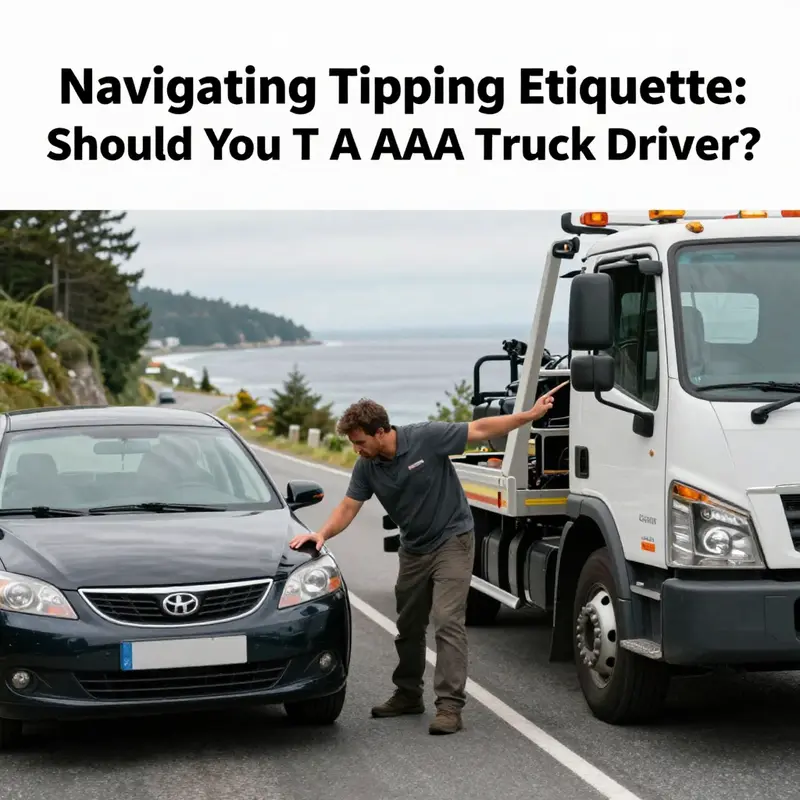
null
Tipping Within the Professional Lane: Understanding the Context and Etiquette of AAA Tow Truck Services
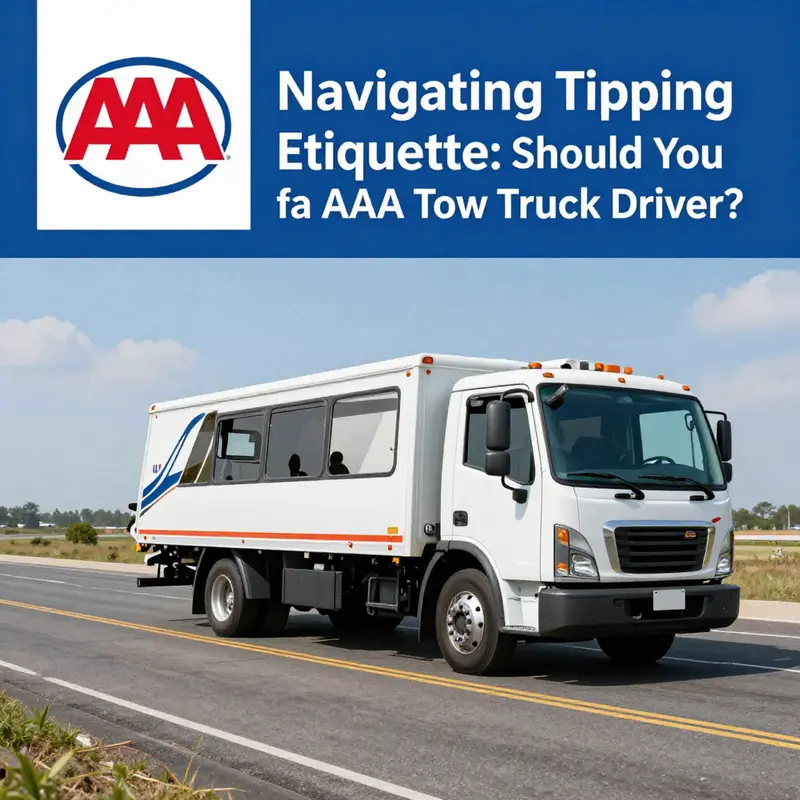
When a car breaks down or is involved in an incident on the road, the immediate concern is safety, speed, and getting back on the road as soon as possible. The person who arrives to help is more than a driver with a tow rope and a winch; they are part of a system trained to handle dangerous, unpredictable situations with skill, restraint, and adherence to strict standards. In conversations about tipping, many drivers and customers alike find themselves at a crossroads: what is expected, what is customary, and what is considered appropriate given the professional nature of the work. In the context of AAA—a membership-based organization that provides roadside assistance—this question is especially nuanced. The service you receive through AAA is typically included in your membership fee, and the tow truck driver’s role is framed as a professional service delivered under the organization’s standards. That framing matters not only for how you assess the cost of the service but also for how you approach any show of appreciation after the fact. The topic, then, is not merely about money. It is about understanding the professional context in which these services operate and recognizing when and how appreciation can be expressed in a way that respects the boundaries of policy, safety, and professional ethics.
Professional tow services sit at the intersection of transportation infrastructure and emergency response. The drivers who arrive under the AAA umbrella are often part of a larger network of licensed operators, insurance-backed providers, and safety-conscious technicians who are trained to handle a spectrum of scenarios. They are not merely pulling a car onto a tow truck for the sake of convenience; they are executing a set of tasks that require precise securing techniques, robust risk management, and a deep understanding of vehicle mechanics in a moving environment. The difference between a casual roadside lift and a professional recovery is the degree of control and predictability that the operator brings to the scene. In professional practice, that control is achieved through a combination of specialized equipment, standardized procedures, and ongoing training. This is why the industry emphasizes safety and reliability as core values. When you understand this, tipping becomes a question of context rather than a reflex.
At the heart of the professional context is the recognition that towing involves high risk and high responsibility. A flatbed tow truck, for example, provides full vehicle support and minimizes the risk of secondary damage, especially for luxury cars, all-wheel-drive vehicles, or vehicles with sensitive transmissions or suspensions. This choice of equipment is not arbitrary; it reflects a careful assessment of the vehicle’s condition, location, and potential hazards on a busy roadway. Integrated tow trucks and rotator units step in for more demanding recoveries, such as overturned loads or complex vehicle extrications. The selection of the appropriate method is a technical decision guided by training, experience, and jurisdictional regulations. It is this technical sophistication that shapes the user’s expectations: a fast, safe, and careful service that leaves the vehicle in a secure state and the owner with a clear path forward. When breakdowns happen, the service you receive is less about “special treatment” and more about applying professional practice to an urgent, real-world problem.
To understand why tipping is not typically part of the routine, it helps to consider how costs are structured in a membership model. AAA memberships are designed to cover the cost of routine roadside assistance, including towing, within the terms of the plan. The member pays a fee that reflects access to a network, dispatch services, and standardized response times, rather than a price per service rendered on the scene. In this framework, the tow driver’s compensation is funded by your membership rather than by a separate, discretionary service charge paid at the moment of service. This distinction is meaningful because it shapes both expectations and etiquette. If you view the tow as a standard component of a service plan rather than a personal favor granted by the driver, tipping tends to feel out of place. It risks signaling that the service is optional or contingent on personal gratitude rather than a professional engagement supported by a contractual arrangement.
Nonetheless, human encounters on the roadside are dynamic. There are moments when an operator goes beyond the call of duty—staying with you during a stressful situation, offering clear explanations about what is being done, or coordinating additional help when a vehicle is trapped in a tight spot. In such moments, a small token of appreciation becomes a personal gesture rather than a business transaction. The important caveat is that any gratuity should be entirely optional, discreet, and respectful of company policy. If your organization’s guidelines permit it, a modest thank-you—expressed in words, or a small, unobtrusive token—can communicate recognition without implying that the service was not mandated by the policy or that the driver’s professional obligations were optional. The best practice in these cases is to consider the driver’s comfort, the setting, and the potential impact on future service experiences. You don’t want to place the driver in an awkward position or create a perception of soliciting special treatment in subsequent interactions.
Beyond the act of tipping, there are meaningful ways to express appreciation that align with the professional nature of the service. One enduring form is feedback. A clear, constructive message to the AAA branch or the service provider can reinforce positive behavior and highlight what went well. If a driver explained complex procedures with patience, or if their calm demeanor helped de-escalate a tense moment, a specific note about these qualities can be both gratifying for the driver and useful for the organization’s training and quality assurance programs. Positive online reviews, when honest and measured, also contribute to the professional ecosystem that keeps roadside assistance robust and reliable. In a world where consumers increasingly search for evidence of professionalism, a well-crafted review can help others understand what to expect and reinforce the standards that make these services dependable in emergencies.
A practical question arises when we consider whether a tip is even appropriate in certain circumstances. What if the driver refuses or indicates that tipping is not expected? What if the service is bundled into a membership and the additional fee structure is not explicit at the moment of service? The fundamental answer remains: tipping is not a norm in the AAA towing context. Yet, the door remains open for a discretionary, modest token in exceptional cases. If you are unsure, a quick, respectful question is perfectly acceptable. You can ask something like, “Is tipping appreciated, or do you prefer that I direct thanks through the AAA feedback channel?” This approach preserves the professional boundary while acknowledging the driver’s effort when they clearly go beyond what is ordinarily required.
The etiquette of appreciation in this setting is shaped by a few practical guidelines. First, do not feel obligated to tip simply because the situation is stressful or inconvenient. The service was part of a contractual benefit, and the cost you would have paid outside a membership is often built into a broader fee structure. Second, keep the tipping discreet if you choose to offer something. A loose bill handed with a direct, quiet expression of thanks can create a moment that the driver may not want to complicate with the business policies they adhere to daily. Third, consider timing and consent. A tip offered after the service is completed, in a private moment, is less likely to disrupt the professional dynamic. Fourth, the form of appreciation matters. Cash tips, while universally understood, can carry unintended implications for company policy or tax reporting. A small, non-monetary gesture like a handwritten note, a positive comment filed through the company’s feedback system, or a brief verbal acknowledgment of specific actions can be equally meaningful but less prone to misinterpretation.
In the broader context of professional tow services, it is worth noting the standard of care that drivers are expected to uphold. These operators are trained to minimize risk, secure the load properly, and navigate complex situations with limited time and space. Their work is performed under the glare of traffic, night or day, with the vehicle’s safety as the paramount concern. The professional standard also extends to how they communicate with customers. Clear explanations about why a particular recovery method is chosen, the conditions that led to the breakdown, and the steps required to secure the vehicle are not just courteous; they are essential for safety and operational transparency. A driver who takes the time to walk a customer through these steps, to reassure them during a tense incident, or to coordinate with dispatch to ensure that the vehicle is secure until it can be properly serviced, demonstrates the professional ethos that anchors the industry.
This is not to say the customer should suppress gratitude entirely. There is a healthy balance to strike. If you want to recognize exceptional service, you can briefly acknowledge it and then direct any further appreciation through appropriate channels. For instance, after the scene has been cleared and the vehicle is safely on the way, you might say to the driver, “I appreciate how you handled that situation. I’m going to share my positive experience with the team.” Then, follow up with a detailed note or a review that describes what impressed you. This approach preserves professional boundaries while ensuring that outstanding performance is acknowledged and can foster improvements across the network. It also reinforces a culture in which high standards are recognized and reinforced, which benefits all customers who rely on these essential services.
The decision to tip, when it is contemplated, should not obscure the broader takeaway: professional tow services are built on reliability, safety, and accountability. The equipment choices—like flatbeds that minimize damage, or rotator units for extreme recoveries—reflect thoughtful engineering aimed at protecting people and property. The training and licensing requirements, the insured status of operators, and the adherence to emergency protocols collectively create an ecosystem in which the customer’s short-term need for retrieval is balanced against long-term considerations of road safety and industry integrity. In this light, tipping becomes a personal gesture that can be meaningful, but it remains optional and context-dependent.
If you are curious about how professional standards shape the field more generally, you might look to industry resources that codify best practices. Organizations such as national associations publish guidelines on vehicle securing, load management, winching techniques, and recovery operations. These standards are designed to reduce the risk of injury and equipment damage, to clarify responsibilities, and to promote a consistent level of service across providers. Reading about these guidelines can offer customers a better sense of what to expect and why certain procedures are followed. It also underlines the idea that what happens on the road is not a spontaneous act of goodwill but a controlled, technical operation governed by defined procedures and professional judgment.
In the end, the question of tipping a AAA tow truck driver is less about a fixed rule and more about a nuanced understanding of professional context. It is about recognizing that the service is part of a structured program designed to provide reliable assistance when it matters most, and about choosing how to express appreciation in a way that respects that structure. If you experience exceptional care, consider offering a sincere thank-you, and reflect that appreciation through the appropriate channels—whether that is direct feedback to the AAA branch, a thoughtful online review, or a quiet, discreet token if allowed by policy and the driver’s preferences. In doing so, you acknowledge the driver’s skill and dedication without compromising the professional integrity of the service network that keeps motorists safe when time is of the essence.
For readers seeking further context on how professional tow operations are evaluated and standardized, a broader look at industry guidelines can be informative. These standards, developed by leading associations and endorsed by regulators, cover not only the mechanics of recovery but also the ethics of service, the responsibilities of drivers, and the expectations of customers in high-stress situations. Such resources help demystify the differences between casual assistance and professional recovery. They also reinforce the understanding that tipping is not a universal obligation in the towing sphere, even as the impulse to show gratitude remains a natural human response in moments of relief and gratitude.
If you’d like to explore related discussions about safety, preparedness, and the role of professional responders, the following resources can provide additional insight while staying relevant to the practical realities of roadside assistance: the Island Tow Truck blog offers perspectives on emergency response strategies and fleet readiness, which can illuminate how professional service providers plan for and manage urgent situations. You can read more at The Island Tow Truck blog. The Island Tow Truck blog.
In closing, the ethics and etiquette of tipping in the AAA towing context reflect a careful balance between policy, professionalism, and personal gratitude. The service is environment governed by a membership model and professional standards, emphasizing safety, reliability, and accountability over discretionary gratuities. Acknowledgment should be thoughtful and appropriate to the circumstances, with a preference for non-monetary feedback or a discreet, optional tip only when it truly represents exceptional service and aligns with policy. By understanding the professional frame in which tow operators operate, customers can navigate appreciation with clarity and respect for the standards that keep road rescue efficient, trustworthy, and safe for everyone involved.
External resource for further standards and practices: https://www.nars.org/industry-resources/technical-standards
Beyond the Call: Exceptional Service and the Question of Tipping a Tow Truck Driver in a National Roadside-Assist Program
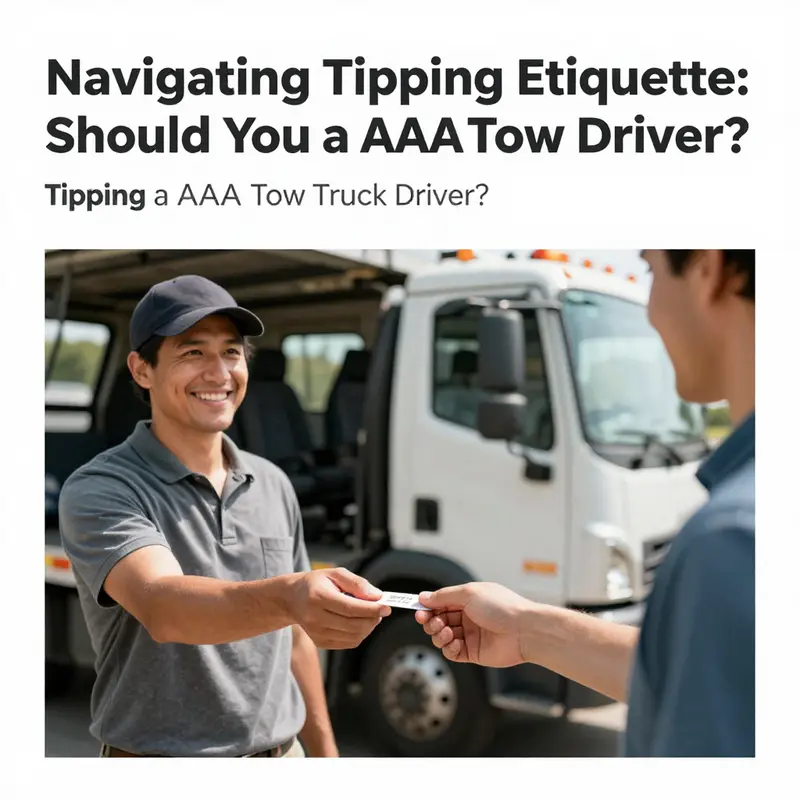
When a car stops in the middle of a road and the world seems to compress into the glow of hazard lights, the instinct to express thanks is immediate. You want to acknowledge the calm competence, the steady hand that steadies a frightened passenger, and the practical help that keeps you moving toward safety. In the broader world of roadside assistance, the answer to whether you should tip a tow truck driver can feel both practical and delicate. The service you lean on in these moments is typically bundled into a membership or a service plan, and the person who arrives is a professional working under strict standards. In most cases, tipping is not expected or required because the cost of the tow has already been covered as part of the program. Yet, as with many areas of human service, there are occasions when extraordinary efforts invite a gesture of appreciation that goes beyond a simple thank you. Understanding where tipping sits in this landscape—when it is discouraged, when it might be considered, and how to show gratitude without creating discomfort or violating policy—helps people navigate the moment with grace and clarity.
Across the spectrum of major roadside assistance organizations, the default stance is clear: tipping a tow truck driver is not an obligation. The drivers are employees or vetted contractor teams who operate under the program’s standards. Their work is professional, time-bound, and safety-driven, and the private cost you pay for the service is not a personal courtesy you owe to them in the form of cash. The underlying reason is straightforward: the service is part of a membership package, and the provider’s policy—consistent with industry norms—discourages acceptance of tips. In practice, this policy protects both the customer and the driver, ensuring that gratuities do not complicate billing, create conflicts of interest, or blur lines about what is paid for and what is given as a reward for good service in a private moment.
That said, real life rarely fits perfectly into policy language. There are moments when a tow arrives under pressure, when conditions are severe, or when a driver goes beyond the call of duty in ways that feel truly exceptional. In those rare instances, a customer may feel the impulse to show appreciation in a tangible way. The guidance that has surfaced from industry norms and the available policy statements emphasizes discretion over obligation. A small token, such as a cash gift that is clearly voluntary and non-coercive, may be considered only if the driver has already refused any accepted gratuities or if the program’s terms explicitly permit such gestures. In practice, the recommended cap tends to hover around a modest amount—often described as not exceeding twenty dollars—and even that is something the driver should be free to decline without any negative repercussions. If offered, the cash gesture should be entirely optional, free of any sense of entitlement, and accompanied by a sincere expression of thanks rather than an expectation of privilege or enhanced service in the future.
When we talk about exceptional circumstances, it helps to frame them with concrete examples. Picture a severe-weather scenario where a vehicle is stranded in a blizzard or flood, and the driver remains on scene longer than the standard tow window would require. The driver may continue to provide safety guidance, resecure the vehicle’s position, or coordinate communication with a dispatch team while you endure the elements. In such moments, the service becomes more than a simple lift from a roadside hazard; it turns into a support system that helps you navigate a dangerous environment. Another scenario involves emergency repair advice or assistance that goes beyond what a first call-offer might reasonably provide. If a driver takes extra steps to ensure your vehicle is safe to operate or to help you understand the next best action—such as advising on tire changes, battery checks, or how to proceed with a claim submission—your appreciation may feel warranted. A third scenario might involve proactive help with paperwork or with contacting your insurance, especially when the situation is chaotic or when you’re shaken and disoriented. If a driver offers these additional services or takes responsibility to guide you through a complicated process, that is when some customers consider a token amount or channeling thanks through official feedback outlets.
Even in such moments, the emphasis remains on choice rather than compulsion. A small cash gift is a potential option, but not a requirement. The phrase “not required” is crucial here, because it preserves the professional boundary that makes roadside services predictable and consistent for everyone who depends on them. If you do decide to offer a tip, you should be mindful of a few practical steps: ensure the gift is truly voluntary; present it at the end of the encounter so the driver isn’t prompted to perform additional tasks for a reward; and consider the possibility that the driver might legally or contractually be prohibited from accepting gratuities. An equally meaningful form of thanks is to provide explicit positive feedback through the program’s official channels, or to share a constructive online review that highlights the aspects of the experience that stood out—whether that was the driver’s calm demeanor, their adherence to safety protocols, or the efficiency with which they navigated a difficult situation.
The option to leave a formal review or to submit feedback is not merely a courtesy; it has tangible benefits. For the program and for future customers, such feedback helps refine response times, safety practices, and the overall customer experience. A well-placed review can elevate a driver’s profile within the team, recognizing the strength of their professional approach without complicating the payment structure. In this sense, feedback channels act as a socially agreed-upon mechanism for gratitude that respects the policy while still allowing the customer to express appreciation. If you want to pursue this route, you might describe how the driver’s actions reduced risk, clarified complex steps, or helped you stay oriented when the situation felt overwhelming. Such details matter because they translate a moment of gratitude into measurable, constructive information that can help others who rely on the same service in the future.
The question then becomes: how should a person who has benefited from this service approach the moment of gratitude? The guidance that emerges from policy documents and industry norms is pragmatic and unglamorous in the best possible way. First, ask yourself whether there is a clear policy about gratuities in the specific program you’re using. If the program’s terms state that tips are not accepted, then your safest course is to decline any cash gesture, regardless of how grateful you feel. If the policy allows for discretionary tips in special circumstances, proceed with caution: the tip should be genuinely voluntary, unobtrusive, and not expected in return for a particular outcome or level of service. In many cases, the recommended practice is to opt for a small token only if the driver has gone far beyond the ordinary duties—perhaps staying on scene longer than necessary due to safety concerns or offering critical, situation-specific advice that you could not have obtained elsewhere.
For those who want to avoid any potential misstep, there is a simple, reliable alternative to cash: channel your gratitude through official feedback channels. A thoughtful note that names specific actions the driver took and explains how those actions helped you navigate a stressful moment will be read by supervisors and may influence future service delivery. Such feedback also helps maintain the integrity of the billing and policy structure, ensuring that gratitude does not inadvertently distort incentives or expectations. In a broader sense, this approach reinforces a culture of professional excellence within the roadside assistance ecosystem. It communicates that the service is valued not for a one-off gesture, but for consistent reliability and a demonstrated commitment to safety and customer well-being.
The practical takeaway is straightforward: tipping is not the default and is not typically expected. Exceptional service can warrant appreciation, but the form that appreciation takes matters. A voluntary, modest cash gesture—if offered at all—should be clearly optional and should not be viewed as a prerequisite for better service in the future. The more dependable and scalable way to recognize exemplary work is through clear, specific feedback that highlights what the driver did well and how it made a difference in your particular circumstance. This kind of recognition sustains the professional environment that makes roadside assistance reliable for everyone who depends on it. If, after considering the policy and the situation, you still feel that a small token is appropriate, remember to keep it discreet, voluntary, and well within the bounds of policy. And if you are unsure, default to a gracious thank you and a written rating that reflects your experience.
In the end, the core of the question—do you tip a tow truck driver from a national roadside-assist program?—rests on a careful balance of policy, personal judgment, and the context of the service. The program’s design is built around predictable costs and professional service rather than discretionary gratuities. Yet human moments can bend at the edges of policy, and when they do, the safest course is to err on the side of professional courtesy and discretion. A sincere verbal thanks, supported by precise, constructive feedback, can have a meaningful impact while preserving the integrity of the service model. If you ever pause at this decision point, remember that the ultimate goal is the same as when you call for help: to restore safety and mobility with minimal friction and maximum dignity for everyone involved. For further context on how to align emergency preparedness and coordinated responses in scenarios like these—such as how to work with island-based fleets and their service teams—consider the resource on emergency preparedness for island fleets. This guide offers practical insights into planning, communication, and execution that complement the gratuity question by reinforcing how professional teams operate within structured, safety-focused systems.
External resource for official policy context: https://www.aaanationalservice.com/faq/does-aaa-accept-tips
Final thoughts
Navigating the decision to tip a AAA tow truck driver boils down to understanding the unique context of roadside assistance services. While AAA members typically do not tip as the service is incorporated in their membership, instances of exceptional service may warrant a gesture of gratitude. Whether you’re managing a fleet, operating a dealership, or simply engaged in island life, recognizing the value of service can foster goodwill and lasting relationships in the automotive community. The key takeaway—consider the context and the service received before deciding if a tip is appropriate, ensuring your appreciation is both sincere and considerate.