
Tipping practices are often a reflection of gratitude and recognition, and this extends to the tow truck industry, where drivers face challenging conditions daily. For businesses involved in auto repair, car sales, and fleet management, creating a culture of appreciation for service providers like tow truck drivers can enhance relationships and improve service experiences. This article tackles the importance of tipping tow truck drivers, examines industry standards, provides guidelines for gratuity amounts, looks at situational factors affecting tipping, and discusses the impact of customer experience on driver satisfaction. By the end, you’ll have a comprehensive understanding of the nuances involved in tipping these essential service providers.
Tow and Thank You: The Subtle Ethics and Practicality of Tipping Tow Truck Drivers
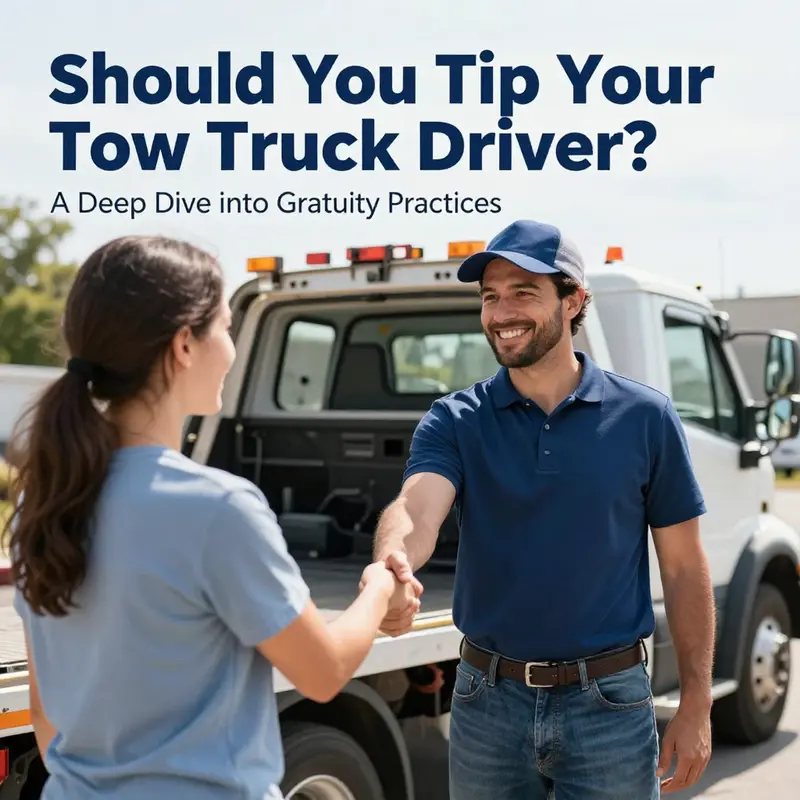
When a roadside emergency drops you into a moment of danger and uncertainty, the arrival of a tow truck can feel like a lifeline. The driver steps into a scene that is often chaotic: flashing lights, slick pavement, weather that can turn relief into risk in seconds, and a vehicle that must be moved with care and precision. In that charged setting, a small gesture can carry more meaning than it might seem at first glance. The question of tipping a tow truck driver sits at the intersection of gratitude, fairness, and practical economics. It’s a topic many people treat as a rule of etiquette rather than a straightforward business gesture, but the realities behind it deserve careful attention. Towing services operate in a space where pricing is frequently regulated, especially for emergency or accident-related calls. Fees are often set by state laws or municipal regulations and may not be discretionary in the way a restaurant tip is. In such circumstances, the driver’s compensation structure can feel out of the customer’s control. Yet even within that framework, tipping emerges as a meaningful, if not mandatory, form of acknowledgment for a job done under pressure and in challenging conditions. The core of the discussion rests not on a bare yes or no to tipping, but on understanding what tipping represents in the tow industry and how to apply it in a way that respects both the service provided and the realities of the driver’s situation.
The practical backdrop is clear: many tow truck drivers earn a base wage that is modest, with a substantial portion of their earnings historically reliant on tips. This is common in service sectors where the labor is physically demanding, requires long hours, and involves risk—elements that do not always align with base pay. It’s also worth noting that some companies include gratuities as part of an invoice, while others do not. In the latter case, a tip becomes a voluntary expression of appreciation for service that goes beyond the routine. The balance between policy and practice is delicate. On the one hand, drivers are often bound by pricing structures that are regulated. On the other hand, the quality of the service—the driver’s professionalism, efficiency, safety-minded approach, and willingness to assist beyond the minimum duties—creates a value proposition that many customers recognize and wish to reward. In this sense, tipping can reflect a genuine assessment of the driver’s performance rather than an obligation tied to the bill itself. When you consider this dynamic, tipping becomes less about conforming to a rigid norm and more about communicating gratitude for someone who has navigated a stressful situation with care.
Guidance from industry observers and consumer advice highlights a practical framework for deciding whether to tip and, if so, how much. A widely cited rule of thumb is to tip somewhere in the 10 percent to 20 percent range of the total tow service cost. The exact percentage depends on the level of service and your satisfaction with the outcome. A straightforward, short-distance tow that proceeds smoothly may warrant a 10 percent gratuity, a modest and respectful acknowledgment of effort. When the situation is more demanding—recovering a vehicle from ditch, maneuvering in heavy rain or snow, or dealing with a high-value car—many customers choose 15 percent to 20 percent as a reflection of the extra risk, skill, and patience involved. If the driver goes beyond the call of duty—offering roadside advice, assisting with minor checks, or providing guidance on the next steps—there is a compelling case for a larger tip. The calculus, however, remains highly personal. Tipping is not a universal expectation, and in many jurisdictions, it is not a formal part of the service agreement. The key is to align your gratuity with the level of personal value you received from the encounter, not with a fixed script.
Beyond the numbers, the ethical and practical context matters. The towing industry has long recognized that the customer’s perception of service quality shapes the driver’s reputation and, by extension, the business’s ability to retain customers in a competitive market. While tipping is not mandated, it is a meaningful way to acknowledge the knowledge and professionalism that keep people safe and vehicles operational. In practical terms, you should first check whether the company includes a tip in the invoice. If the tip is not included and you are satisfied with the service, a gratuity of at least 10 percent of the total charge is a reasonable starting point. In exceptional cases—such as when a driver has to navigate hazardous conditions, work exceptionally long hours, or assist with additional tasks beyond towing—consider tipping more generously. This approach respects the driver’s skill and the extra effort required to achieve a successful outcome in challenging circumstances.
There are legitimate caveats to this stance. For one, tipping should never feel coercive. Some drivers may explicitly request no tips, either due to company policy or personal preference, and customers should honor those boundaries. For another, the regulatory pricing structures surrounding towing services can strip some of the discretionary flexibility that tipping others in the service industries enjoy. Even so, tipping remains a practical and humane way to recognize a job well done, particularly when the driver’s actions reduce risk, increase safety, or provide crucial guidance during a stressful episode. It is also important to consider how you pay the tip. Cash can be a quick, direct form of gratitude, but many customers pay by card through the company’s payment system. If you choose to tip with a credit or debit card, make sure the driver is comfortable with handling the payment in that manner and that the tip is clearly connected to the service received. In all cases, a brief expression of gratitude can be just as valuable as a monetary gesture, especially when delivered with courtesy and respect for the driver’s expertise.
For readers seeking a broader sense of how tipping is framed within towing culture, a quick look at industry discussions can be illuminating. The broader dialogue often points to a balance between policy and generosity. If you want to explore more about towing industry norms beyond tipping, a resource such as the Island Tow Truck blog offers in-depth discussions on related topics and practical insights for both customers and fleets. The blog serves as a useful companion to the practical questions raised in this chapter, helping readers understand how professionals approach emergencies, safety, and service quality in real-world settings. You can visit the resource through the page linked to the blog for further context and guidance. The Island Tow Truck blog.
The discussion around tipping also intersects with broader consumer rights and safety considerations. Official guidance, including the role of the Federal Motor Carrier Safety Administration (FMCSA) in overseeing commercial vehicle operations and safety regulations for tow services, provides essential context for understanding why pricing may be regulated in certain scenarios. The key takeaway is that tipping is not a formal component of service pricing in many cases, but customer appreciation remains a valuable signal of service quality. The practical takeaway for most readers is simple: before you tip, verify whether a tip is expected or included, assess the level of service you received, and decide on a gratuity that feels fair given the circumstances. A normal yardstick—10 percent, up to 20 percent for more demanding tasks—offers a useful baseline, while adjusting for conditions such as weather, the vehicle’s value, the complexity of the recovery, and any extra help provided by the driver.
In real-world terms, this means you can approach tipping with a clear, principled mindset rather than a sense of guilt or obligation. You might find yourself in a situation where the tow is a straightforward, single-move operation, and a small tip seems appropriate to acknowledge promptness and professionalism. On another occasion, you could be facing a long, difficult recovery in the dark, with weather and road hazards compounding the challenge. In that scenario, a more substantial gratuity aligns with the risk and the extra effort involved. The core message is straightforward: tipping, when offered, should reflect the value the driver added to your sense of safety and the practical outcome of the service.
As you navigate these decisions, remember that tipping is, at its core, human reciprocity. It is a way of saying, in a tangible form, that you recognize the driver’s competence and the care they showed in a high-stakes moment. It is not a legal requirement, nor should it ever be used as a metric that prioritizes one driver over another. It is, instead, a personal judgment rooted in the quality of service, the circumstances of the tow, and the customer’s capacity to express appreciation. The most prudent approach is a blend of courtesy, respect for policy, and a thoughtful assessment of the service quality you received. In the end, you are not just paying for a service; you are acknowledging a difficult job done well, often under pressure, with attention to safety, efficiency, and professionalism. For those who want to delve deeper into why the practice exists and how it is evolving, the linked external resources offer broader perspectives on tipping norms and consumer expectations in the towing industry. For further reading, see The New York Times tipping piece on tow-truck drivers, which provides additional context about how tipping fits into mainstream expectations.
External reference for deeper context: The New York Times tipping piece
Tipping Tow Trucks: Rethinking the Gesture in a Fixed-Price Service
Tow services are a peculiar kind of emergency work. They appear on the scene in moments of disruption, often under pressure, in weather extremes, and with vehicles that may be damaged or immobile. In these conditions, a driver is not just moving a car from one place to another; they are managing safety, traffic, and the specifics of a vehicle that may be unfamiliar to a layperson. It is within this context that the question of tipping arises, and the answer, when viewed through recent industry findings, diverges from the long-standing stereotype of tipping as a universal reward for good service. The prevailing research, including perspectives gathered from industry analysis and regulatory guidance, points toward tow-industry practices built around fixed pricing rather than discretionary gratuity. In other words, the standard for towing services is typically to agree on a fee before the work begins, with the price determined by distance, vehicle type, urgency, and the logistics of the pull or winching required. In that frame, tipping is not an expectation or a routine component of the transaction. The driver’s income is expected to come from the service fee and their base pay, rather than from customer gratuities. It is a subtle, but important distinction that reframes how a customer might evaluate the encounter and express appreciation if they feel it is warranted.
This is not to deny the human reality of the work. Tow operators often perform physically demanding tasks that require careful handling of heavy gear, precise vehicle positioning, and the navigation of hazardous conditions—whether slick roads, poor lighting, or the complexity of recovering a car from a ditch or an awkward angle. These factors contribute to the real value of the service, yet they do not automatically translate into a universal custom of tipping. Industry commentary has highlighted that while some customers may offer gratuities or feel moved to reward excellence, there is no formal or universal tipping standard within towing. The pricing model itself tends to be transparent and prearranged: a quote is given, terms are discussed, and the job proceeds with a price that reflects the scope and risk involved. In this sense, the professional service is structured as a fixed-fee, not a discretionary gratuity model. When a consumer asks whether they should tip, the most consistent guidance across professional sources is that tipping is not expected and should not be considered part of the standard transaction.
The implications for the consumer are practical and simple. First, always review the invoice or service agreement. If the company explicitly includes a gratuity or tip line in the bill, that line is not optional in the sense of standard etiquette—it is part of the accepted payment for that particular job. If the tip is not included, and the service was delivered to the customer’s satisfaction, there is no obligation to add one. This approach aligns with the pricing structure and avoids the potential confusion that can occur when tipping is uncertain or irregular. In more routine tow scenarios—such as a standard short-distance tow or a straightforward recovery—the absence of a tipping expectation is a consistent signal about pricing norms and service economics. The customer can still acknowledge the driver’s professionalism in other ways if they wish to show appreciation, but those gestures should be calibrated to align with the industry norm rather than personal obligation.
There is room for thoughtful nuance, of course. If the driver goes beyond standard duties—say they stay late during bad weather to ensure the car is safely secured, offer actionable roadside advice, or perform an additional task that substantially eases the customer’s predicament—a customer might feel compelled to express gratitude. However, even in such cases, it is important to recognize that gratuities are not the established currency of this service. A sincere verbal acknowledgment or a brief note of thanks can convey appreciation without implying a tipping expectation for future encounters. In fact, tipping in a context where it is not expected can inadvertently create confusion for the driver or the company, especially if the policy varies by location, employer, or the type of tow being performed. The practical takeaway is to treat the invoiced price as the service value and to consider non-monetary expressions of gratitude when warranted.
This broader view dovetails with the professional framework many tow operators emphasize. Towing is a professional service with fixed pricing designed to reflect the complexity, urgency, and safety considerations of a given situation. The driver’s task is to provide a reliable, safe solution within those constraints, and their effectiveness is measured by the end result—whether the vehicle is transported securely, whether the scene is left safe for other road users, and whether the customer feels informed and respected throughout the process. In this light, tipping becomes less about rewarding a personal degree of kindness and more about clarifying expectations—both for the customer and for future engagements with the same provider. Acknowledging this distinction can help prevent awkward or inconsistent tipping practices that might otherwise arise from uncertain norms.
For readers seeking guidance that aligns with this framework, the practical route is straightforward. Begin by inspecting the invoice to see whether gratuity is included. If it is not, there is no obligation to tip. If the service met or exceeded professional standards, the most constructive forms of appreciation are often non-monetary: a courteous word, a clear note of thanks, or even a positive review that highlights the driver’s professionalism and safety-minded approach. These gestures reinforce good service without implying a gratuity expectation that could complicate future transactions with the same company—or with others who may interpret tipping differently. If you want to deepen your understanding of how such guidelines intersect with broader roadside and fleet management practices, you can explore resources on emergency-response planning and how fleets prepare for sudden roadside incidents, such as the strategies outlined in essential fleet emergency-response frameworks. For more on that front, you can read through the material at the following resource: essential fleet emergency-response strategies.
In addition to the substantive discussion of tipping norms, it is helpful to situate this topic within the wider landscape of towing regulation and road safety. Transportation authorities have long emphasized the professional nature of towing work and the importance of clear pricing and transparent billing. While many consumers expect some level of gratuity in say, a restaurant or a hospitality setting, the towing industry is distinct in its pricing conventions and the way services are structured. This distinction is reinforced by guidance from regulatory bodies that emphasize safety, reliability, and accountability in vehicle towing and roadworthiness. The underlying message is not simply about whether to hand over cash; it is about choosing a service that is priced fairly, delivered with competence, and communicated clearly at the outset of the engagement. When customers approach towing with this frame of reference, they can better assess the encounter and align their expressions of appreciation with the normative practices of the industry. It also helps ensure that drivers are valued for their skill and safety-conscious approach rather than perceived as reliant on discretionary gratuities to supplement their income.
As a reader navigates the decision in a real-world scenario, the nuanced conclusion from the current body of results is clear: tipping is not a standard practice in towing, and it should not be expected. If you decide to engage with a driver under this paradigm, your best course is to treat the invoice as the complete price for the service, acknowledge the driver’s competence and professionalism, and consider non-monetary forms of gratitude when appropriate. This approach preserves fairness and clarity for both customer and provider, while still recognizing the demanding nature of the work and the importance of courteous, respectful interaction on the roadside. The discussion of tipping, then, becomes less about a universal rule and more about aligning expectations with the realities of a fixed-price, professional service.
External resource: National Highway Traffic Safety Administration (NHTSA) – Vehicle Towings and Roadworthiness can provide additional context on towing regulations and safety standards. See https://www.nhtsa.gov/vehicle-towing-and-roadworthiness for more information on how towing fits into broader transportation safety and policy considerations.
Tow Line Etiquette: How Much to Tip Tow Truck Drivers
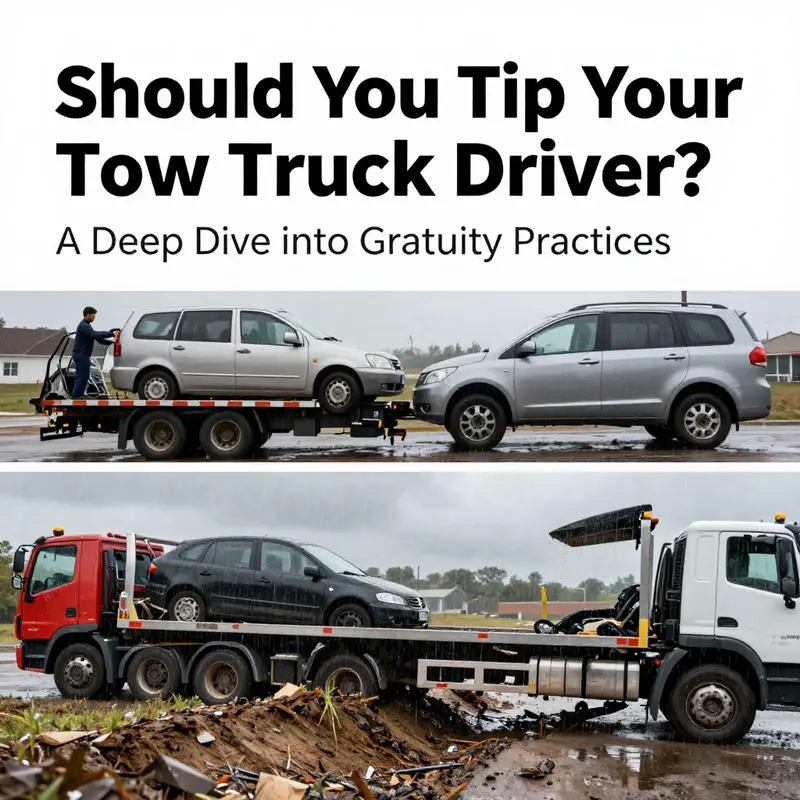
When a tow truck arrives, a practical ritual unfolds. The driver surveys the scene, asks a few essential questions, and moves with a calm efficiency built from years on the road. In a matter of minutes a stranger becomes a steady presence you can rely on to navigate a stressful moment.
Tipping in this context is not a reward for luck but a recognition of skill, caution, and clear communication. Tow work blends technical know how with the sensitivity to handle your vehicle and your emotions at a vulnerable time. A thoughtful tip acknowledges the labor that keeps people safe and on the move.
Consider the cost of the tow and the level of service when deciding how much to give. A common guideline is to tip a portion of the tow fee, with more for complex recoveries or high value vehicles and a bit less for routine transports. For example, tipping around 15 to 20 percent of the total charge is a reasonable baseline, with adjustments for safety, courtesy, and extra effort.
Some invoices may already include gratuity. If so, you can adjust your tip accordingly or opt to skip it. If no gratuity is included, a tip in the thoughtful range reflects appreciation without inflating the price of the service.
Practical tips for tipping include paying cash if possible, or using a digital method if that is the norm in your area. It helps to have a small amount ready so you are not scrambling in a stressful moment. And if the service was unsafe or careless, it is appropriate to withhold extra tipping and to provide feedback to the dispatcher after the fact.
Beyond the moment, tipping etiquette fits into broader conversations about fair pay and professional respect in service industries. A tip is a personal signal that you value competence and care, and that you recognize the driver’s role in getting you back on the road.
null
null
Tow Line Etiquette: Weighing Customer Experience, Driver Satisfaction, and the Question of Tips
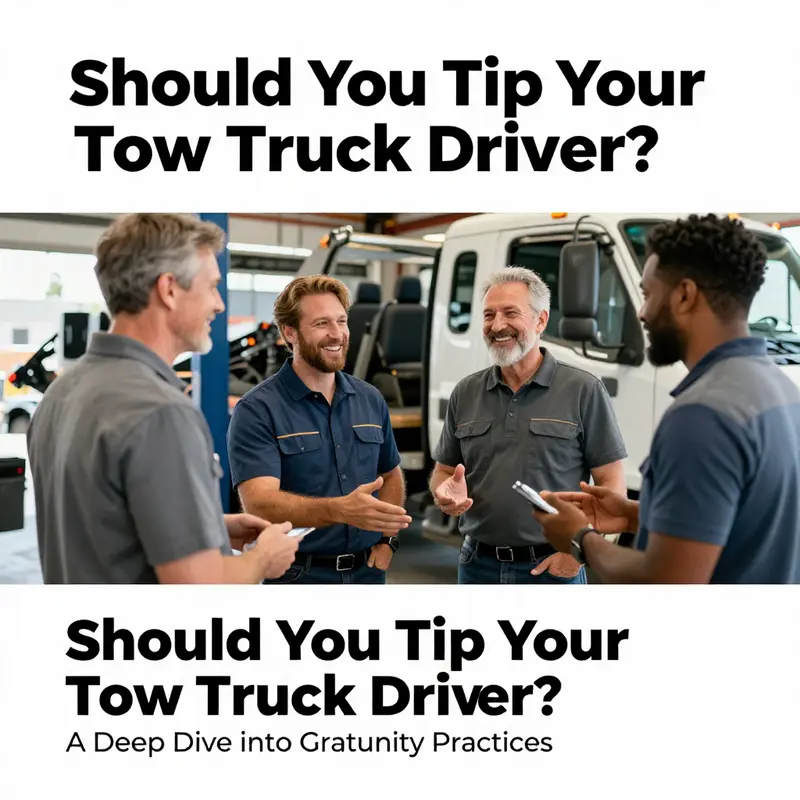
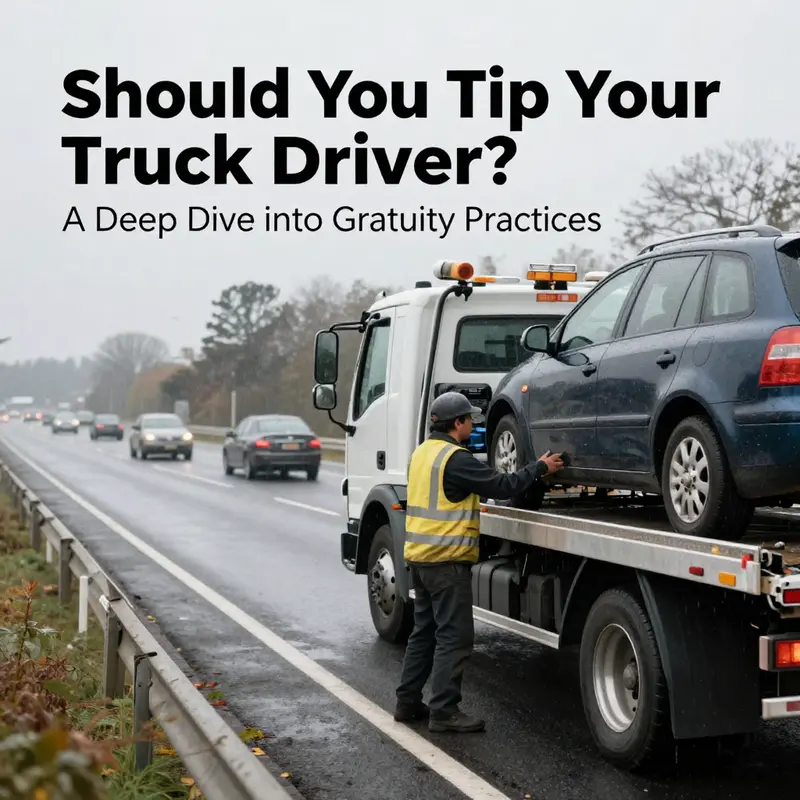
When you call for help on a roadside crisis, time slows and judgments feel oversized. A tow truck arrives; the driver steps out with a steady pace, and the immediate concern shifts from the vehicle to the person who will move it. Tipping becomes more than a custom; it signals how you value expertise, safety, and the stress of a difficult job. The question should I tip a tow truck driver is not simply about dollars. It reflects expectations, pricing, and how communities recognize the labor that keeps traffic moving. The debate around tipping in towing is not monolithic. It threads through regional norms, company policies, and the unpredictable realities of road service. Some voices insist tipping is standard practice, a way to acknowledge skill and courage under pressure. Others argue that tipping is optional or unnecessary, and that a fair wage with transparent pricing should stand on its own. Your stance may vary by location, provider, and the service performed. Either way, understanding the landscape helps you navigate the moment with fairness for everyone involved, including the driver, the dispatcher, and the person waiting on the curb.\n\nIn the broader conversation, two threads often appear. On one side, the economic argument frames the driver as a professional who bears risk, carries training, and works in unpredictable conditions. The base wage is often complemented by tips that reflect service quality and extra effort. In many service industries gratuities are part of income, and customers add compensation for efficiency, courtesy, and problem solving under duress. When a driver handles a tricky maneuver, a tip can feel like a direct acknowledgment of skill and commitment. The logic is straightforward: when the service exceeds expectations, tipping helps align incentives and supports drivers who work long hours under challenging conditions.\n\nOn the other side, tipping is optional or discouraged in some contexts. Here the emphasis is on pricing, transparency, and company policy. Towing fees are often set by local rules, not by tips. Tipping might complicate the relation by creating a private subsidy in a service with a defined price. There is also a concern about misinterpretation: a tip could imply dissatisfaction with base pay or create confusion about what constitutes acceptable service. Gratitude can be expressed through prompt payment, and a positive word to the company, rather than cash handed to a driver who says that tipping is not expected. This view does not deny the value of a thoughtful gesture; it reframes it as discretionary and not something that should distort professional boundaries.\n\nYet reality often sits between those poles. Some operators include gratuity in the invoice, others do not. The same city may host households with a tradition of tipping and others with little. In practice, tipping is shaped by service quality, complexity, and situational factors. For a standard tow, the task is straightforward and the driver is mainly tasked with safe, legal movement. A tip might be modest or unnecessary depending on local norms and the company policy. If the driver faced a difficult recovery in bad weather, or a recovery of a high value vehicle, the extra effort can be meaningful. A tip in such cases signals appreciation for time, risk, and care.\n\nAs you decide, a practical lens helps: what does the invoice say, and what is the value of the service received? If gratuity is included, a separate tip could be redundant or seen as over tipping. If no tip is listed and you are satisfied, a tip can be an extra thank you for careful handling, clear communication, and calm professionalism. If you are unsure, ask if gratuity is part of pricing and decide after you have seen the service, not as a reflex before you know what you are receiving.\n\nA simple framework for readers: if the service was professional and straightforward, consider a small tip, perhaps around 5 to 10 percent of the total. If the situation was more complex—recovering from a ditch, difficult weather, or rescuing a high value vehicle—a larger tip in the 10 to 20 percent range might be appropriate. When the driver goes beyond the call of duty, offering extra roadside help or exceptional courtesy, a more generous gesture is reasonable.\n\nTo avoid awkwardness, treat tipping as a separate decision from payment. Confirm the total, check whether gratuity is included, and then decide. If you decide not to tip, express gratitude verbally and perhaps praise the company. If you want broader context, consider reading consumer etiquette guidance and industry discussions on towing practices. The aim is to support fair compensation while recognizing good service, and to maintain clear boundaries between customer, driver, and company.\n\nThis chapter does not claim to settle a big debate, but it offers a practical, empathetic approach to tipping in towing. It invites readers to see tipping as a signal of respect for skill and risk, while recognizing that gratitude can be expressed in many ways beyond cash. A courteous word, a clear review, a transparent transaction, and respectful interaction all contribute to a climate in which drivers feel valued and customers feel their urgent needs were met with competence and care.\n\nFor readers seeking additional perspectives, reputable outlets on consumer etiquette in specialized services can be helpful. The tipping question remains a spectrum, flexible enough to adapt to local norms, company policies, and the unpredictable nature of roadside emergencies. When you approach the situation with awareness of these dynamics, you can choose in line with your values, support fair pay, and preserve trust in quick, safe roadside assistance.
Final thoughts
Tipping tow truck drivers is more than just a customary practice; it’s a way to acknowledge their hard work and dedication, especially in challenging conditions. By understanding the nuances around tipping, such as industry standards, situational factors, and the influence of customer experience, those in auto repair, car dealerships, property management, and commercial fleet operations can foster a culture of appreciation and enhance service interactions. It’s imperative to consistently show gratitude through tipping, not just as an obligation, but as a reflection of the professionalism and efforts of tow truck drivers navigating the complexities of their job.