Half-ton trucks, such as the Ford F-150 and Chevy Silverado 1500, have become indispensable in various local operations due to their remarkable versatility and towing capabilities. A proper understanding of how much weight these trucks can tow is crucial for property managers, commercial fleet operators, and resort owners alike. In this journey, we’ll explore the nuances of half-ton truck towing capacity, the vital factors that influence these limits, a detailed evaluation of different models, and best practices to ensure safe towing. Each chapter providing insights will not only aid in making informed decisions but also enable the continued success of your operations in our vibrant island community.
Tow Limits Revealed: The Real Weight Thresholds and What They Mean for a Half-Ton Pickup
A half-ton pickup is lauded for its versatility, serving as a family hauler, a workhorse, and a practical tow vehicle all in one package. When people ask how much weight such a truck can tow, the instinct is to pull a number straight from a spec sheet and treat it as a fixed ceiling. In truth, the answer is more nuanced. The official towing capacity you see published for a half-ton pickup—usually quoted in the broad range of about 7,000 to 12,000 pounds—is a maximum trailer weight under ideal conditions and with the right equipment. It is a ceiling, not a target to chase on every trip. Understanding what sits beneath that ceiling helps drivers make safer, smarter choices on the road and when hitching up in the driveway.
The published maximum is a value determined by the vehicle manufacturer through a combination of testing and engineering limits. It reflects how much trailer weight the powertrain, cooling system, transmission, brakes, chassis, and tires can handle when the truck is not burdened by other weight in the cab or bed. Exceeding that limit is not simply a bad idea; it is unsafe and can lead to reduced braking effectiveness, increased stopping distances, sway, overheating, and, in the worst cases, loss of control. The manual and the placard on the driver’s door frame are the two most reliable sources for the exact limit on a specific truck. This emphasis on the exact spec is essential because not all half-ton pickups in the same class are created equal. Different model years, engines, drivetrains, and optional towing packages interact in ways that can push or pull the published maximum up or down.
A broad takeaway is that base configurations with smaller engines tend to land toward the lower end of the spectrum, while well-equipped versions with robust engines and heavy-duty towing packages can push toward the upper end. In plain terms, if you own a basic model with a smaller engine, expect your peak towing figure to hover around 7,000 to 8,000 pounds. If you add a more powerful engine and opt for a factory towing package designed to handle heavier loads, you can approach or even exceed 10,000 pounds in some configurations and, in rare cases, approach 12,000 pounds. This spectrum is not a marketing blip; it reflects real engineering and testing outcomes when the vehicle is in its most favorable condition for towing. It is important to remember that these are maximums, and most practical towing tasks sit well below them, with margins built in for safety and reliability.
To anchor this discussion in the framework of what drivers actually experience, it is helpful to consider two parallel concepts that cap the usable towing capacity: the gross combined weight rating (GCWR) and the tongue weight that sits on the hitch. The GCWR represents the total allowable weight of the truck plus the trailer and everything loaded in them. It is a limiting figure that accounts for everything exerting force on the vehicle during movement, including passengers and cargo in the cab and bed, the trailer’s own weight, and the payload of any living or inert cargo in the trailer. Tongue weight, typically around 10 to 15 percent of the trailer’s gross weight, matters for stability. If the tongue weight is too light, trailer sway can become a hazard; if it is too heavy, steering and braking can degrade performance. These physics are why the published maximum towing capacity is not the only number you must watch. A truck that is loaded near its tongue and payload limits will feel different in handling than a truck carrying a lighter load with the same trailer.
This science of weights also underscores an important practical principle: towing capacity is highly sensitive to the configuration of the truck itself. The body, chassis, suspension tuning, axle ratio, and the presence or absence of a towing package all tilt the odds one way or another. A basic configuration with a smaller engine will typically tow less, whereas an optioned-out configuration with a bigger engine and a heavy-duty towing package can raise the ceiling. However, even with the theoretical maximum being higher, real-world towing is still constrained by the truck’s payload capacity—the weight you can add in the cab and on the bed without exceeding the vehicle’s design limits. When you combine a loaded trailer with passengers and cargo in the truck, the available headroom for a trailer shrinks quickly. This interplay is why many drivers discover that the practical towing limit, for daily use, sits well below the published maximum.
The driver’s responsibility is to translate these numbers into a safe, legal, and sane plan for each trip. The owner’s manual and the tire placard are your first stop for the exact ratings on your particular truck. The manual also provides crucial guidance about maintenance, weight distribution, and recommended hitching practices. A misstep in any of these areas can turn an otherwise simple tow into a hazardous situation. A fundamental rule is to respect the published limits and to perform a careful calculation that accounts for all weights involved, including occupants, cargo, and fuel. The moment you start to toy with the published ceiling—by trying to tow a heavier trailer than recommended or by allowing payload to exceed its rating—your safety margin erodes and so does your warranty protection. This is not a suggestion to be cautious for caution’s sake; it is a straightforward acknowledgment that the numbers exist to balance performance, safety, and reliability over the life of the vehicle.
The range of 7,000 to 12,000 pounds is not a one-size-fits-all prescription. It is a map of possibilities that depend on the vehicle’s exact build. A base-model half-ton with a standard V6 engine is likely to sit toward the lower end of that map, while a well-equipped model with a bigger engine, perhaps an updated induction system, and a heavy-duty towing package can navigate closer to the top end. This is not merely hypothetical. It reflects real engineering choices that manufacturers make to broaden the capability of the half-ton class without compromising everyday drivability, fuel economy, and warranty protections. The precise limit for any individual truck, however, is carved out by the combination of the engine’s torque, the transmission’s ability to handle sustained load, the cooling system’s capacity to shed heat, the structural integrity of the frame, the braking system’s adequacy for stopping a heavy trailer, and the overall stability when under load. These are the engineering guardrails that define what a particular vehicle can safely tow.
What does this mean for someone shopping in this class or already owning a half-ton pickup? It means a careful, numbers-informed approach is essential. If you are in the market, ask to see the specific vehicle’s towing chart, which details the maximum trailer weight for the exact engine and drivetrain combination and for the presence or absence of towing equipment. If you already own a truck, your best bet is to pull the relevant numbers from the owner’s manual and the door placard, then do the math with your planned load. It also means recognizing that not every towing task is eligible for the maximum rating. For instance, long-distance towing on hot days, towing up steep grades, or carrying heavy payloads in the truck itself reduces the margin available for the trailer. In such cases, the safest choice may be to downsize the trailer weight or to consider a heavier-spec vehicle designed for higher capacities.
To connect these concepts to a concrete decision-making process, imagine you are planning a weekend haul of equipment and gear. Suppose the trailer’s gross weight is 8,000 pounds. If your truck’s tongue weight comes in at roughly 8,000 pounds times 12 percent, that’s about 960 pounds. The rest of the trailer’s weight sits behind the hitch as dynamic load. Now add in the weight of passengers and cargo in the cabin and bed. If the truck’s payload rating is 1,500 pounds, you can see how quickly the numbers can align or clash. If you have two adults and a loaded toolbox in the bed weighing 500 pounds, you have 1,000 pounds of payload left. That means the trailer could be heavier than the max if you push beyond 960 pounds on the tongue and the combined load begins to approach the GCWR. In other words, the practical limit is not simply the trailer weight. It is the balance of all weights acting on the system during motion. Such balancing acts often push everyday expectations toward more moderate towing tasks than the published peak capacity would allow.
For readers who want to connect this domain knowledge to the realities of fleets and emergency response, the practical takeaway is that towing capacity matters, but reliability, handling, and predictability matter just as much. The decisions you make about towing weight influence not only fuel and maintenance costs but also the safety of drivers and bystanders. In fleet contexts, where vehicles routinely haul equipment and supplies, the margin between a successful tow and a dangerous situation can hinge on properly matched cargo, a well-tuned vehicle, and a driver who understands how a loaded trailer changes handling characteristics. It is here that the nuanced understanding of the published limits—along with a disciplined approach to load calculation and trip planning—becomes invaluable. If you want to explore practical, fleet-oriented nuances and emergency response considerations that tie into the broader topic of towing with half-ton pickups, you can visit practical resources through industry-focused content that keeps safety at the center of decision-making. The Island Tow Truck blog offers a breadth of perspectives that complement the core concepts discussed here by translating weight, load, and stability into actionable, real-world guidance for operators and enthusiasts alike.
Beyond the math and the manuals, there is a core mindset that governs safe towing with a half-ton pickup: respect the data, respect the vehicle, and respect the road. The published maximum is a tool, not a permission slip. It gives engineers and manufacturers a target to ensure reliability over the life of the vehicle. It gives drivers a framework for planning. And it gives operators a reminder that performance cannot be divorced from safety. In everyday use, most trips do not come close to the upper limit, and many are nowhere near the payload thresholds that would encroach on the trailer’s stability. But when circumstance does push toward the outer edge—whether due to a heavy load, a high-altitude route, or a long, winding grade—the prudent course is clear: choose a lighter trailer, reduce payload, or select a configuration that provides more headroom. Finally, always verify your numbers, as manufacturers may adjust ratings across model years or in response to regulatory changes. Keeping the manual handy and the door placard visible ensures you stay aligned with the vehicle’s design intentions and legal requirements.
For readers seeking a more technical reference on official specifications, consult the external resource that details towing capacity and the related performance criteria established by vehicle manufacturers. This information helps ground the discussion in formal documentation and supports a grounded approach to decision-making when planning any tow task. See the official specifications for broader context and precise figures for the exact configuration you own or are considering. https://www.ford.com/trucks/f-150/specs/
Tow Truths: Understanding Half-Ton Towing Reality

A half-ton truck is a weight class as much as a vehicle type. The label signals capabilities, not a single number you should rely on in every situation. Real towing power depends on a mix of curb weight, payload, drivetrain, and equipment. In practice, you can safely tow a broad range, but the exact ceiling is defined by GCWR (gross combined weight rating) and the manufacturer’s tow rating for your specific configuration. To tow safely, you must stay within GCWR, keep tongue weight in the recommended range, and consider road conditions, weather, and brake setup. In short: the half-ton label is a starting point, not a guarantee of a fixed maximum.
To plan a tow, check the GVWR and GCWR in the owner’s manual, calculate the truck’s curb weight plus payload, and ensure that the trailer’s weight plus tongue weight stays below the GCWR. If in doubt, choose a lighter trailer or add more towing aids (hitch, brakes, cooling). The practical takeaway is conservative planning, proper hitching, and respect for the ratings.
Tow Weight Reimagined: Real-World Capacity Across Modern Half-Ton Trucks and What It Means for Your Hauling Plans
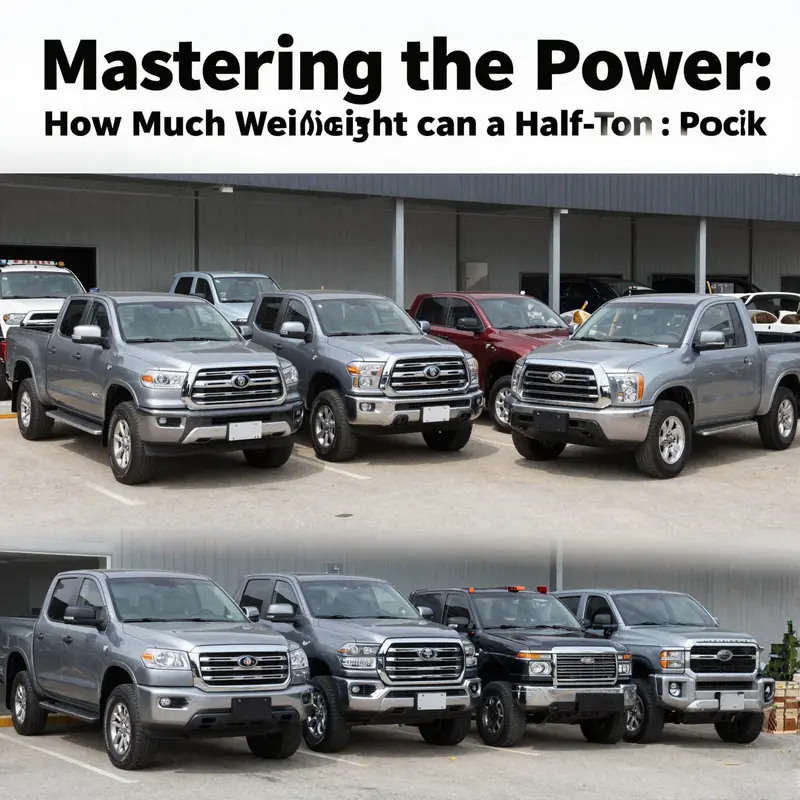
The label half-ton has evolved from a simple payload guess into a more nuanced performance promise. Today’s popular light-duty pickups carry far more than a thousand pounds of payload every day, and their towing numbers reflect advances in engine technology, chassis design, and materials. Yet the number stamped in the door jamb or listed in a brochure remains a ceiling, not a guarantee for every journey. The maximum towing capacity a manufacturer publishes is determined under controlled conditions and with equipment that may not be present on every build. That means the practical question is not just “What is the peak rating?” but rather, “What can I tow safely, reliably, and within the margins that protect me, my gear, and other road users?” The answer rests on a combination of configuration choices and careful planning, with the real-world towing experience shaped by more than horsepower alone.
In broad terms, the base or entry configurations of these modern half-ton platforms typically sit in a range from roughly seven thousand to eight thousand pounds for towing, while more highly equipped versions push toward twelve thousand pounds or beyond. The spread isn’t a weakness; it’s a recognition that towing capability is not a single knob you turn. It is the product of several interacting components: the engine’s torque reserve, the transmission’s ability to hold the correct gear under load, the rear axle gearing, and the availability of a dedicated towing package. Each of these elements can alter the usable towing capacity by hundreds or even thousands of pounds depending on how they are paired with the rest of the truck’s drivetrain and ancillary equipment. When a manufacturer lists a maximum, that figure assumes a specific combination of engine, transmission, rear-end ratio, hitch setup, cooling capacity, brake setup, and trailer package. It is not a universal threshold that applies in all circumstances.
What has changed in recent years is the upper bound of these figures. Advances in powertrain technology, chassis engineering, and even lightweight materials have allowed manufacturers to extend the towing envelope well beyond historical benchmarks associated with the “half-ton” label. With the right configuration, some modern half-ton trucks can approach—and in rare, well-managed cases exceed—ten thousand pounds, especially when the trailer is designed for high-load, long-distance journeys that demand sustained torque and steady cooling. In controlled testing and in real-world road demonstrations, multiple configurations have demonstrated remarkable capacity: a configuration with a robust, high-torque engine and a well-tuned towing package can reach into the fourteen-thousand-pound vicinity in optimal conditions. Another setup, focused on balanced performance and efficiency, can hover in the mid-teens on a carefully paired drivetrain and trailer. And a third configuration, designed for heavier daily use, can still reach into the low thirteen-thousand-pound zone when conditions align, though these figures are the exception rather than the rule for every vehicle and every trailer.
These numbers illustrate a core truth: the differences from one truck to another are driven largely by how the powertrain, gears, and equipment are tuned for towing. A twin-turbocharged or high-output V6 setup paired with a capable eight- or ten-speed transmission can deliver a lot of steady torque at low RPM, which translates into easier controlled acceleration and more stable hill climbs when towing. A larger displacement or more aggressive gearing can push the rated capacity higher, but only if the cooling system and the hitching arrangements keep the powertrain within safe thermal and mechanical limits. Conversely, a more modest configuration, perhaps paired with a smaller turbocharged engine or a less aggressive rear-end ratio, will deliver respectable towing for everyday tasks but will not rival the top configurations when all else is equal. The take-away is simple: the maximum number published by a manufacturer is not a one-size-fits-all ceiling. It is a target that depends on the exact build you choose and how you use it.
To understand the practical implications, consider how a typical towing plan is formed. A person purchasing a half-ton pickup might start with a rough headcount of what they intend to haul regularly—equipment, campers, or a sizable utility trailer—and then seek a configuration that can handle those loads with a comfortable margin. That margin matters. A widely cited rule of thumb is to design around a buffer of ten to fifteen percent below the published maximum to account for trailer length, tongue weight variations, dynamic road conditions, and the cumulative effect of long hauls. This is not a hard law, but a prudent practice that helps prevent marginal overload situations that could compromise braking, steering, or stability. The reality is that the published peak is rarely the number you should chase on a daily basis.
The actual numbers can be eye-opening in aggregate. A base setup might tow around seven to eight thousand pounds, a configuration with a strong gasoline V6 or a turbocharged option might push that toward ten thousand or twelve thousand with the right towing package and aerodynamic trailer. When the stars align—the right engine and transmission pairing, the correct rear-axle ratio, and the trailer package that includes enhanced cooling and hitch-ready hardware—the upper end climbs further. In recent assessments of modern half-ton platforms, engineers have observed maximums in the vicinity of fourteen thousand pounds for some setups, with other configurations in the thirteen thousand to thirteen thousand four hundred range. A peak nearing twelve thousand seven hundred fifty pounds has appeared in setups designed for heavy duty usage but still marketed as half-ton. These figures reflect a combination of high-torque output, robust cooling capacity, and carefully chosen gearing to keep the engine in its most efficient window while towing.
These distinctions matter for anyone planning even occasional heavy hauling. The difference between a setup that can reliably tow thirteen thousand pounds and another that can approach fourteen thousand pounds often comes down to a handful of engineering choices. The engine design, the number of gears in the transmission, the rear-end ratio, and the availability of a true towing package—complete with upgraded radiator and transmission coolers, a dedicated hitch system, and a brake controller—are the levers that push capacity up or down. It is not merely about raw horsepower or peak torque; it is about how those numbers are harnessed under load, how heat is managed, and how the entire drivetrain behaves when a heavy trailer sways or when long grades demand sustained energy.
Even more critical than the raw capacity is how the vehicle handles the weight safely in practice. A trailer that produces significant tongue weight—where a noticeable portion of the trailer’s weight rests on the hitch—will remove more payload capacity from the truck than a trailer with a lighter tongue weight. This interaction between payload and towing capacity means that a truck may appear capable of a given tow on paper, yet actual performance can be constrained by how the load is distributed, how well the trailer brakes function, and how the tow setup manages sway. Those realities underscore why the owner’s manual and the tire placard in the driver’s door jamb remain essential references. They translate the abstract numbers into practical limits for your exact configuration, including cab style, bed length, drivetrain, and wheel and tire spec. The same chassis that handles a big payload with composure may struggle with another trailer if tongue weight is mismanaged or if the braking system is not adequately matched to the load.
For readers seeking a clearer sense of how these principles play out in the field, it helps to think in terms of three interlocking factors: the powertrain envelope, the weight budget, and the trailer’s behavior under load. The powertrain envelope is the region in which the engine produces usable torque across a broad RPM window, allowing confident acceleration and stable cruising with a heavy trailer. The weight budget considers not only the trailer’s gross weight but also the truck’s own weight, payload capacity, and the tongue weight. The trailer’s behavior—how it sways, how it tracks, and how quickly it can be slowed or stabilized—depends on hitch configuration, braking, and the effectiveness of sway control devices. When these elements align, towing becomes a smoother, safer endeavor; when they diverge, the risk of instability rises, and the margins of safety shrink.
The practical pathway to safe towing starts with disciplined planning. That begins with a careful assessment of what you actually need to haul on a regular basis. If your typical load is well under the published maximum for your chosen configuration, you have a good margin for comfort and safety. If your planned load approaches the high end of a configuration’s rating, you should carefully examine the trailer’s tongue weight, the weight distribution of the load, and the reliability of trailer brakes and hitching hardware. It is also wise to consider the environment in which you live and drive—hills, headwinds, and city traffic all demand more from the drivetrain and braking system than the flat, calm conditions of a test track.
The language of capacity can be clarified by looking at the broader weight framework of a half-ton vehicle. Payload capacity—the amount of freight you can carry in the cab and bed—reduces the amount of weight that can be safely allocated to the trailer. The gross vehicle weight rating (GVWR) indicates the maximum loaded weight of the truck itself, while the gross combined weight rating (GCWR) marks the upper limit of the truck plus trailer combined. When planning a tow, you must ensure that the combined weight does not exceed the GCWR, and that the tongue weight remains within the hitch’s intended range. The interplay of these numbers matters because exceeding GCWR or delivering excessive tongue weight can impair steering response, braking distance, and overall stability. The outcome is not merely a legal issue; it becomes an issue of real-world safety as road grades, gusts, and congested traffic all interact with a heavy, dynamic load.
To translate these considerations into practice, a prudent approach is to select a configuration with a comfortable cushion below the published maximum, then verify the actual load through careful measurement. Weigh the trailer and its cargo separately to determine tongue weight and gross trailer weight. Confirm that the combined weight remains within the GCWR for your truck, and ensure that the tongue weight sits within the recommended range for the hitch and suspension setup. If the trailer requires special brakes or cooling, ensure those systems are compatible with long towing sessions and hot conditions. The aim is not to squeeze every possible pound from the rating but to maintain a durable, predictable towing experience that keeps you and others safe on the road.
In this landscape, the choice of configuration is as important as the numbers themselves. A truck that can tow more might not always be the best choice for daily driving if its overall weight, fuel economy, and maneuverability are compromised for occasional peak performance. The best path often lies in balancing capability with reliability, efficiency, and ease of use. For many buyers, the sweet spot lies in a configuration that delivers ample towing capacity, solid stability, and a drivetrain that remains tractable under real-world conditions—without pushing the limits to a level that invites risk with every trip. As you evaluate different half-ton options, remember that the published maximum is a useful benchmark, not a guarantee on every road, under every load, or in every weather scenario.
For readers who want to connect these towing principles to broader fleet and safety planning, there is a resource that links practical towing strategies with emergency readiness. You can explore more context and guidance at theislandtowtruck.com/blog.
Ultimately, the journey from label to reality in half-ton towing is about understanding the interplay of design intent, configuration options, and safe operating practices. The numbers tell a story of capability, but the story’s true measure is the trust you place in your equipment during every mile of the journey. Reading the owner’s manual, inspecting the hitch and braking system, and planning with margins transforms a powerful piece of equipment into a dependable partner for work, travel, and the unpredictable rhythms of the road. As the capabilities of modern half-ton pickups continue to push outward, drivers gain more room to plan ambitious hauls. Yet with that increased capability comes the responsibility to match trailer weight, tongue weight, and cooling capacity to the truck’s package, so every tow can be completed with the same confidence that guided the design in the factory lane.
External reference for real-world context on how these variables play out across similar platforms is available for readers who want a detailed, side-by-side look at tow performance in tested conditions. The discussion highlights how different drivetrain configurations respond under load, how steering and braking feel when a trailer is in tow, and how margins of safety shift with trailer weight and road grade. For a comprehensive, real-world comparison from a trusted automotive publication, see the detailed towing test and analysis referenced in Car and Driver’s 2024 coverage.
Tow Weight, Tow Wisdom: A Real-World Guide to Safe Hauling with a Half-Ton Truck
Towing with a half-ton pickup sits at a nuanced intersection of capability and caution. Manufacturers publish maximum figures that look impressive on a spec sheet, but the practical truth is that safe, predictable towing hinges on margins, proper loading, and disciplined driving. The half-ton class has earned a reputation for versatility, capable of hauling trailers for work, recreation, and everyday tasks. Yet the same platforms that pull a heavy load with confidence can falter if weight, balance, or equipment are mismanaged. To translate the numbers into reliable, safe performance, treat the task as a system that blends vehicle capability with careful preparation, load management, and disciplined operation. In this view, the question of how much weight a half-ton truck can tow becomes less about chasing a single ceiling and more about respecting a range and maintaining control across real-world conditions.
The practical range of towing capacity for a modern half-ton pickup typically spans from about seven thousand to twelve thousand pounds, with some configurations peaking toward fourteen thousand on paper. That upper end is rarely realized in everyday driving without favorable conditions and meticulous setup. If you think of towing capacity as a ceiling rather than a target, you start making smarter choices about what and how you haul. Several factors shape what you can safely tow in any given trip: engine output, drivetrain design, axle ratio, transmission type, the presence of towing packages, trailer type, and how the load is distributed. Each element interacts with the next, and a misstep in one area can cascade into handling problems, brake fade, or tire overload. Understanding this interplay is key to turning a nominal capability into a reliably safe experience on the road or the job site.
To determine your exact limits for any truck and trailer, start with the manufacturer resources. The owner’s manual remains the authoritative reference for your engine, drive configuration, and hitch setup. Many manufacturers publish an online towing guide that translates ratings into practical loading scenarios, taking into account engine type, drivetrain configuration, axle ratio, and the trailer hitch package you have installed. The total weight capacity for towing, known as the gross combined weight rating or GCWR, accounts for the weight of the vehicle itself, passengers, cargo, and the trailer being towed. Pushing toward or beyond GCWR invites issues such as reduced braking effectiveness, altered steering response, and potential structural or mechanical strain. The core takeaway is that the numbers on the placard or in the manual are safety thresholds that deserve margin and respect, especially when conditions shift or you’re towing near the limit.
A practical anchor for planning is this framing: the typical half-ton towing capability covers a broad set of tasks, from small to mid-size trailers for weekend projects to larger travel trailers and equipment haulers. Even with a high-tow package, actual safe capacity varies with load distribution, road grade, wind, and the trailer’s braking system. This is not a denial of capability but a reminder that towing is a dynamic balance. Attaching a trailer changes handling, adds weight behind the rear axle, and increases braking demands. A responsible approach prioritizes stability, predictability, and adequate stopping power over raw numbers.
A core practice is proper loading and hitching. A weight-distributing hitch helps achieve a stable pull by redistributing some tongue weight across the tow vehicle and trailer axles. This reduces rear-axle load on the truck, dampens trailer sway, and improves straight-line stability, which matters as loads rise toward the upper end of capacity or in crosswinds. The concept is simple, but execution matters. A balanced tongue weight keeps the trailer from acting like a sail, helps preserve steering feel and braking control, and can yield a noticeable safety improvement. A good target is tongue weight around 10 to 15 percent of the trailer’s gross weight, with the exact range adjusted for your hitch and trailer design. Weigh the trailer when loaded as you intend to tow, then adjust payload to keep tongue weight in that window. A quick on-site check with portable scales can make this process repeatable.
Beyond the hitch, ensure the tow vehicle and trailer are road-ready. Tires should be inflated to the manufacturer’s recommended pressures for both the truck and trailer, which can change with load and temperature. Brake systems deserve special attention; the added thermal load of a heavy tow means brake fade is a real risk on long grades or stop-and-go traffic. The trailer brakes should work correctly and synchronize with the tow vehicle, and electrical connections should be checked for reliable brake lights and signals. Pre-trip safety checks matter: verify hitch connections, secure cargo distribution, confirm trailer brakes and lights function, inspect safety chains and wiring, and recheck wheel lug torque after a few miles of towing. These steps form a disciplined routine that becomes second nature with practice.
In summary, understanding how much weight a half-ton truck can tow safely is a continuous practice of assessment, preparation, and adaptive driving. Treat the stated capacity as a ceiling to stay well below rather than a target to chase. When you couple careful loading, accurate weight distribution, and thorough maintenance with conservative driving margins, the half-ton platform reveals its true value as a versatile and reliable workhorse on the road and at the job site.
Final thoughts
Understanding the towing capacity of half-ton trucks is paramount for local operators looking to leverage these vehicles for work and leisure. With proper knowledge of what each model can handle, as well as the factors that influence their capabilities, you can ensure that your operations run smoothly and safely. By following best practices when towing, you also protect your investment and the safety of the community. As we thrive in our vibrant island setting, the power of a half-ton truck can be harnessed effectively with the right insights.