The question of tipping a tow truck driver may seem straightforward, but it often weaves through the fabric of local customs and individual circumstances. In island communities where service and direct interaction are paramount, understanding what to do when a tow truck driver assists you can deeply enrich the professional relationship and enhance your overall experience. This article details the practices and perspectives surrounding tipping tow truck drivers, delving into when it is appropriate to tip, the factors influencing your decision, and the broader cultural context. Each chapter aims to empower stakeholders—local auto repair shops, car dealerships, property managers, resort operators, and commercial fleet operators—with the insights needed to navigate this intricate aspect of service in a thoughtful and informed manner.
Tipping Etiquette on the Move: Understanding When to Tip a Tow Truck Driver and Why It Matters
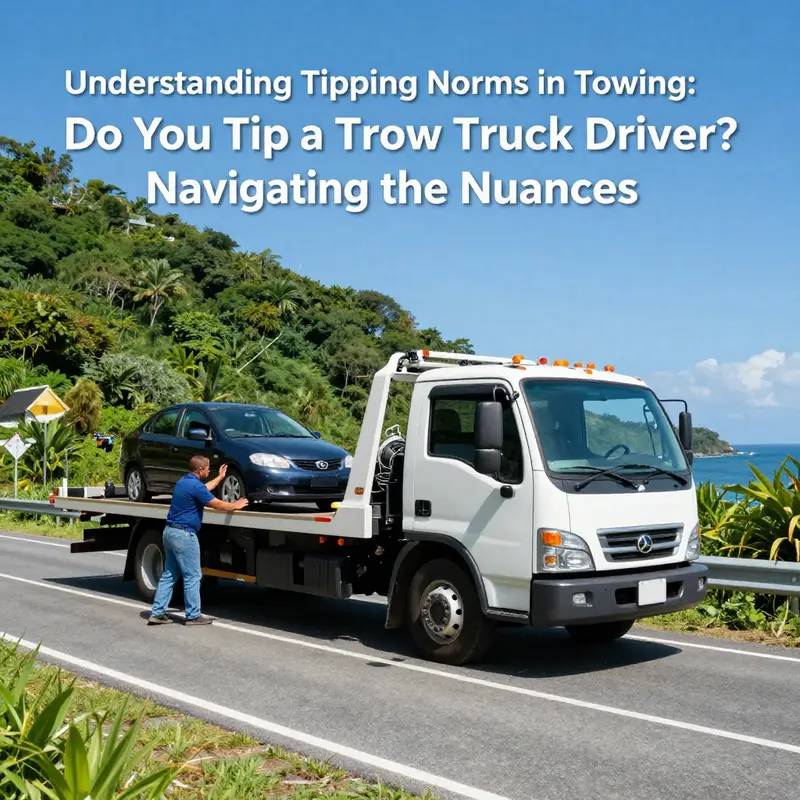
A tow truck arrives when you least expect it and in moments when stress can tilt the simplest decisions toward habit or haste. In the glare of blinking lights and the hum of a roadside, a question can surface that doesn’t always have a universal answer: should you tip the tow truck driver? The truth is more nuanced than a single rule. Tipping in towing is not a universal expectation, and most drivers operate within a framework that treats the service as a professional transaction rather than a hospitality encounter. The fee charged by the towing company is intended to cover labor, equipment, and the expertise needed to secure a vehicle, navigate traffic hazards, and deliver it to a safe destination. In many places, tipping isn’t standard practice, and in some cases it isn’t even permitted by company policy. Yet human moments don’t always fit policy papers. When a driver goes beyond the basics—when they respond to an emergency with composure, when they solve a tricky tow with careful problem‑solving, or when they demonstrate a level of courtesy that eases a tense situation—a gesture of appreciation can feel appropriate and meaningful. The balance between policy and personal judgment is where tipping comes into play, and where it becomes less about a mandated ritual and more about recognizing exceptional service in a difficult moment.
General guidelines can help frame the decision without turning it into a rigid rule. Tipping is not an expectation in the sense of a standard professional courtesy demanded of customers. The fee you pay typically covers the driver’s labor and the service provided, and many companies explicitly discourage tips to avoid billing complications or complicating wage structures. This is a practical consideration that often surprises people who come from industries where tipping is deeply ingrained in the business model. In towing, a company’s policy may be shaped by billing practices, regulatory considerations, and internal compensation structures. If you’re unsure about a policy, a quick, respectful inquiry at the outset can save awkward moments later. A simple question like, “Do you accept tips?” or “Is tipping allowed with this service?” can set the right tone and prevent a misstep that could complicate the driver’s work or the company’s billing records.
Even when tipping isn’t expected, there are circumstances in which a small token of appreciation feels natural. If a driver completes a tow under time pressure, in difficult weather, or in a hazardous environment, and if they demonstrate calm professionalism, clear communication, and practical problem‑solving, you may choose to acknowledge those efforts. A small tip in the range of five to twenty dollars is common in many communities when service has been notably above and beyond the basic requirements. The idea is not to buy preferential treatment or to create an obligation for future drivers, but to express genuine gratitude for a job well done in a moment when that job was performed under challenging conditions. In such moments, you might also consider the human side of the experience—the way the driver listened to your concerns, explained the steps they were taking, and offered practical safety assurances as the vehicle was reattached to the road. These human touches, more than the dollar amount, often leave a lasting impression and can reinforce positive expectations for what good roadside assistance should feel like.
An important part of navigating tipping in towing is understanding the local customs and the specific circumstances you’re in. The United States Department of Labor, along with common industry practices, indicates that tipping is not standard for towing services, especially when one views the service as a professional transaction rather than a personal hospitality moment. This contextual reality means that in many regions, a driver may not expect a tip, and any tip offered is a discretionary gesture that reflects personal satisfaction with the service. Local customs can vary; some communities might be more comfortable with tipping a tow driver who has provided services that went beyond basic towing, while others adhere strictly to the policy that the company’s fee is the full compensation. When you travel between states or encounter drivers who serve in different jurisdictions, the variability in expectations becomes more pronounced. In such cases, the prudent approach is to assess, in real time, the quality of the service and the driver’s demeanor. If the service is straightforward and routine, a tip is unlikely to be necessary. If the service is complex or hazardous, or includes extra care—such as recovering a vehicle from a dangerous location, safely securing cargo, or coordinating with other responders—you may decide that a tip is a reasonable form of thanks.
If you’re drawn to the idea of tipping as a way to acknowledge excellent service, consider how you present it and what message you convey. A small cash tip handed directly to the driver is a straightforward method that avoids potential billing conflicts. This approach also preserves clarity about who is receiving the gratuity. However, if you feel the company’s policy discourages tips, or if you’re unsure about the appropriate method, you can still show appreciation through alternative channels. A sincere verbal thank you goes a long way; a written note or an online review can amplify the driver’s professionalism beyond the moment of service. In a world where each service encounter adds to a driver’s reputation, a positive review can influence future customers and, indirectly, a driver’s standing within the company. The impact here extends beyond a single transaction and contributes to a larger culture of trustworthy roadside assistance.
For readers seeking practical guidance drawn from industry discussions and customer experience, a reflective approach can help. If you decide to tip, keep the amount modest and context‑driven. A typical range of five to twenty dollars aligns with general expectations in many parts of the country and keeps the gesture proportional to the service delivered. It’s also worth considering the duration and difficulty of the call. A short tow on a quiet street might not warrant a tip, while a longer haul through snow or ice, or a tow performed under tense circumstances, may feel more deserving of a small token of appreciation. The key is to ensure that the gesture is voluntary, nonpressured, and clearly separate from the payment for the service itself. This separation preserves transparency for both the customer and the company, reducing the risk of misunderstandings about compensation or billing.
The broader context matters as well. Towing is a service industry where reliability, safety, and clear communication are highly valued. A driver who messages you about what they’re doing, explains potential delays, or offers practical safety tips as they secure the vehicle can be seen as delivering more than a basic service. In such cases, a tip—if you choose to give one—should reflect appreciation for those extras, not merely for the arrival of a vehicle. If the driver’s handling of your situation demonstrates sensitivity to your safety, respect for your time, and a calm, professional demeanor, your response can become a tangible sign of your recognition for their expertise. Even when a tip is not appropriate, a public compliment—such as a positive online review or a personal thank‑you to the dispatcher—can bolster a driver’s standing and support the company’s reputation for quality service. The flow from personal gratitude to public acknowledgment can be a constructive way to reward exceptional service without disrupting the norms that govern tipping.
In practice, a simple rule of thumb can help you navigate the moment with confidence. If the service required is routine and the driver handles the call efficiently and professionally within the standard scope of work, do not feel obligated to tip. If the service included special effort—navigating a hazardous area, coordinating with multiple parties, or providing clear explanations under pressure—consider a discreet tip or a strong verbal acknowledgment. Before making a decision, it’s wise to assess the company’s policies and the driver’s behavior. If possible, you can politely ask, “Are tips allowed with this service?” or “Would you prefer that I not tip and instead leave a positive review?” If you’re still unsure, err on the side of gratitude expressed through verbal appreciation and a future‑oriented gesture like sharing a positive review with the company or on social media. After all, the core purpose of the tipping question is not to reward a transaction but to recognize a service experience that stands out in a challenging moment.
To connect these reflections to a broader sense of professional courtesy, consider how this dynamic plays into the culture of roadside assistance and the ethics of paying for skilled labor. Tow truck drivers are highly trained professionals who shoulder real risks, from heavy loads to unstable terrain and unpredictable traffic conditions. Their work often happens in adverse circumstances, outside the comfort of a controlled environment. In such a context, tipping can be a way to convey appreciation for restraint, safety, and a job well done under pressure. Yet the responsible stance remains to respect company policy, local norms, and the driver’s preferences. The most important takeaway is that tipping is a discretionary, situational gesture—a personal choice shaped by service quality, safety considerations, and the specific social setting in which the assistance occurs. When in doubt, prioritize courtesy and clarity: a clear expression of thanks, an honest assessment of the service, and a respectful inquiry about tipping norms. These elements together form a practical framework that helps you navigate one of the more nuanced social rituals surrounding roadside help.
For readers seeking additional perspectives or guidelines beyond personal judgment, a useful touchstone lies in established industry resources. A quick reference point is the guidance offered by the American Automobile Association (AAA), which provides broad context on towing procedures and customer relations. This external resource can help situate tipping within the wider landscape of towing norms and professional standards that shape expectations for customers and drivers alike. You can explore these reflections and related topics to better understand where tipping fits within a professional ecosystem that prioritizes safety, reliability, and respectful communication on every mile of the road.
In summary, tipping a tow truck driver is not a universal obligation. It is a discretionary gesture best considered against the backdrop of policy, locality, and service quality. When a driver demonstrates exceptional care, safety, and courtesy in challenging conditions, a small tip—within a reasonable range—can be a meaningful acknowledgment. However, a verbal thank you, a positive review, and a respectful question about tipping policies can equally convey appreciation without introducing billing complexities or conflicting incentives. The underlying principle is simple: treat the encounter with the same clarity and respect you would want when you are the one needing help on the road. If you want to explore more on related topics, you can turn to resources like the Island Tow Truck blog for practical perspectives on service norms and professional practice in roadside assistance. The journey through these norms is not about enforcing a rule so much as cultivating a culture of thoughtful, context‑driven gratitude in moments when help arrives just when you need it most. For further guidance on towing practices and tipping norms, see AAA: https://www.aaa.com.
Gratuity on the Road: Navigating When and How to Tip a Tow Truck Driver

A roadside crisis has a way of narrowing attention to the immediate needs: safety, a functional ride home, and a window into the human beings who keep the wheels moving when things go wrong. A tow truck arrives with flashing lights, a measured stride, and a voice that steadies the moment. It is a professional service, one that many people call when they feel most vulnerable—pushed to the edge by a breakdown, a broken down car on a busy strip, or a storm-slicked shoulder where help can’t arrive soon enough. In such contexts, the question of tipping often arrives as part moral concern, part practical etiquette, and part curiosity about what is customary. Do you tip a tow truck driver? The simplest answer is that tipping is not expected or required. The fee you pay for the tow is usually the price of the service, and tipping remains discretionary. Yet, as with many professional services, there are moments when a small gratuity can recognize genuine effort, skill, and care, especially when the driver goes above and beyond under pressure or in a hazardous environment.
To begin with, it helps to distance the tipping question from a rigid rulebook and anchor it to the actual service you received. Tow operators exist within a landscape of state regulations, licensing requirements, and company policies that shape what is permissible and customary. The broader context matters because it frames what you should expect, and how your gesture may be received. In many cases, the service charge you’ve been asked to pay already acknowledges the labor and expertise of the driver, the complexity of the tow, and the risk entailed in transporting a vehicle that may be in a compromised state. In that sense, a tip can feel like an extra word of thanks rather than a mandate, a personal endorsement of the driver’s conduct rather than a formal obligation.
The practical psychology behind tipping in this line of work resonates with broader service industry norms. In restaurants or hotels, tipping is often a reflexive part of the transaction, tied to the likelihood of repeat visits or a direct, tangible improvement in your immediate experience. Tow services operate differently. The driver’s fee is typically contracted as a business transaction, and the fit between service quality and gratuity is less about ongoing relationship-building and more about recognizing clear, exceptional performance in a single encounter. When a driver handles a tight, potentially dangerous tow with poise—managing risk, communicating clearly, and maintaining your vehicle with care—the impulse to acknowledge that effort with a small discretionary tip becomes understandable. And since every roadside moment carries the potential for miscommunication or conflict, a kind gesture can also reflect your appreciation for professional conduct under stress.
From a policy perspective, there is an important caveat to keep in mind. Many tow truck companies have explicit guidelines about accepting tips. In some cases, drivers may not be permitted to accept gratuities, or they may be instructed to avoid them due to company policy, insurance considerations, or internal budgeting. Because these policies exist for legitimate reasons, the prudent approach is to ask about tipping before or at the start of the service if possible. A quick, respectful inquiry—“Is tipping appropriate for this company?”—takes the guesswork out of the moment and helps you avoid an awkward situation later. When in doubt, err on the side of courtesy: even if tipping is discouraged, a sincere verbal thanks, a firm handshake, or a written compliment to the company can carry weight and be seen as a form of recognition that doesn’t violate any policy.
The legal and regulatory layer adds another dimension to the decision. Tow services are typically regulated by state laws, licensing schemes, and sometimes local ordinances. The driver must operate in the correct license class for the vehicle and comply with safety standards that protect both the vehicle and the operator. In this context, the focus of the encounter should be on professionalism, safety, and compliance rather than gratuities. The emphasis is on the driver’s ability to secure the vehicle, communicate hazards, and navigate the logistics of a tow with minimal disruption to you and your surroundings. Tipping, when it occurs, should never be a substitute for solid service or a workaround for subpar handling. It is a discrete acknowledgment of exceptional performance, not a compensation for substandard work.
When considering whether to tip, there are several practical signals to weigh. First, did the driver respond quickly and courteously, especially in a time of need? Was the communication clear and calming, helping you understand the steps involved and what to expect next? How careful was the driver with your vehicle—avoiding scuffs, docketing panels, or dragging a frame? If the answer to these questions is yes, then a tip of a few dollars—typically between five and twenty dollars, depending on the circumstances and your satisfaction—becomes a fitting gesture. This range is a useful rule of thumb because it preserves the discretionary nature of tipping while acknowledging above-and-beyond service. If a tow involves a complicated recovery in a challenging environment—nighttime, icy roads, or a precarious load—the driver’s extra exertion, problem-solving, and visible concern for safety may merit the higher end of that range.
The timing and manner of giving a tip matter as much as the amount. If you decide to tip, hand the driver the gratuity directly and discreetly at the conclusion of the service. A cash tip has the advantage of simplicity and immediacy, ensuring the driver can keep it without it being processed through a payment terminal. If cash is not practical, some drivers may accept tips via card, but you should verify this through the company’s policy beforehand. The key is to be respectful and unobtrusive, avoiding any appearance of coercion or bargaining. Expressing thanks aloud—“I appreciate how you handled that situation”—can be as meaningful as the tip itself, and it reinforces a positive experience for both you and the driver.
The social dimension of tipping is nuanced by personal and regional norms. In some communities, tipping is customary for any form of roadside assistance; in others, it remains unusual or even discouraged due to company rules. If you travel across states or regions, you might encounter different expectations. The safest approach is to prioritize the provided guidance from the company and the general best practices in professional services, but remain responsive to the indications of a driver who goes beyond the call of duty. It is not unusual for drivers to appreciate a small extra acknowledgment when the service has been clearly above and beyond, such as stabilizing a vehicle in a dangerous location, explaining the mechanics of the tow in plain language, or offering practical advice about next steps after the tow completes.
Beyond cash and cards, there are other reliable, low-stakes ways to show appreciation when tipping isn’t appropriate. A formal compliment to the company—whether through a customer service channel, a note to a supervisor, or a positive online review—can go a long way. These gestures reinforce the driver’s reputation and can influence their standing within the company, potentially informing future assignments. If you do leave a tip, never feel pressured to offer more than you can afford. The measure of generosity should align with your own financial comfort and the quality of the service, not a perceived obligation. The sincerity of the thanks often matters more than the sum given, and that sincerity can create a ripple effect, encouraging higher standards across the field.
From a practical standpoint, there is value in knowing the typical boundaries and the intention behind them. The United States Department of Labor and common industry practice both suggest that tipping is not a standard expectation for towing services. This framing helps orient expectations, particularly for people who are new to the experience or who encounter tow services only infrequently. It also clarifies that the primary accountability rests with the service provider’s professionalism and compliance, rather than with the gratuity itself. Knowing this can ease the pressure to tip in every encounter and help you distinguish between ordinary service and exceptional, tip-worthy efforts. If you want a broader sense of how towing regulations and classifications are approached in the official landscape, you can consult resources from the Department of Transportation, which covers regulatory considerations that influence professional towing practice at a policy level. These references remind us that the job’s value lies in training, risk management, and adherence to standards as much as in any gratuity.
For readers seeking practical continuity beyond the scene of the tow, there are resources that speak to broader emergency response and vehicle management practices. The themes that underlie tipping—responsiveness, calm communication, careful handling of equipment, and a steady focus on safety—are transferable to other aspects of road service work. If you want to explore how these service principles translate into broader emergency readiness, including fleet management and response strategies, you might find value in industry-focused guidance and checklists that emphasize preparedness, response times, and the humane dimension of roadside assistance. A related discussion can be found in practical updates and insights on the Island Tow Truck platform, where the emphasis on reliable, safety-first service is a throughline across their guidance and resources. For readers who want to dig into the broader ecosystem that shapes tow services and roadside support, the following resource provides a gateway to deeper reading and context: the Island Tow Truck blog.
In this light, tipping a tow truck driver becomes less a universal obligation and more a nuanced choice anchored in service quality, company policy, and the specific circumstances surrounding the tow. The decision rests on a thoughtful assessment of the driver’s performance, the risks involved, and the context of the request for assistance. It requires a balance between personal generosity and institutional boundaries, a balance that respects both the human element of a roadside encounter and the professional framework within which tow services operate. By staying mindful of these factors, you can approach tipping as a meaningful, context-sensitive gesture rather than a reflexive transaction. The result is a moment of gratitude that upholds dignity for the driver, assurance for you as a client, and a professional standard that reinforces the value of skilled, safety-conscious roadside support.
As you move through future encounters, this approach to tipping can evolve into a more confident, informed etiquette. You may find yourself weighing the same questions with greater clarity: Was the response timely and considerate? Did the driver maintain a respectful stance toward your vehicle and your concerns? Was the explanation of the process clear and reassuring? If the answers lean toward yes, you will likely feel comfortable extending a modest tip as a sign of appreciation. If not, you will still have offered your thanks in a way that is consistent with policy and your own financial boundaries, without diminishing the gratitude you secretly hold for someone who has helped you navigate a difficult moment on the road.
In the end, the core message is straightforward. Tipping a tow truck driver is not a universal requirement, but it can be a heartfelt and appropriate gesture when service is exemplary and circumstances warrant that extra acknowledgment. The best practice is to know the policy of the company, assess the quality of the service, and act with discretion and respect. By keeping these principles in mind, you can transform a stressful experience into a constructive exchange that recognizes professionalism and fosters a culture where skilled roadside assistance is valued and respected. And if you want to explore more about the broader world of emergency response strategies and the principles that guide fleet readiness, the linked resources offer routes to further reading and practical application, while staying true to the core idea that good service comes with accountability, safety, and earned appreciation.
External resource for further context on regulation and safety in towing and vehicle classifications: https://www.transportation.gov
Between Courtesy and Custom: Navigating When and How Much to Tip a Tow Truck Driver
On the roadside, the moment a tow truck arrives is both practical and vulnerable. The question of tipping is not a universal rule but a choice that reflects local norms, the quality of service, and the company’s policies. Tipping remains discretionary in many regions, but there are scenarios where a small gesture of appreciation feels appropriate.
Local customs vary. In some parts of the United States, a modest tip, typically five to twenty dollars, is common when the driver is prompt, handles the vehicle with care, or provides extra help beyond the basic tow. In other areas, tipping tow services is less expected or discouraged, so readers should follow the vibe of the situation and any guidance from the company. A tip should not be seen as a punishment for poor service; if no tip is given, it may simply reflect different norms or budget practices.
Service quality matters. A courteous, professional driver who communicates clearly, prioritizes safety, and reduces stress can justify a small gratuity, especially in difficult conditions. Conversely, rude behavior or sloppy handling can make tipping feel inappropriate, even if the outcome is successful.
Consider the nature of the service. Routine towing is different from complex maneuvers in tight spaces or hazardous locations. If the driver goes beyond basic duties such as jump-starting, securing the vehicle, or offering useful guidance, an extra gesture is reasonable.
Company policy and practicalities. Some outfits discourage tipping, others invite it. If unsure, ask politely about tipping expectations at the start. Cash is the most universal form of tip, typically five to twenty dollars, though card tips may be possible where the provider accepts them.
Bottom line: tipping should be a voluntary acknowledgment of exceptional effort, not a rule. Align your action with the service you received, your local norms, and your own comfort level.
null
null
Final thoughts
In a world where service interactions can often be transactional, the act of tipping can foster goodwill and enhance relationships, especially within the unique contexts of island communities. Understanding the nuances of when to tip a tow truck driver—based on the situation, the service provided, and local norms—is a valuable component of engaging with this essential service. By considering these factors, stakeholders like local auto repair shops, car dealerships, and resort operators can navigate their tipping practices effectively, ensuring that appreciation for hard work and exceptional service is recognized.